From fundamental self-attention projections to full encoder-decoder sequence pipelines. Systematic mathematical breakdowns, geometric intuition, visual diagrams, and interactive computational sandboxes.
Trace the computational flow of a sentence through every single layer of the Transformer. Click on steps or use the controls to animate the process.
Speed:1.5s
1
Input ProcessingACTIVE
Enter source & target text
2
Tokenization (BPE)ID MAP
Convert words to vocabulary IDs
3
Embedding Lookup512-D
Lookup 512-dim vectors
4
Positional EncodingWAVES
Inject sequence order waves
5
Encoder Layers (x6)ATTN
Multi-Head Self-Attention + FFN
6
Decoder Layers (x6)MASKED
Masked Self-Attention + Cross-Attention
7
Linear Projection37K
Project 512-dim to Vocab Size
8
Softmax ProbabilitiesPROBS
Calculate vocabulary probability
9
Autoregressive LoopCYCLE
Select word and feed back
[ STAGE 01 / 09 ]SEQUENCE TRANSDUCTION
Step 1 — Input Sentence & Seq2Seq Setup
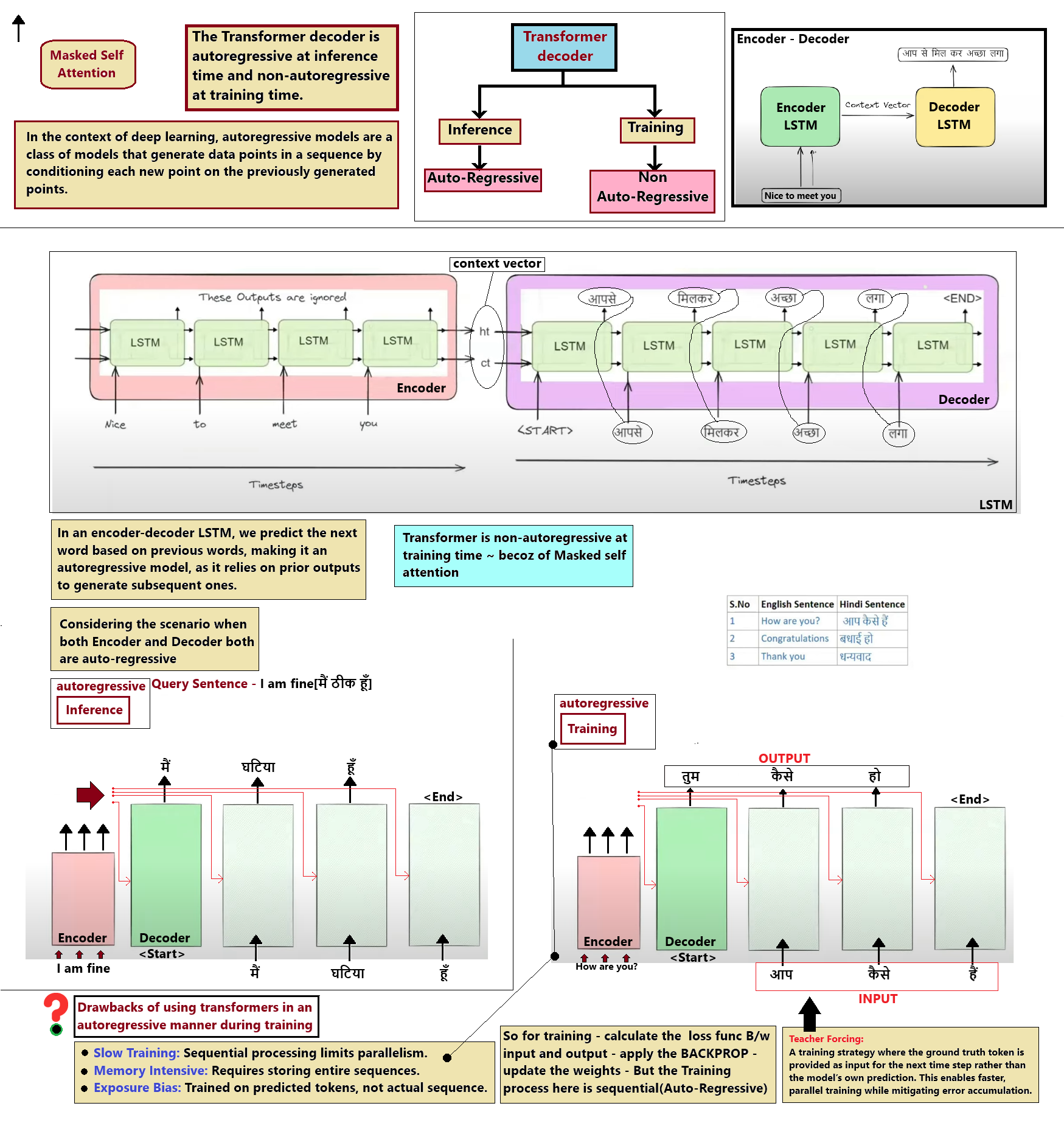
Transformers are encoder-decoder sequence transduction models. The Encoder processes the full source sentence in parallel, while the Decoder autoregressively predicts the target sentence token-by-token.
GoalFormat English input tokens and Spanish target prefix into sequence vectors.
AnalogyLike placing the English novel open on your left desk, while writing the Spanish translation line-by-line into your notebook on the right.
Source Sequence (Encoder Input X)
T_enc = 5 tokens
Attention is all you need
ENCODER-DECODER TRANSDUCTION
Target Prefix (Decoder Input Y)
T_dec = 7 tokens
<bos> La atención es todo lo que
🎯 Next Target Word to Predict: The model will compute probabilities over the entire vocabulary to predict the next Spanish word: "necesitas".
[ STAGE 02 / 09 ]SUBWORD ENCODING
Step 2 — Byte-Pair Encoding (BPE) Tokenization
Computers cannot read text directly. A tokenizer splits text into sub-words (tokens) and converts them into indices from a pre-defined Vocabulary list (V = 37,000 words/symbols).
GoalBreak raw text into standard numerical pieces (vocabulary IDs).
AnalogyLike looking up words in a dictionary index to convert a sentence into a series of page numbers.
Source Tokens & Vocabulary IDs (Click any token to inspect details)
Token Inspector
Click a token above to inspect character indexes and statistics.
Vocabulary Distribution (V = 37,000)Select Token
0 [Common]9,25018,50027,75037,000 [Rare/Subwords]
⚙️ BPE Algorithm: It iteratively merges the most frequent pairs of characters/bytes. This prevents "Out-of-Vocabulary" errors by breaking unknown words down into smaller subwords (like "transformer" → ["trans", "former"]).
[ STAGE 03 / 09 ]VECTOR LOOKUP
Step 3 — Token Embedding Lookup (d_model = 512)
Each Token ID is used to lookup a 512-dimensional vector. These vectors represent the semantic meaning of the token in a continuous vector space where similar concepts cluster together.
GoalTranslate discrete word indexes into semantic vectors representing meaning.
AnalogyLike looking up GPS coordinates on a multi-dimensional map where related words are located close to each other.
Embedding Matrix Grid (Hover cells to view specific dimensions)
Hover over cells to see float values and dimension numbers.
📊 Shape:[Sequence Length × 512]. Each row is a 512-element vector containing floating-point numbers learned during training.
[ STAGE 04 / 09 ]ORDER INJECTION
Step 4 — Sinusoidal Positional Encoding Injection
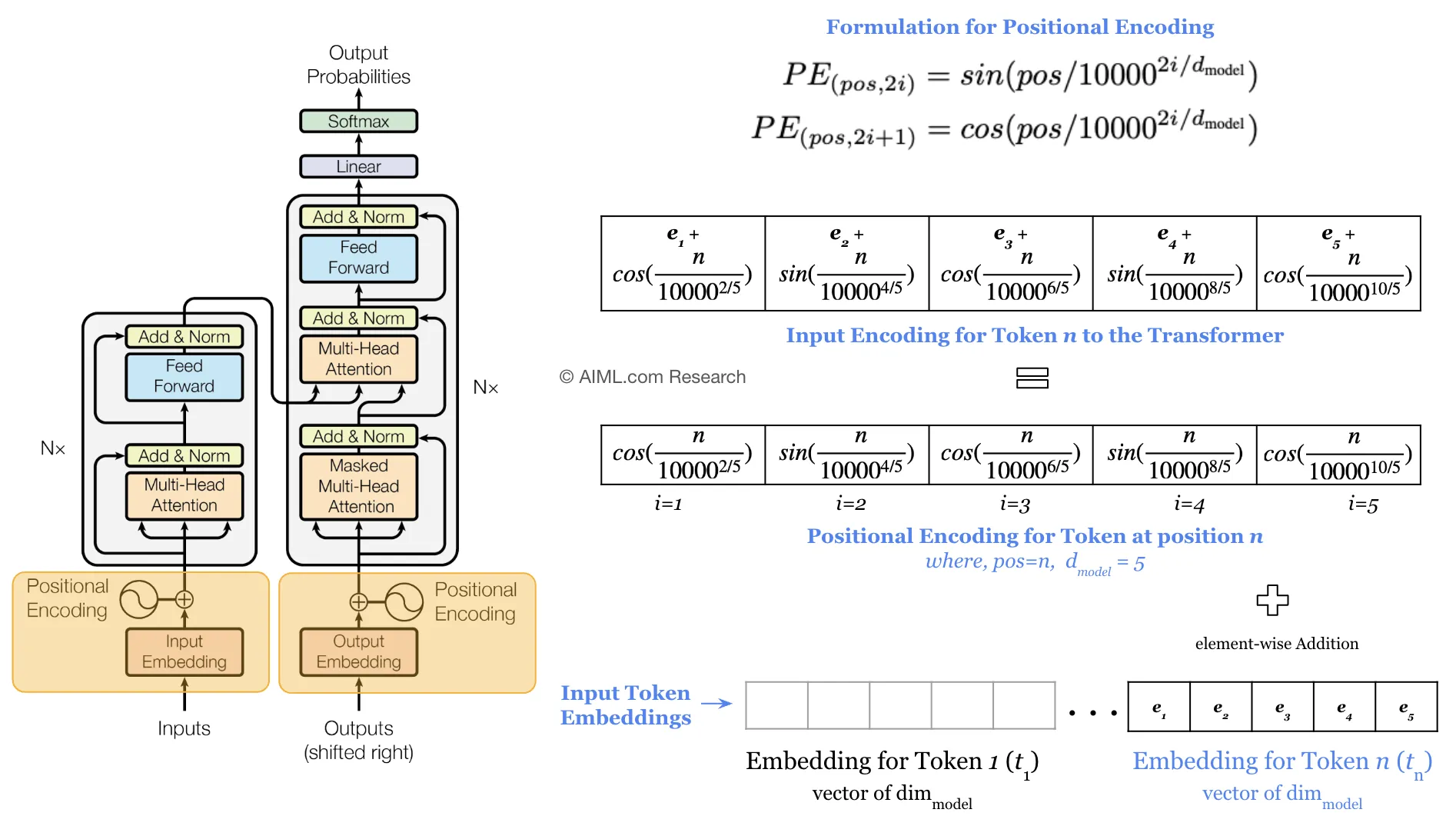
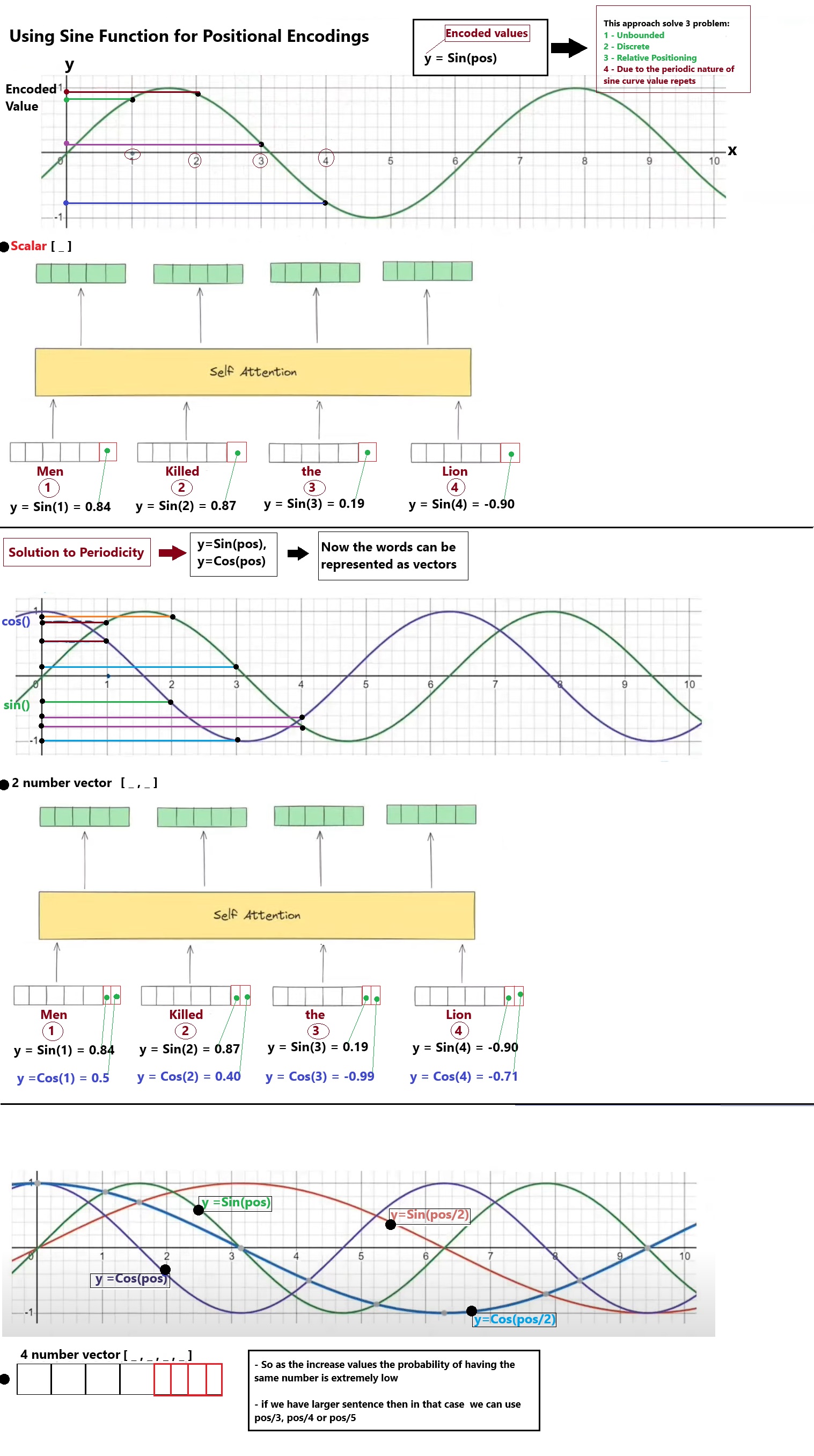
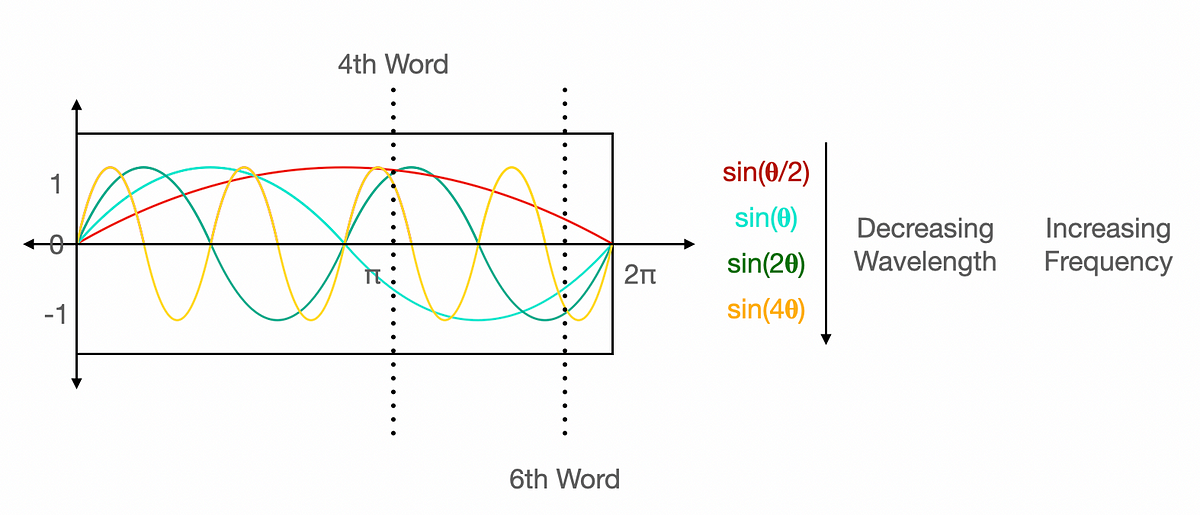
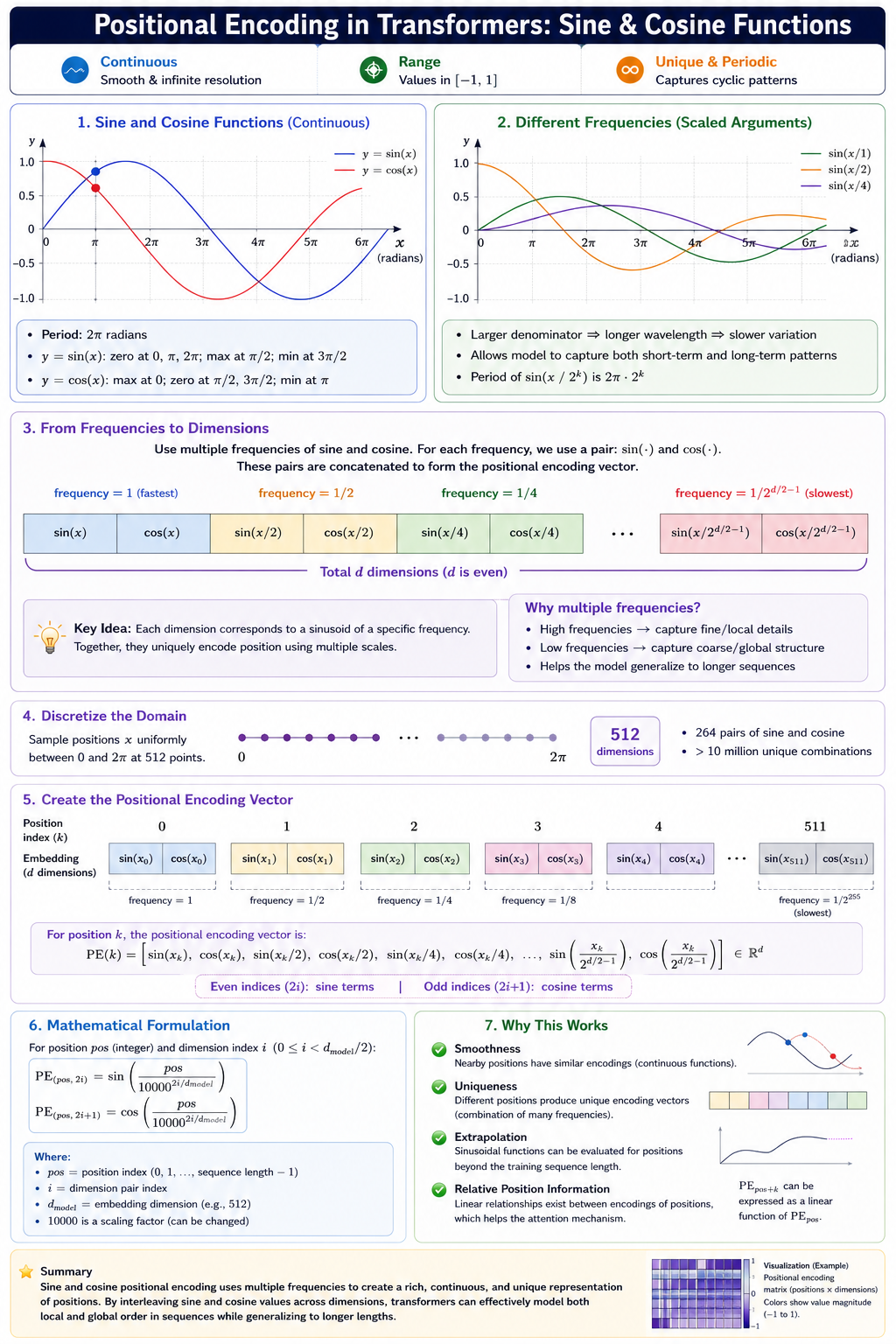
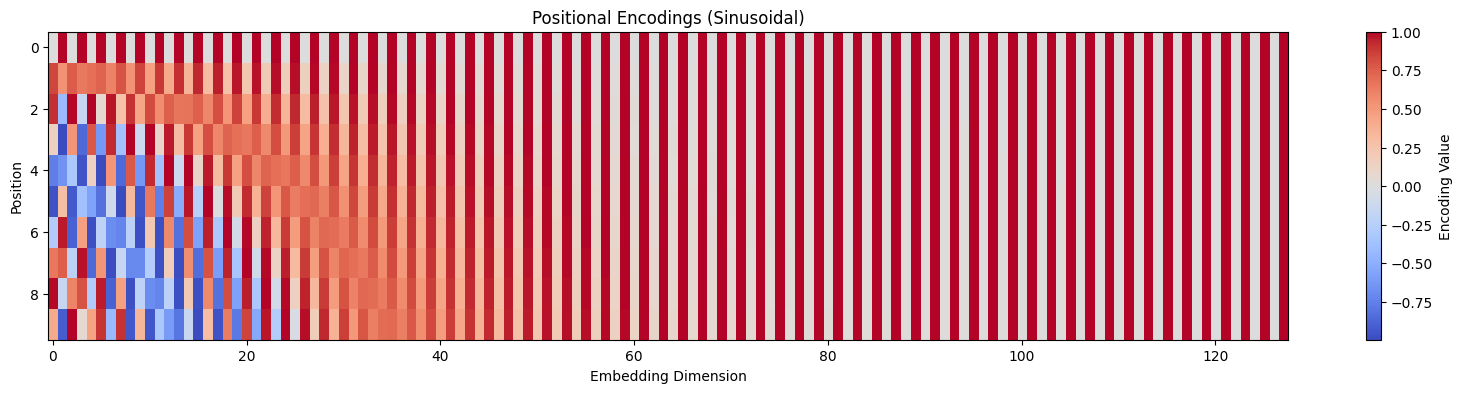
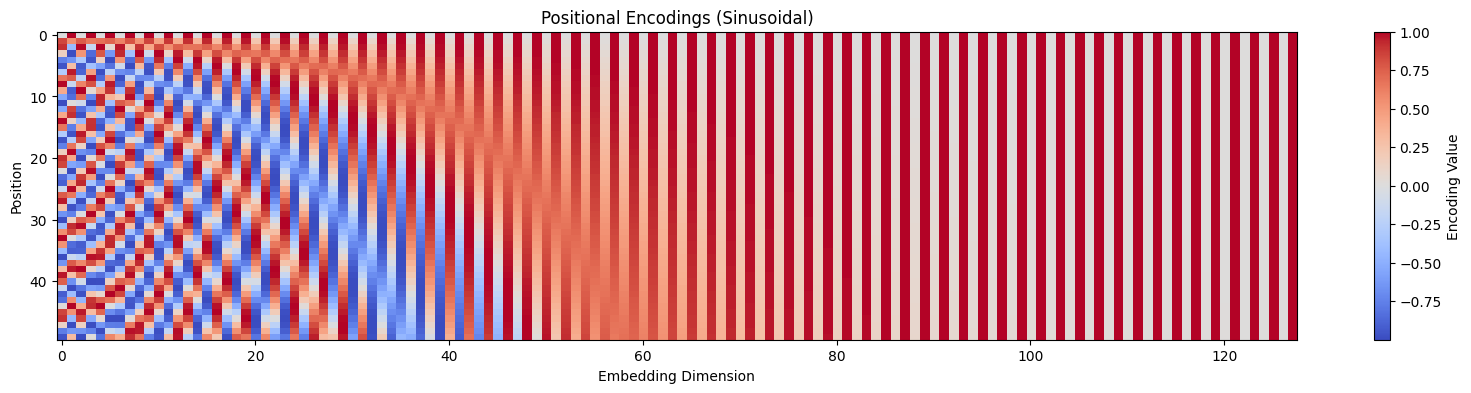
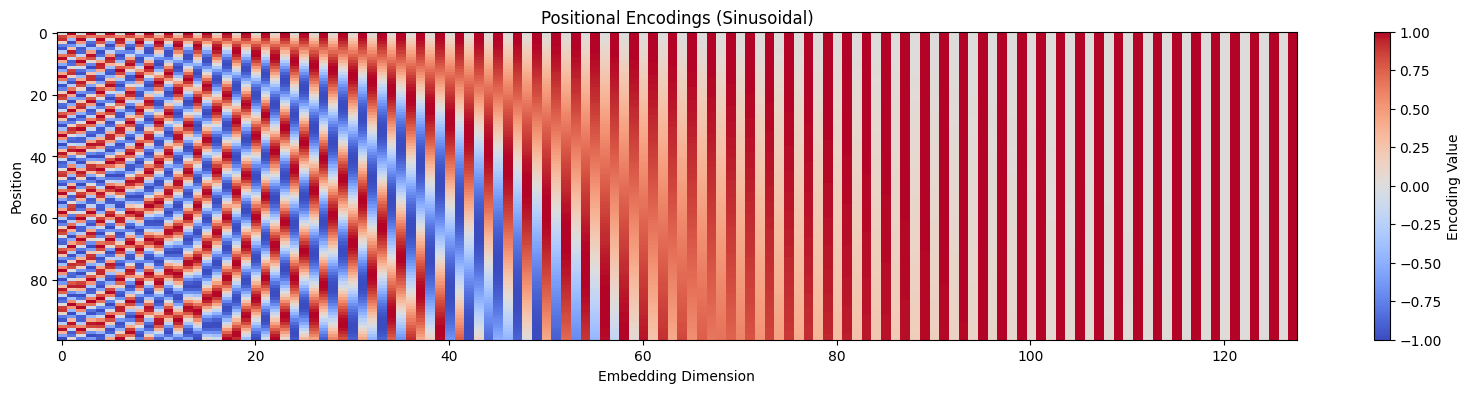
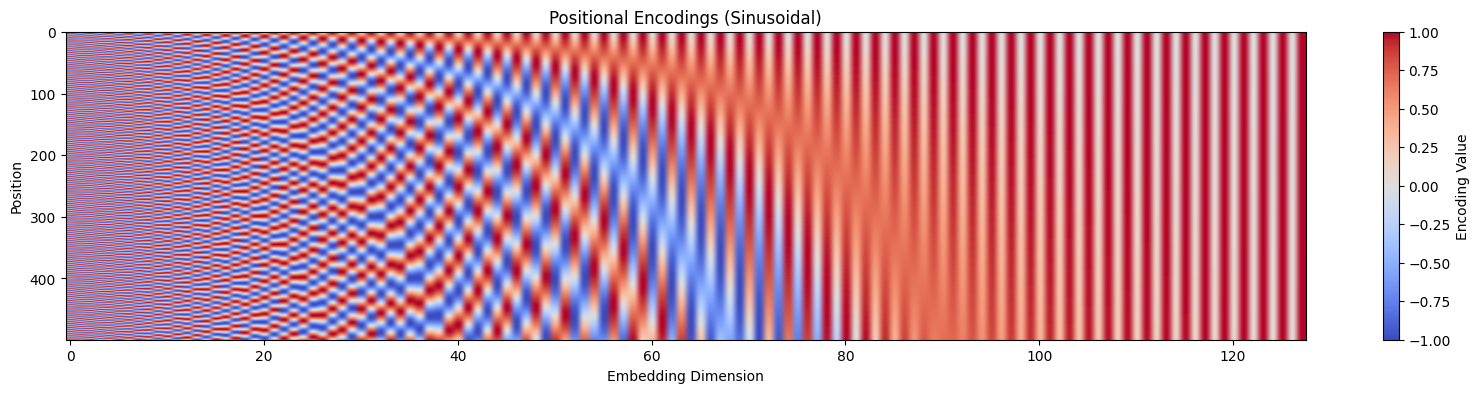
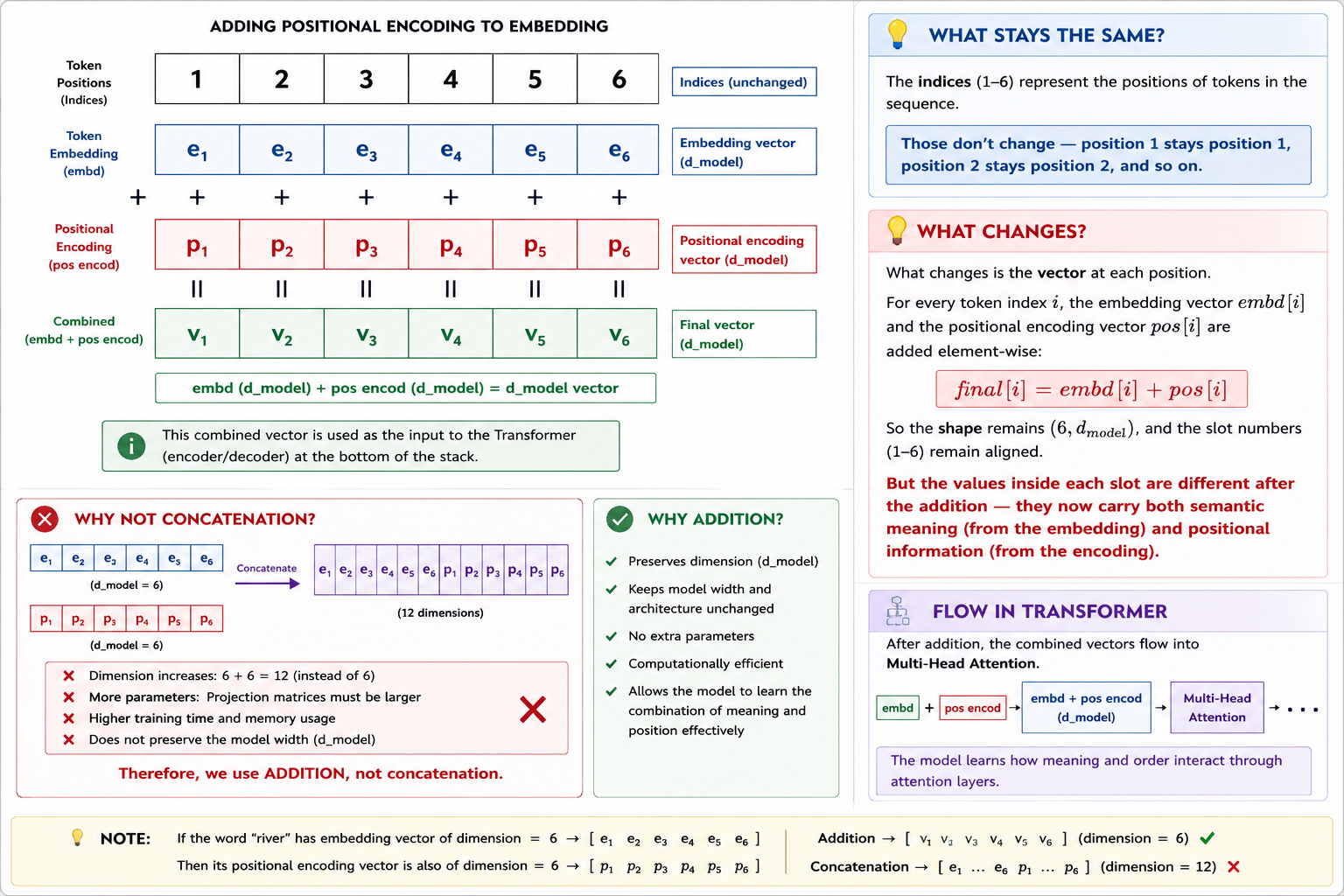
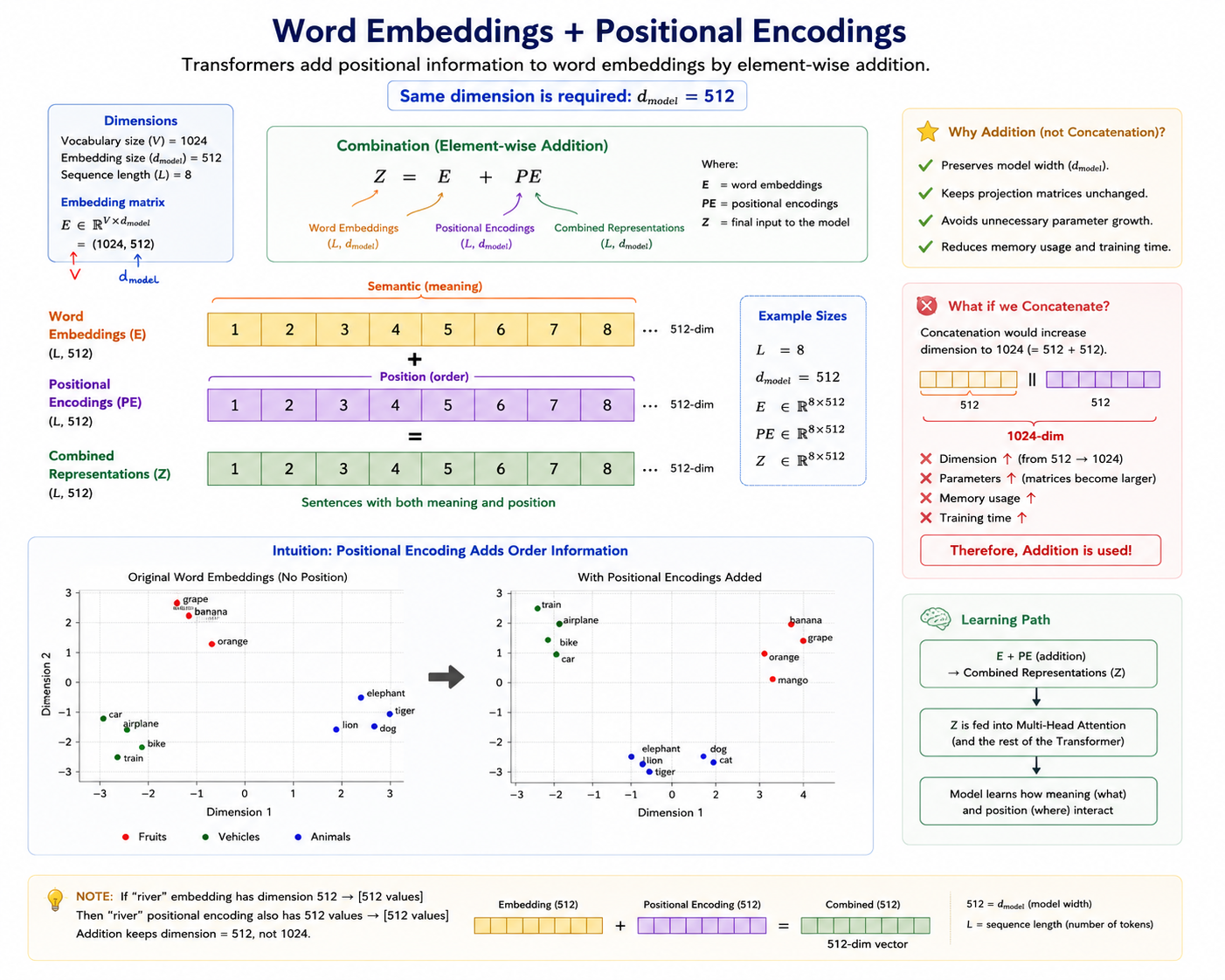
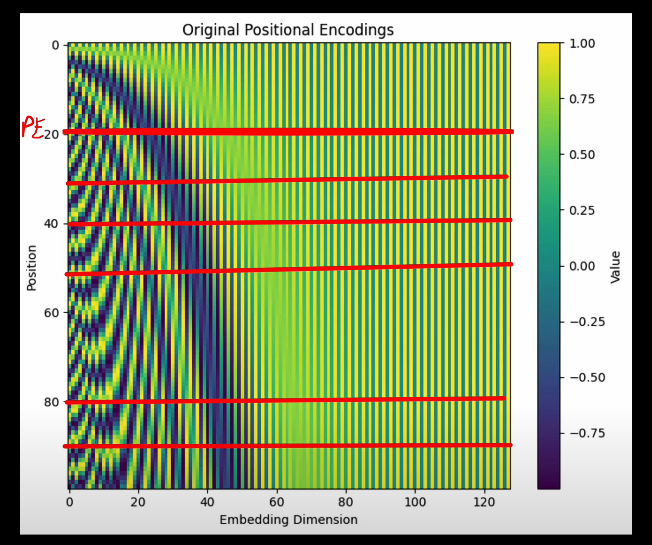
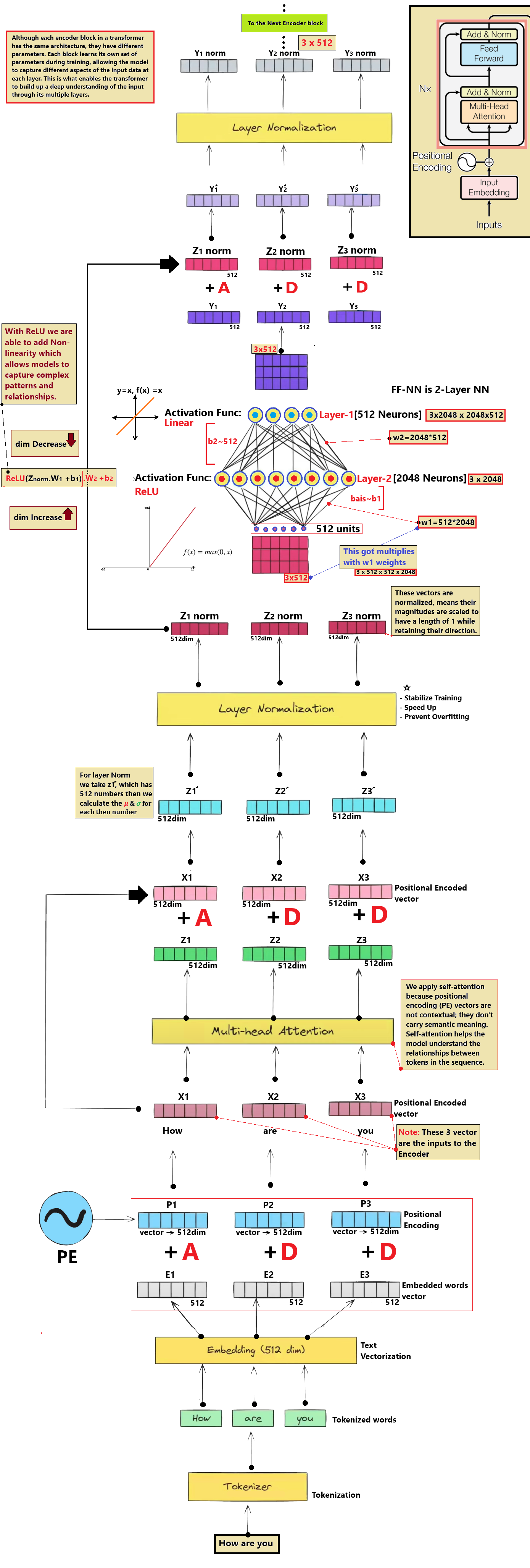
Self-attention processes all words in parallel, losing order information. To fix this, fixed sine/cosine waves of different frequencies are added element-wise to the embeddings.
GoalInject word position information without using sequential recurrences.
AnalogyLike writing a date watermark on letters so that even if they are delivered out of order, you can easily sort them.
Sinwave (Even Dim 2i)
Coswave (Odd Dim 2i+1)
Current Position Marker
1
0
E (Semantic Embedding)
+
PE (Positional Wave)
=
Z (Position-Aware Input)
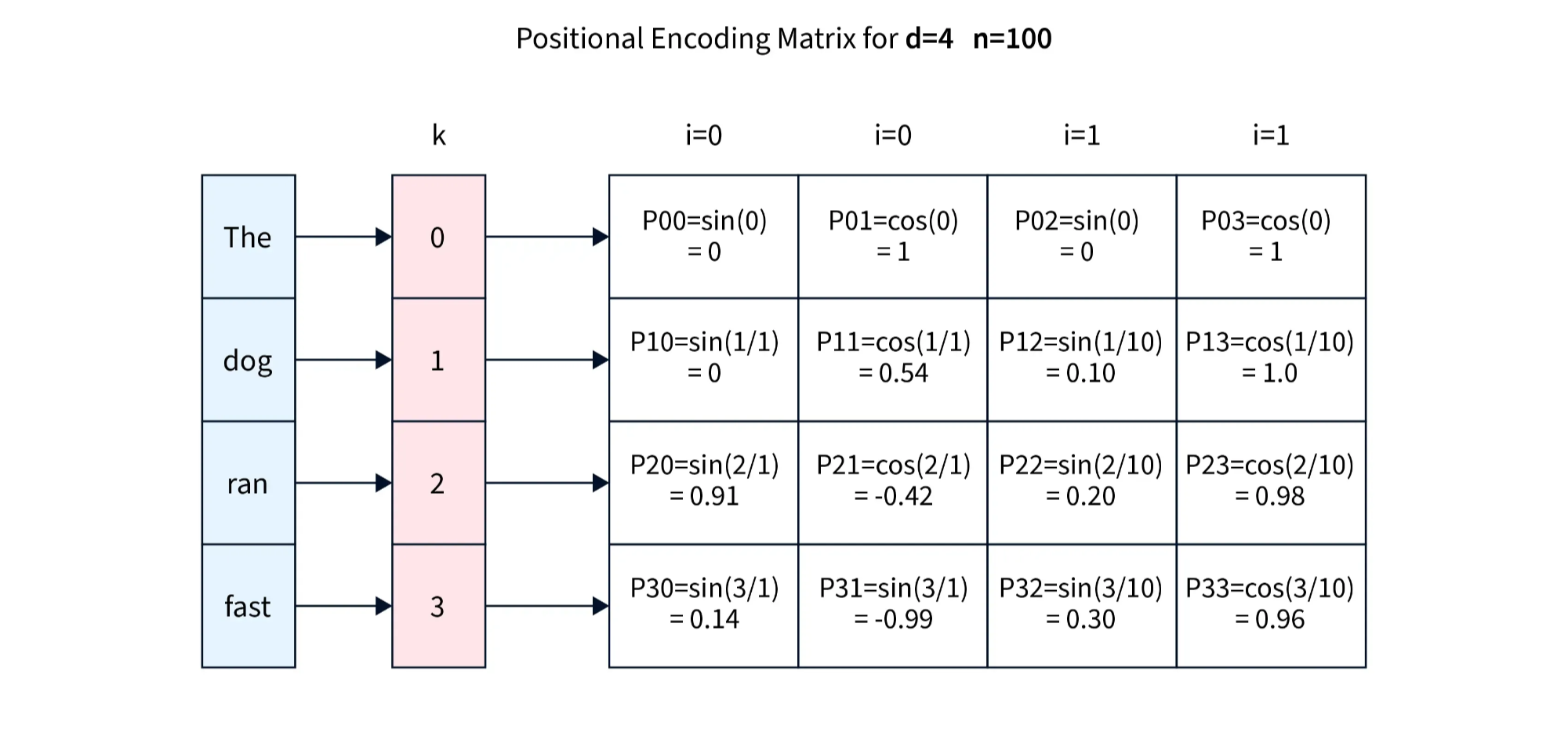
🧮 Formula:PE(pos, 2i) = sin(pos/10000^(2i/d)), PE(pos, 2i+1) = cos(pos/10000^(2i/d)). This enables the model to extrapolate to longer sequences than seen during training.
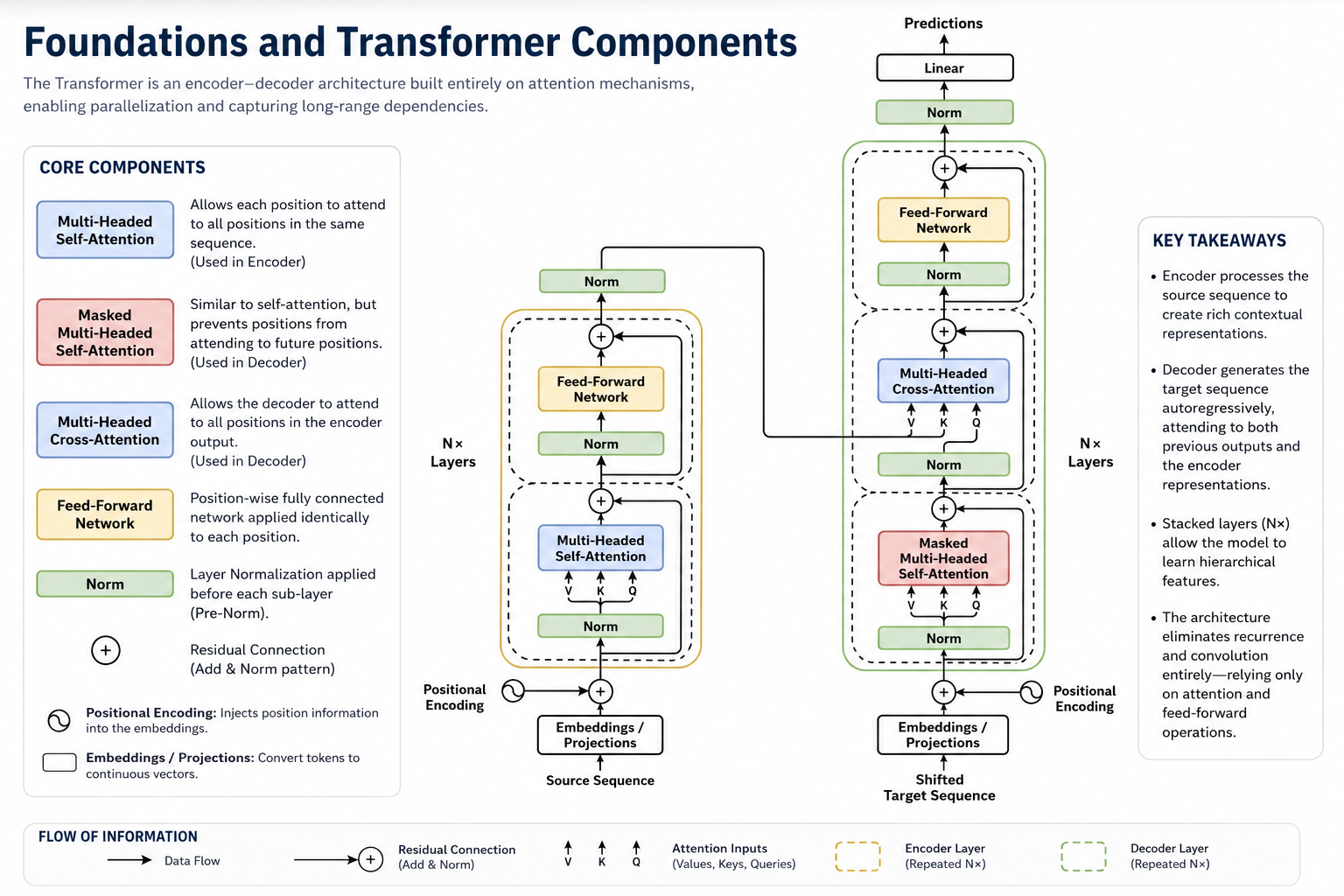
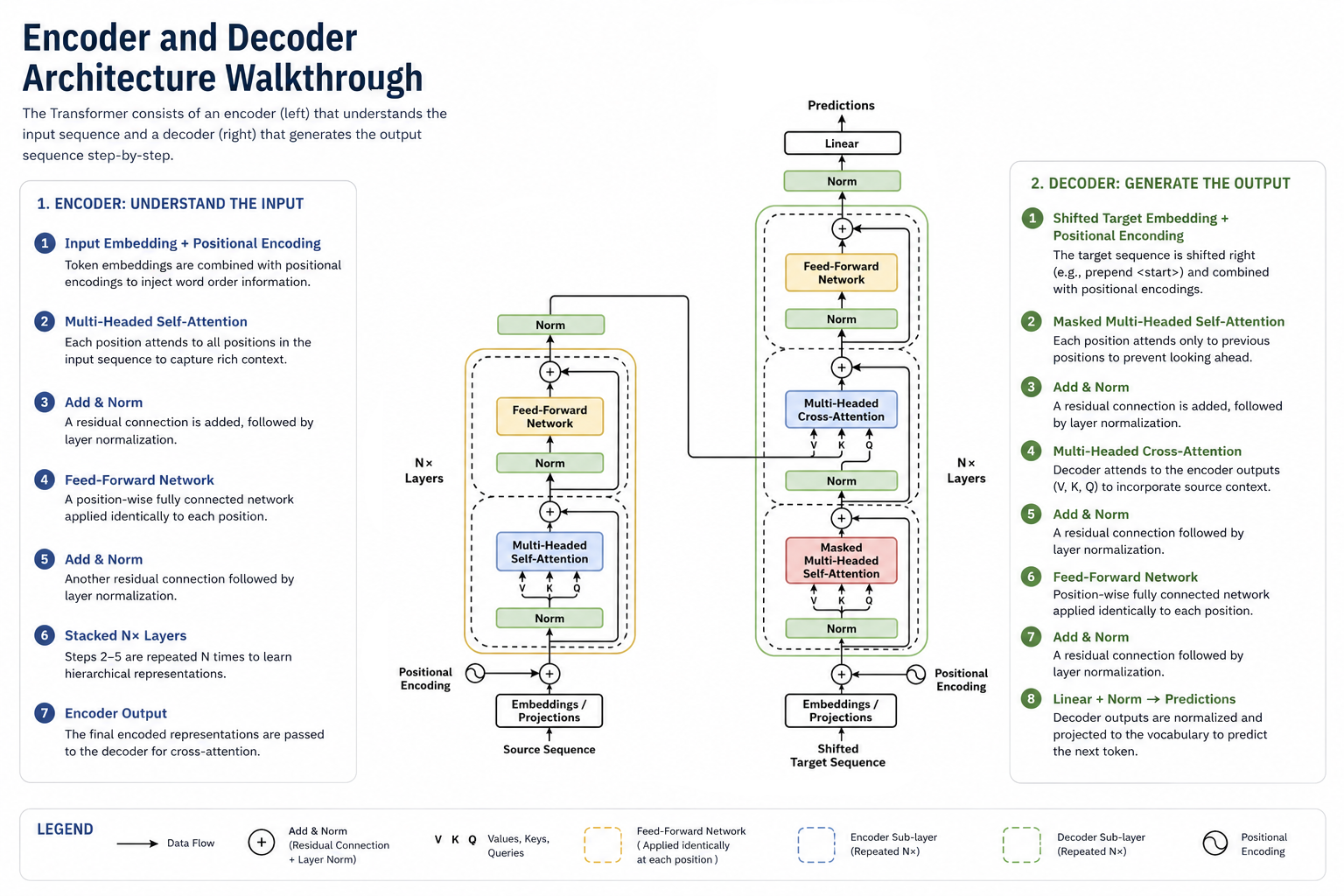
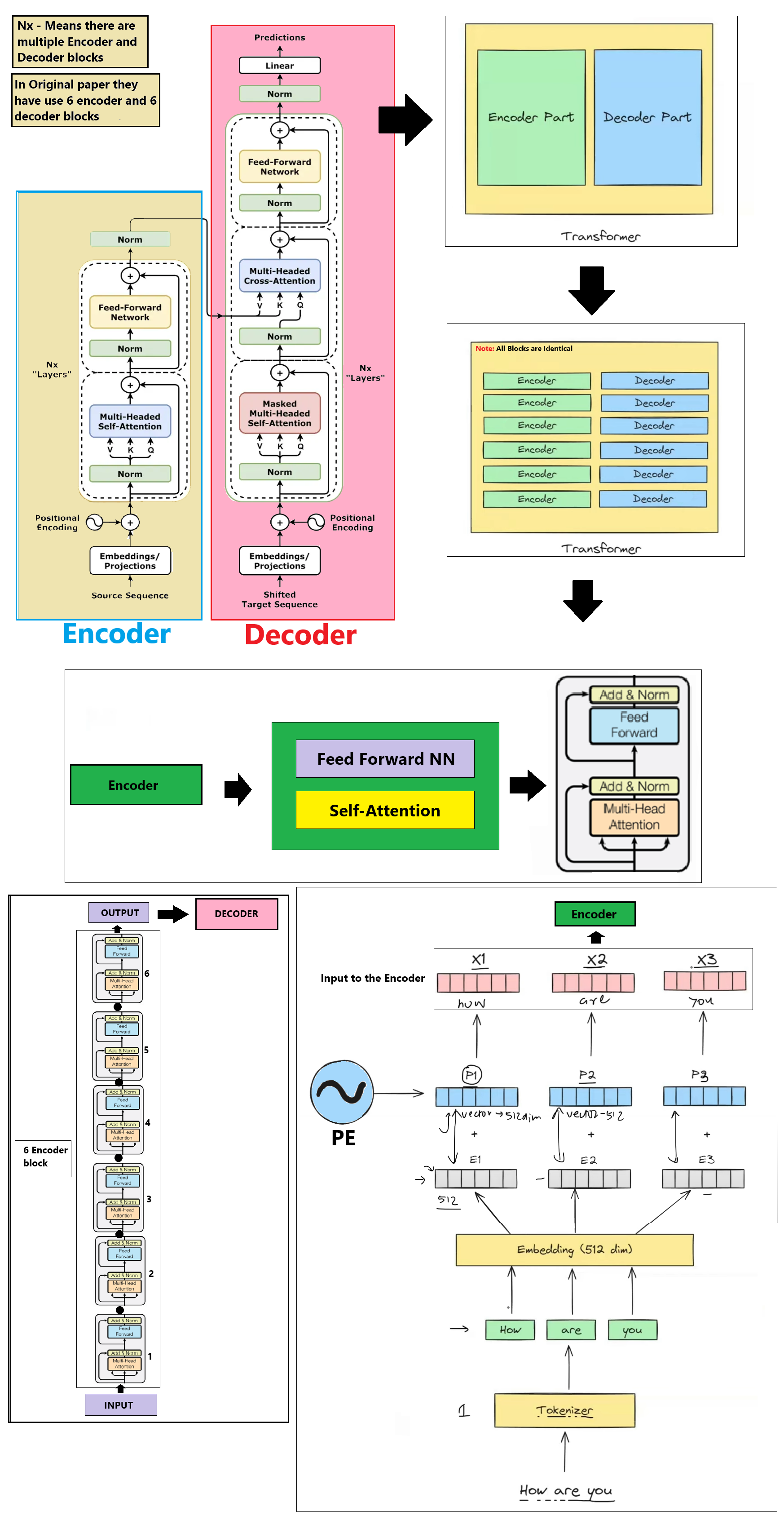
The Encoder uses a stack of 6 identical layers. In each layer, tokens attend to each other via Self-Attention to gather contextual information, then pass through a Feed-Forward Network.
GoalUnderstand each word in context (e.g. linking "bank" to "river" or "money").
AnalogyLike a group meeting where every person (word) makes eye contact (attention) with all others to establish relationships.
Encoder Layer 1 (Active)Interactive Node Graph
Attention Head:
Self-Attention Link Network (Hover any word to project attention laser arcs)
Encoder Layers 2–6Stacked Identical
1. Dimension Flow Map
Follow how the shapes transition. Hover over a box to learn about its dimensions.
$Z$$[T \times 512]$
➔
$Q, K, V$$[T \times 64]$
➔
$Q K^T$$[T \times T]$
➔
$\text{Attention} \cdot V$$[T \times 64]$
Hover over any shape above to inspect its details.
2. Interactive Matrix Multiplier Sandbox
Choose a step to explore how rows and columns multiply. Hover over cells in the output matrix (C) to see the dot product animation.
Z$[T \times 512]$
×
W_Q$[512 \times 64]$
=
Q$[T \times 64]$
Hover over an element in the output matrix to trace its dot product calculation.
[ STAGE 06 / 09 ]CAUSAL MASK & CROSS-ATTN
Step 6 — Decoder Layer Stack & Attention Masking
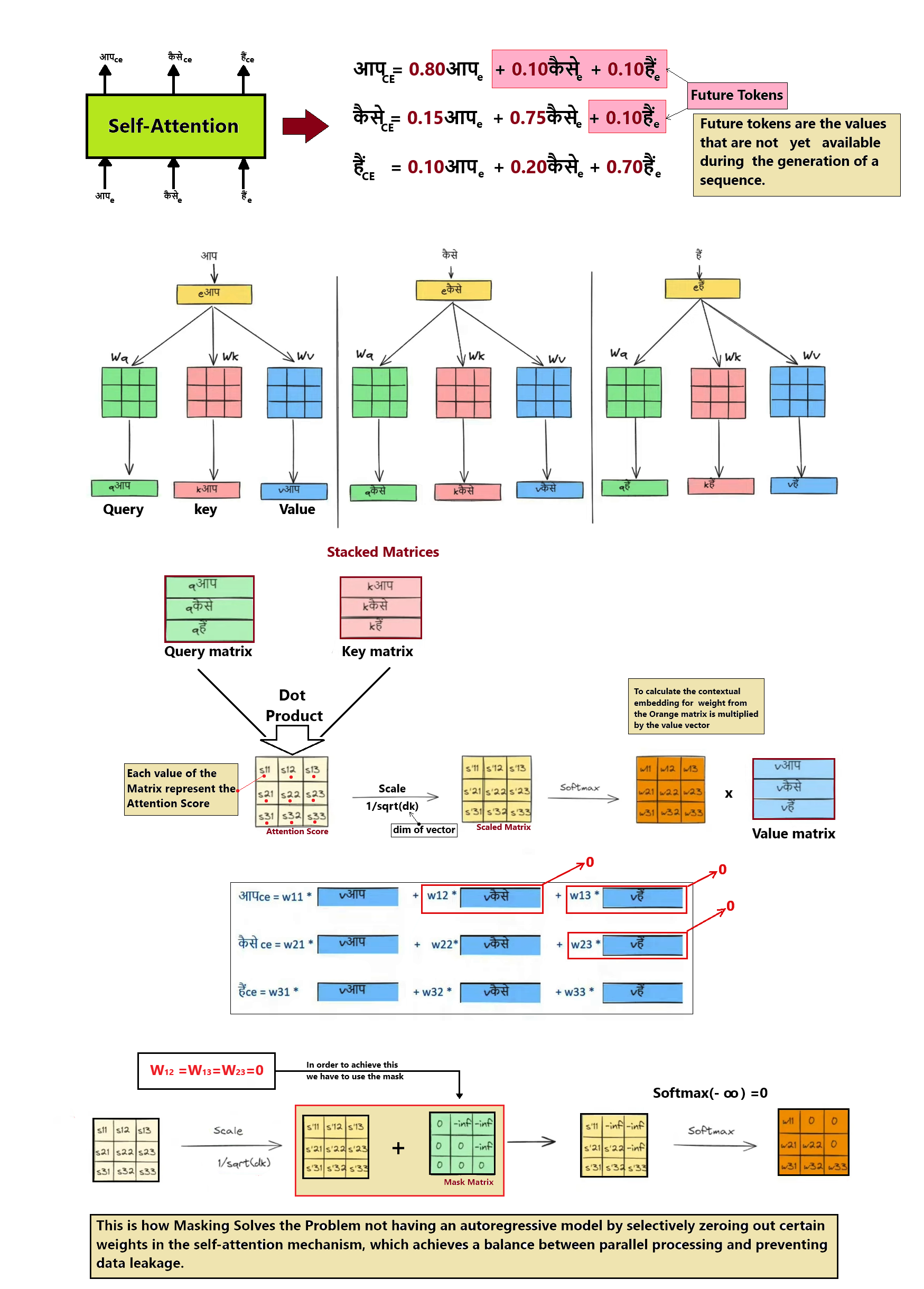
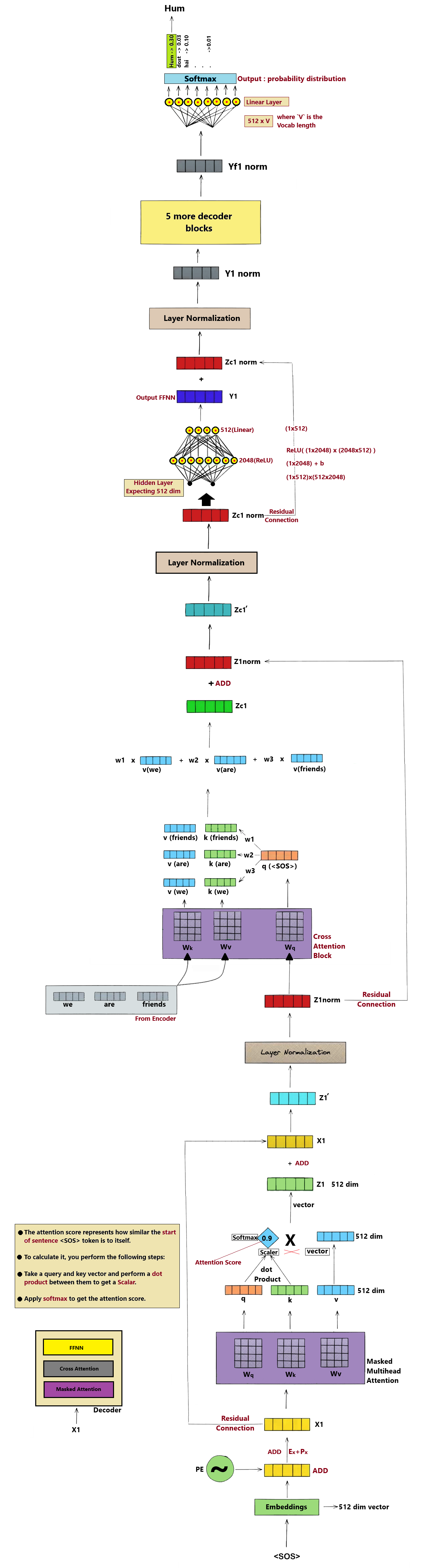
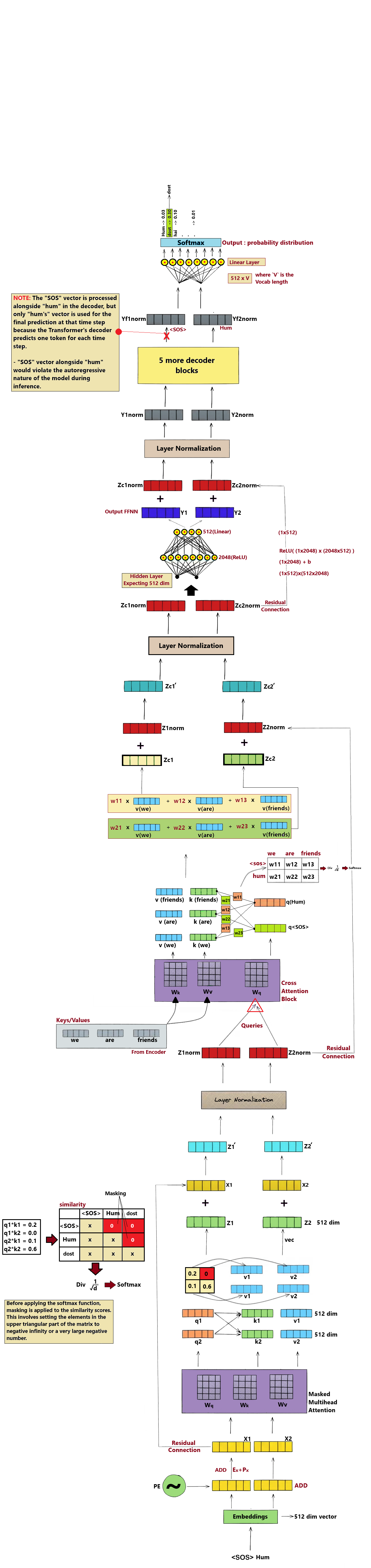
The Decoder stacks 6 layers to generate target tokens. It first applies Masked Self-Attention (protecting future tokens), then performs Cross-Attention to read Encoder outputs.
GoalGenerate translation step-by-step while attending to source memory and preventing looking ahead.
AnalogyLike translating a sentence where you are blindfolded to future parts of the sheet but have a clear look at the English original.
Decoder Layer 1 (Active)Interactive Masks
Masked Attention matrix (🔒 Padlocks represent masked future tokens set to -∞)
The output of the final Decoder layer is a 512-dim vector for the active position. The Linear layer projects this back to the size of our Vocabulary (37,000 logits).
GoalExpand low-dimensional representation to match the word options count.
AnalogyLike projecting a slide onto a giant wall of vocabulary tiles to highlight which tile matches the slide.
Decoder Output
[1 × 512]
×
Projection Matrix W_U
[512 × 37,000]
=
Output Logits Vector
[1 × 37,000]
Top Raw Unnormalized Logits (Pre-Softmax)
📝 Logits: These are raw, unnormalized scoring values. A higher score means the model thinks that vocabulary index is more likely to be the correct next word.
[ STAGE 08 / 09 ]PROBABILITY NORMALIZATION
Step 8 — Softmax Probabilities & Temperature Control
The Softmax function normalizes raw logits into a probability distribution. The values sum to 1.0 (100%), with each representing the probability of that word being the next token.
GoalConvert raw scores into positive percentages summing up to 100%.
AnalogyLike converting raw class votes into actual vote share percentages for every candidate.
Top Vocabulary Candidates (Softmax Probability Distribution)
The token with the highest probability is selected (greedy decoding) and printed. To generate the next word, the selected token is appended to the target prefix, and the loop restarts.
GoalEmit the final word and feed it back to start generating the next one.
AnalogyLike translating a sentence word-by-word, where each word you write down helps you figure out the sentence flow.
...
➔Appended to Target Sequence
New Decoder Input
➔
<bos>...
Strategy:Greedy (Argmax)Top-K (k=3)
AUTOREGRESSIVE DECODING LOG
[INIT] Decoder prefix loaded: <bos> La atención es todo lo que
[UPDATE] New prefix: <bos> La atención es todo lo que necesitas
🔄 Auto-Regressive translation: The model generates translation tokens one-by-one. Generation stops when the model outputs the special end-of-sequence token <eos>.
Recommended order
Study Path
Read in this order if you want the architecture to feel connected instead of scattered.
3. Full ArchitectureFollow the encoder stack first,
then the decoder stack with masking, cross-attention, and autoregressive output
generation.
Part 1 · Foundation
Foundations and Transformer Components
This part introduces the Transformer idea, the NLP timeline, attention, embeddings, positional
encoding, multi-head attention, residual connections, feed-forward networks, and normalization.
01 - Introduction to Transformers
⭐ Overview
🔴 The Paradigm Shift: The Transformer architecture, introduced in late 2017, abandoned sequential recurrence (RNNs/LSTMs) entirely in favor of parallel self-attention.
🔴 Global Context: By processing all tokens simultaneously, it enables direct connection between any two words regardless of distance, solving the vanishing gradient and memory bottleneck issues.
🔴 Foundation of Generative AI: The Transformer serves as the universal backbone for modern Large Language Models (LLMs) like GPT, Claude, Gemini, as well as scientific breakthrough models like AlphaFold 2.
Transformer [Generates the dynamic contextual embeddings]
1. Core Concept & Sequence Tasks
Sequence-to-Sequence (Seq2Seq): Designed to transform one sequence (like text) into another. Typical sequence tasks include:
Machine Translation: Translating language (e.g., English to French) where order dictates meaning.
Text Summarization: Distilling a long document sequence into a short summary sequence.
Question Answering: Mapping context + question tokens to answer tokens.
Speech Recognition: Translating continuous audio waves into text sequences.
Simultaneous Processing: Unlike sequential models, Transformers ingest and process all tokens in a sequence at once, replacing step-by-step reading with matrix operations.
2. Historical Context & Paradigm Shift
Legacy Bottlenecks: Prior architectures (RNNs, LSTMs, GRUs) processed text sequentially:
Vanishing Gradients: Information was squashed or lost over long distances, making it hard to link distant words.
GPU Underutilization: Sequential steps prevent parallel processing, limiting models to small datasets.
"Attention Is All You Need" (2017): Google Brain researchers proposed discarding recurrence and convolutions entirely, utilizing **Self-Attention** to calculate dependencies globally and in parallel.
3. Key Components of the Architecture
The standard Transformer architecture consists of the following components:
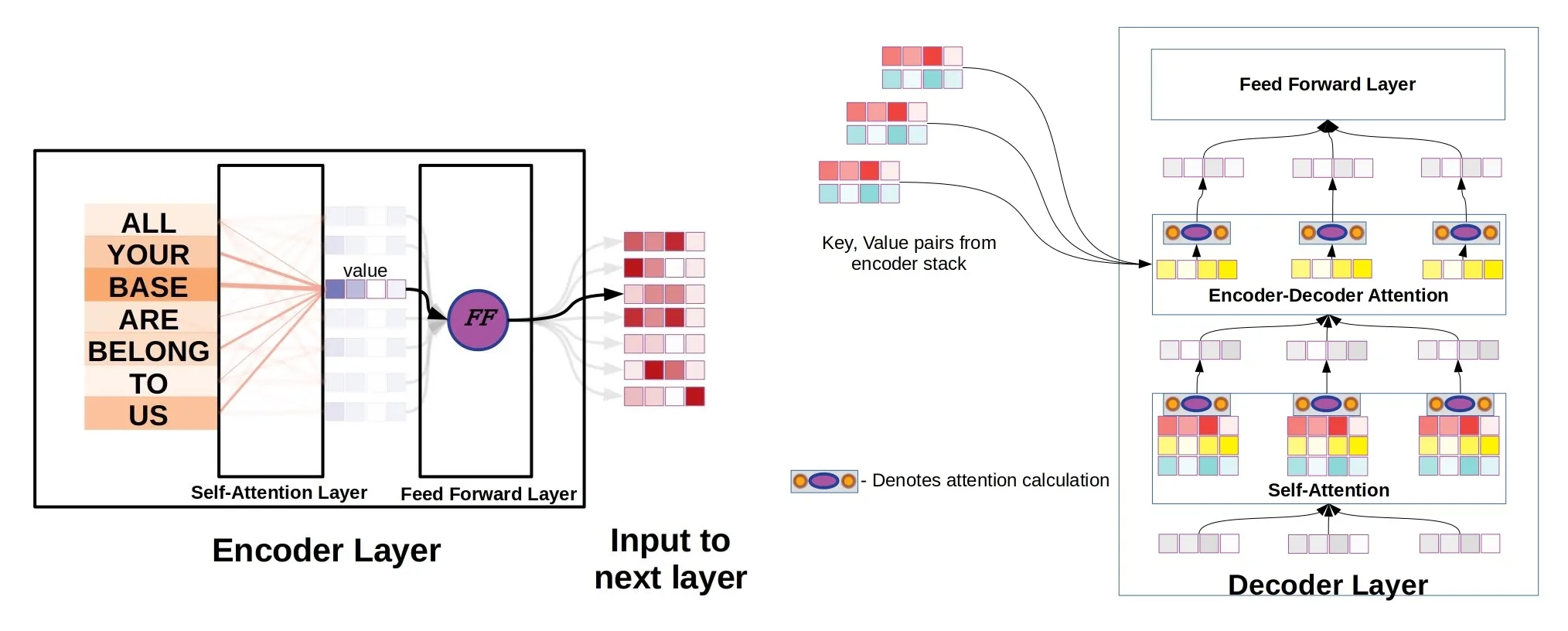
Encoder: Reads the input sequence, processes relationships, and builds context-aware embeddings.
Decoder: Generates output tokens sequentially, attending to both previous outputs and Encoder representations.
Self-Attention: The engine that computes similarity weights between every pair of tokens.
Feed-Forward Network (FFN): Applies non-linear transformations individually at each position to capture complex facts.
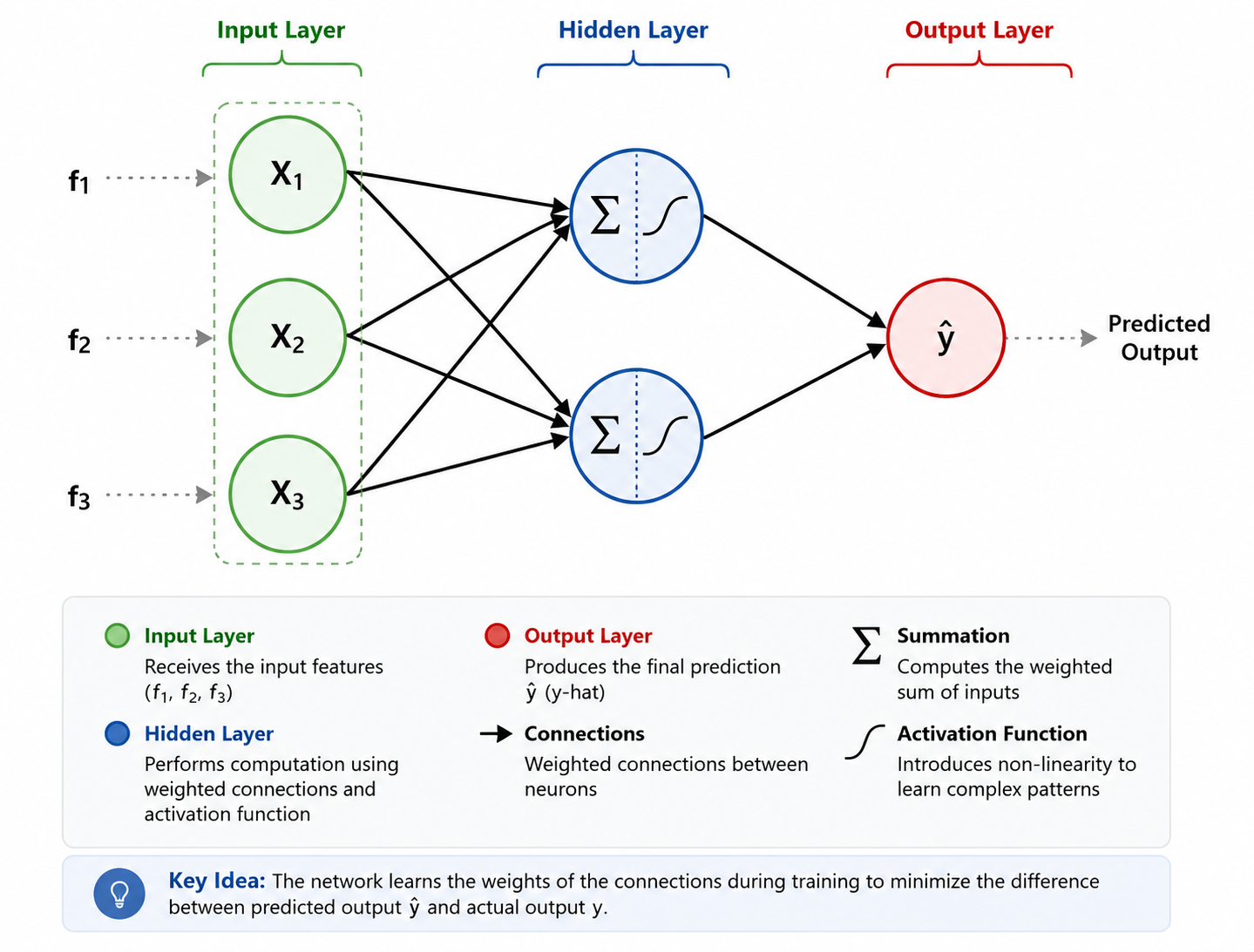
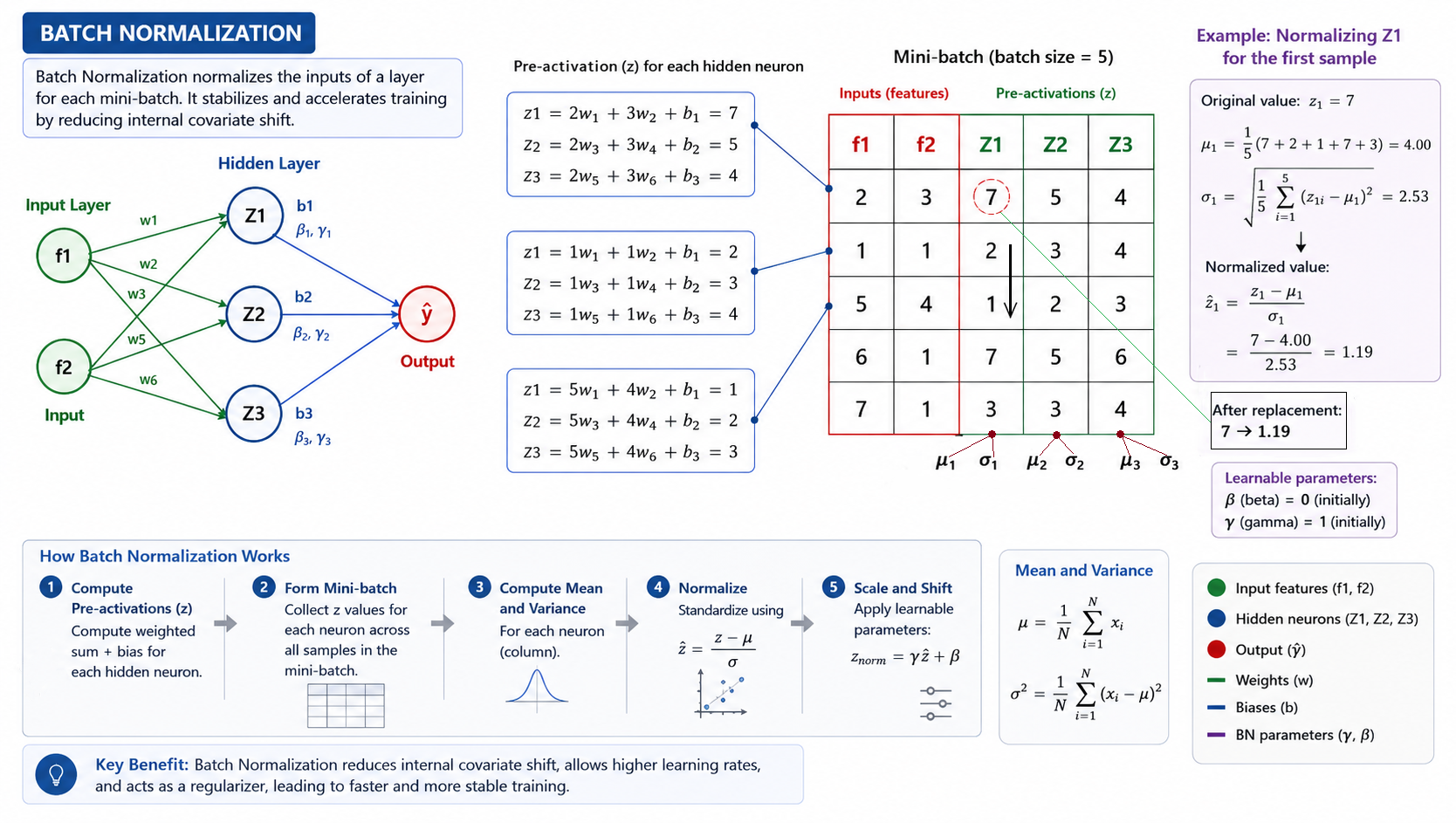
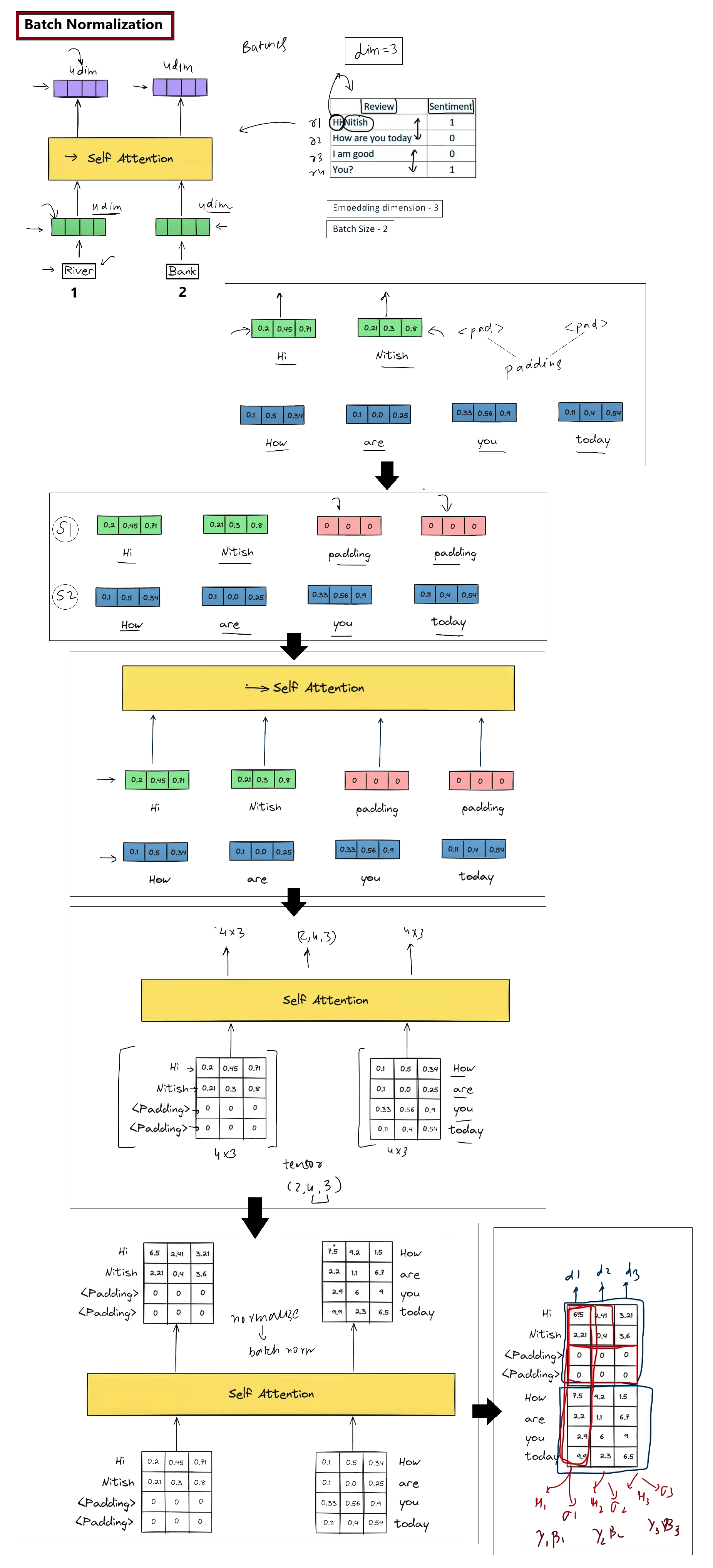
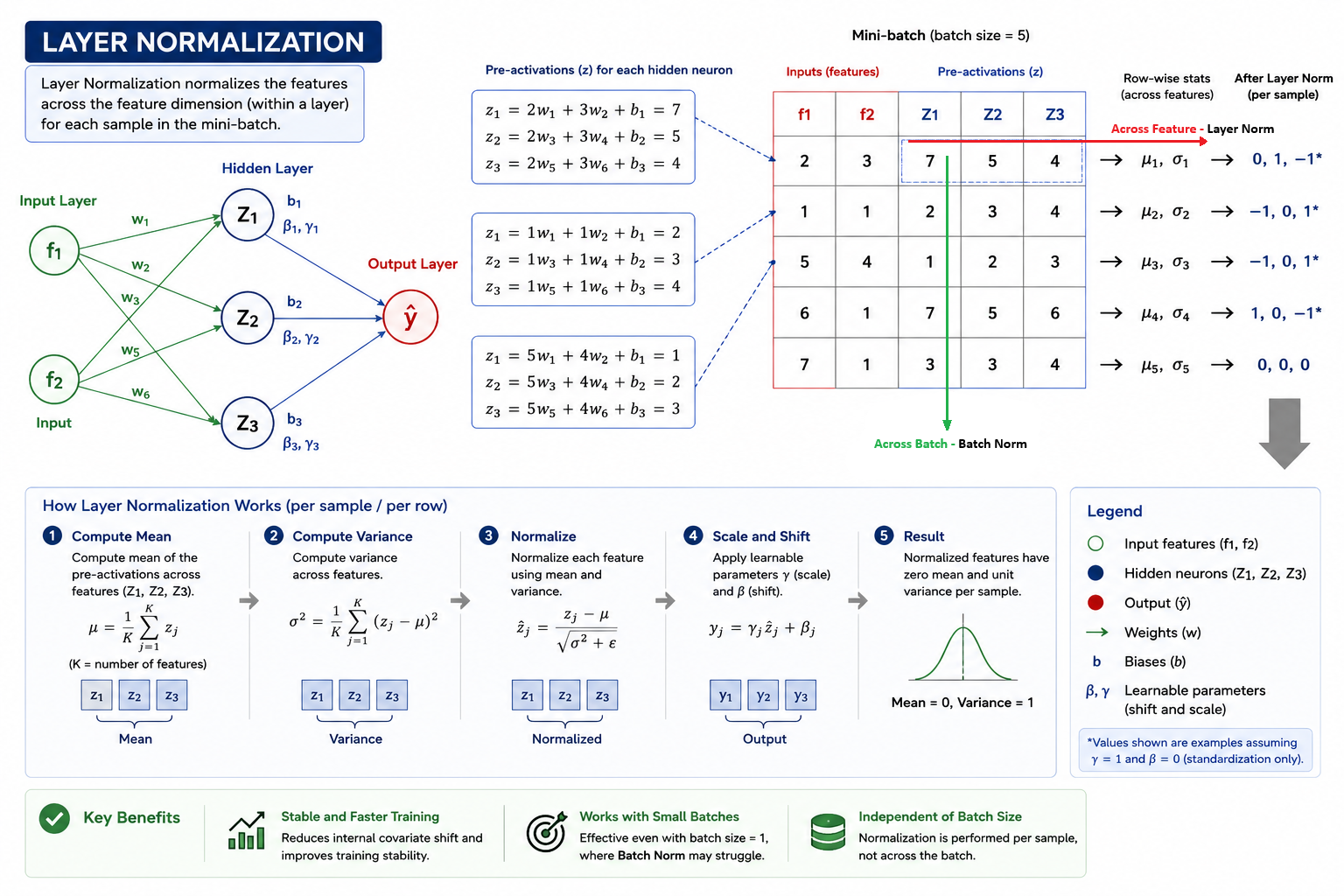
Layer Normalization & Residuals: Stabilizes training and enables deep networks (skip connections) by preventing vanishing gradients.
4. Transfer Learning & AI Democratization
Pre-training vs. Fine-tuning:
Pre-training: Large-scale, self-supervised learning on massive internet datasets to learn grammar, facts, and reasoning (extremely expensive).
Fine-tuning: Adapting the pre-trained model to specific downstream tasks (e.g., classification, translation) with limited labeled datasets (cheap).
Democratization: Transfer learning allowed small groups and startups to build state-of-the-art tools using API services or fine-tuning open models (like LLaMA) without needing huge compute centers.
5. Scientific Frontiers & Multimodality
Beyond Text: Transformers have unified deep learning across vision (Vision Transformers / ViT), audio (Whisper), and biology (AlphaFold 2 for protein structure prediction).
Multi-Modality: A single Transformer architecture can now map multiple modalities (text, images, audio, video) into a shared vector space, enabling unified models like GPT-4o or Gemini.
6. Advantages & Disadvantages
Advantages: Parallel training, direct long-range dependencies, unified architecture, and excellent scaling capacity.
Disadvantages:
Quadratic Complexity: Attention scaling cost is \(O(N^2)\) with sequence length, making long context windows expensive.
Resource Intensive: High training cost, massive energy footprint, and hard-to-explain "black box" decisions.
7. Final Summary Table
Core Topic
Primary Mechanism & Key Idea
Paradigm Shift & Impact
Key Examples / Architectures
Transformer Architecture
Uses self-attention (no sequential processing) to weigh relationships between all tokens simultaneously.
Revolutionized AI by enabling fully parallelized training, replacing sequential bottlenecks of RNNs/LSTMs.
Original Transformer (2017), BERT (Encoder), GPT (Decoder)
Self-Attention
Each token dynamically calculates attention weights for every other token in the sequence.
Solves the long-term dependency problem; model understands context globally rather than locally.
Focus on efficiency (quantization, pruning), interpretability, and domain-expert models.
Moving towards specialized, optimized models that run locally, alongside massive multimodal generalists.
FlashAttention, MoE (Mixture of Experts), Edge AI
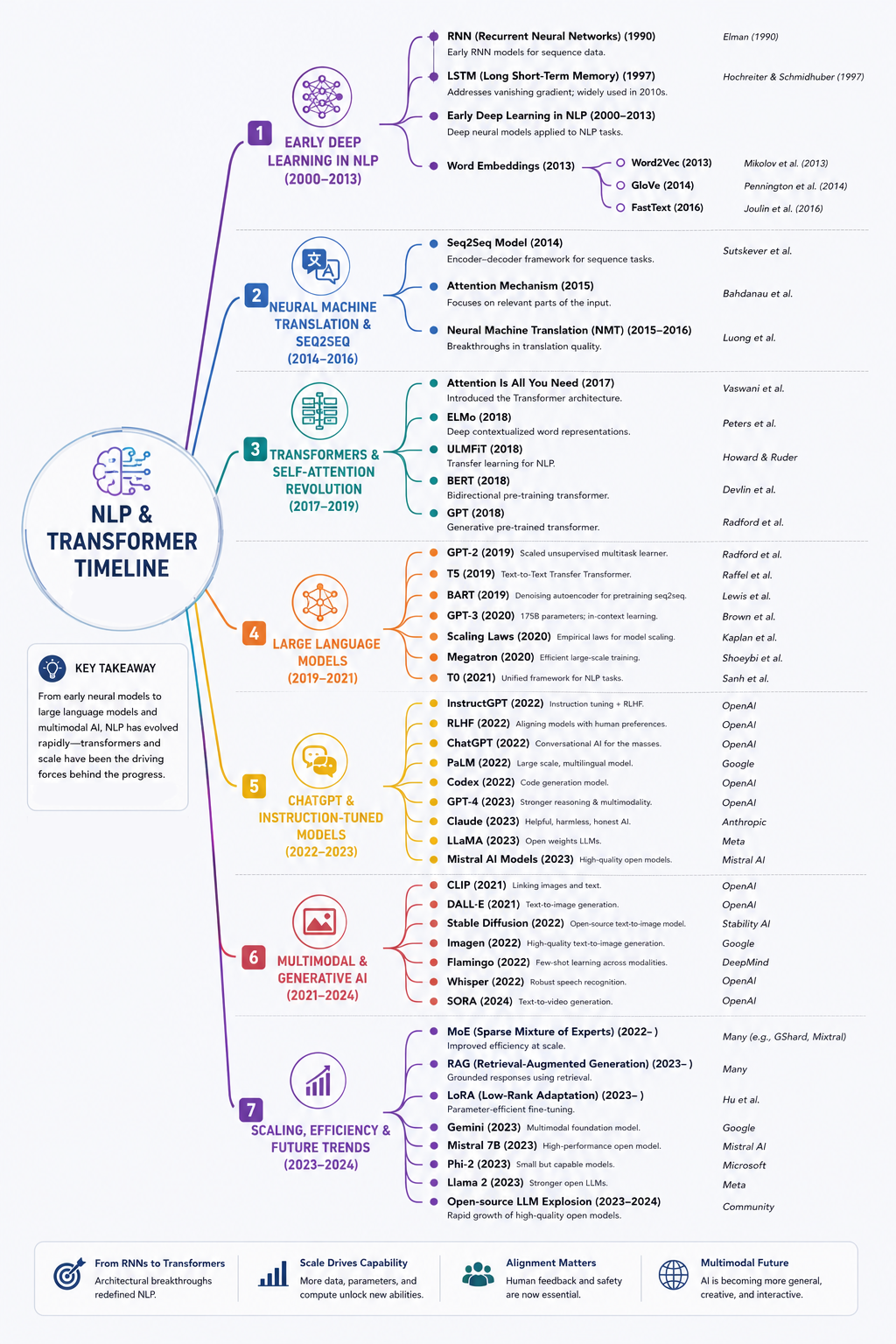
8. NLP Transformer Timeline
9. Practice Questions & Concept Intuitions
Q1Why did the Transformer architecture represent a major paradigm shift in NLP?
Elimination of Sequential Bottlenecks: Prior architectures (RNNs, LSTMs, GRUs) computed hidden representations sequentially step-by-step ($h_t = f(h_{t-1}, x_t)$). The Transformer entirely discarded recurrence, processing all tokens concurrently across the sequence via multi-head self-attention.
Massively Scalable GPU Parallelization: Because recurrence was removed, training over the sequence length is parallelized across GPU/TPU tensor cores via batched matrix multiplications, unlocking training on trillion-token datasets.
Direct $O(1)$ Information Highways: Recurrent models compress history into a fixed vector where distant signals degrade. Self-attention provides a direct constant-path connection between any two positions, regardless of distance ($O(1)$ maximum path length vs $O(N)$ for RNNs).
Q2What are the key limitations of sequential models like RNNs and LSTMs?
Strict Sequential Dependency: Inability to compute step $t$ before completing step $t-1$ makes sequence parallelization impossible, leaving compute clusters underutilized during forward and backward passes.
Vanishing and Exploding Gradients (BPTT): Backpropagation Through Time involves continuous chain rule multiplications of the recurrent weight matrix ($\prod_{j=t}^{T} W_{hh}^T$). This causes gradients to decay exponentially to zero or explode numerically.
Fixed-Capacity Information Bottleneck: Compressing an entire sentence or document into a single fixed-size hidden state vector inevitably causes loss of long-range syntactic and factual dependencies.
Q3How do Transformers solve the vanishing and exploding gradient problems?
Direct Attention Skip Connections: Pairwise dot-product attention connects any source and target token directly in a single step, ensuring gradient signals don't decay over temporal steps.
Residual Additive Highways: Every sub-layer implements an identity skip connection: $\mathbf{x}_{out} = \mathbf{x}_{in} + \text{SubLayer}(\mathbf{x}_{in})$. During backpropagation, the gradient $\frac{\partial \mathcal{L}}{\partial \mathbf{x}_{in}} = \frac{\partial \mathcal{L}}{\partial \mathbf{x}_{out}} (I + \frac{\partial \text{SubLayer}}{\partial \mathbf{x}_{in}})$ flows directly backwards without diminishing.
Layer Normalization: Normalizes intermediate activations across feature dimensions at every layer, keeping variance bounded and preventing gradient explosion.
Q4What is the difference between autoregressive and autoencoding Transformer architectures?
Autoregressive (Decoder-only, e.g., GPT, LLaMA): Employs causal masking to restrict token $t$ to attending only to tokens $\le t$. Trained on next-token prediction ($\mathcal{L} = -\sum \log P(x_t | x_{
Autoencoding (Encoder-only, e.g., BERT, RoBERTa): Employs bidirectional self-attention where tokens attend to both past and future tokens. Trained via Masked Language Modeling (MLM), making them ideal for classification, extraction, and embedding generation.
Sequence-to-Sequence (Encoder-Decoder, e.g., T5, BART): Employs a bidirectional encoder coupled to an autoregressive causal decoder via cross-attention, specialized for conditioned transformation tasks (translation, summarization).
Q5Why is transfer learning crucial for modern Transformer models?
Sample Efficiency in Downstream Tasks: Pre-training learns general linguistic syntax, semantic representations, and factual world knowledge from unlabeled corpora. Downstream fine-tuning then converges with very few labeled examples.
Amortized Training Compute: Pre-training requires millions of GPU hours. Transfer learning amortizes this foundational cost, allowing developers to adapt foundation checkpoints using lightweight fine-tuning (e.g., LoRA, QLoRA) or prompting.
Cross-Domain Generalization: Pre-trained representations generalize across zero-shot and few-shot tasks, exhibiting strong emergent reasoning capabilities that task-specific models cannot achieve.
Q6How does pre-training differ from fine-tuning in the Transformer pipeline?
Pre-training Phase: Unsupervised or self-supervised training on broad, uncurated web-scale corpora (trillions of tokens) using general objectives (next-token prediction or masked tokens) to build foundational representations.
Fine-tuning Phase: Supervised adaptation on curated domain-specific datasets (instructions, dialogues, classification labels) using a significantly smaller learning rate to align model outputs to specific task formats.
Compute & Optimization: Pre-training uses large batch sizes (millions of tokens) and distributed data-parallel/model-parallel pipelines; fine-tuning operates on smaller batches and often freezes the majority of parameters.
Q7What are the computational complexity differences between RNNs and Transformers?
Sequential Operations: RNNs require $O(N)$ sequential operations (where $N$ is sequence length), whereas Self-Attention executes in $O(1)$ sequential operations per layer, running as a single parallel tensor kernel.
Per-Layer Computational Complexity: Standard Self-Attention costs $O(N^2 \cdot d)$ compute and memory (where $d$ is hidden dimension), while recurrent layers cost $O(N \cdot d^2)$.
Regime Trade-offs: When sequence length $N < d$ (typical in short sentences), Self-Attention is computationally faster and far more parallelizable than RNNs. When $N \gg d$, self-attention's quadratic scaling becomes memory-intensive.
Q8Explain the contribution of the paper "Attention Is All You Need".
Complete Elimination of Recurrence & Convolution: Vaswani et al. (2017) demonstrated that state-of-the-art sequence transduction could be accomplished relying purely on attention mechanisms.
Multi-Head Scaled Dot-Product Attention: Introduced the projection of queries, keys, and values into multiple parallel subspaces, allowing the model to jointly attend to information from different representation subspaces.
Empirical Breakthrough: Outperformed established recurrent and convolutional architectures on WMT 2014 English-to-German (28.4 BLEU) and English-to-French tasks while requiring a fraction of the training time.
Q9What roles do the Encoder and Decoder play in seq-to-seq tasks?
Encoder Role (Comprehension Engine): Ingests the full source sequence bidirectionally, building unmasked contextual representations that encode syntactic relations and semantic meaning into memory keys ($K$) and values ($V$).
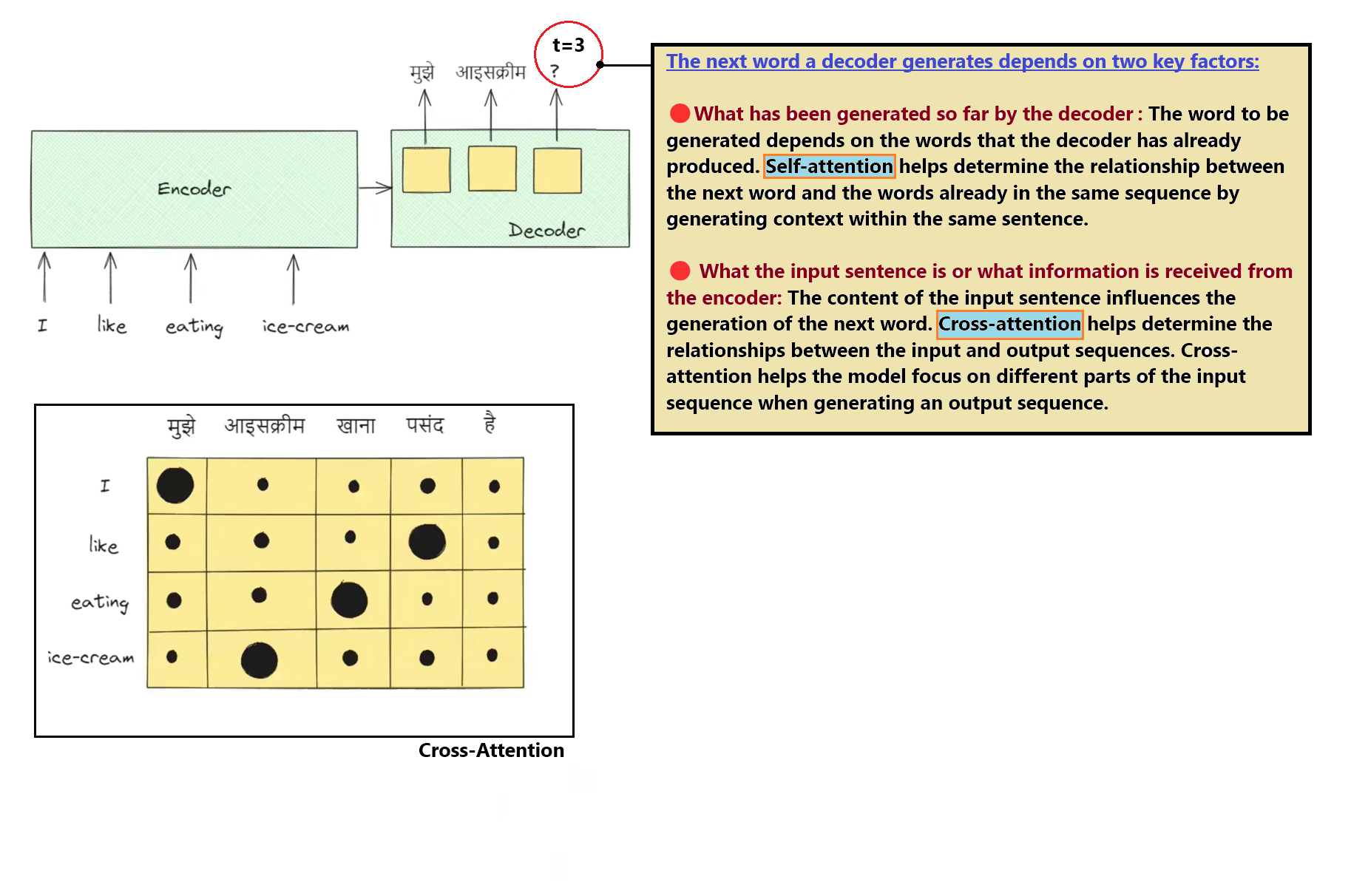
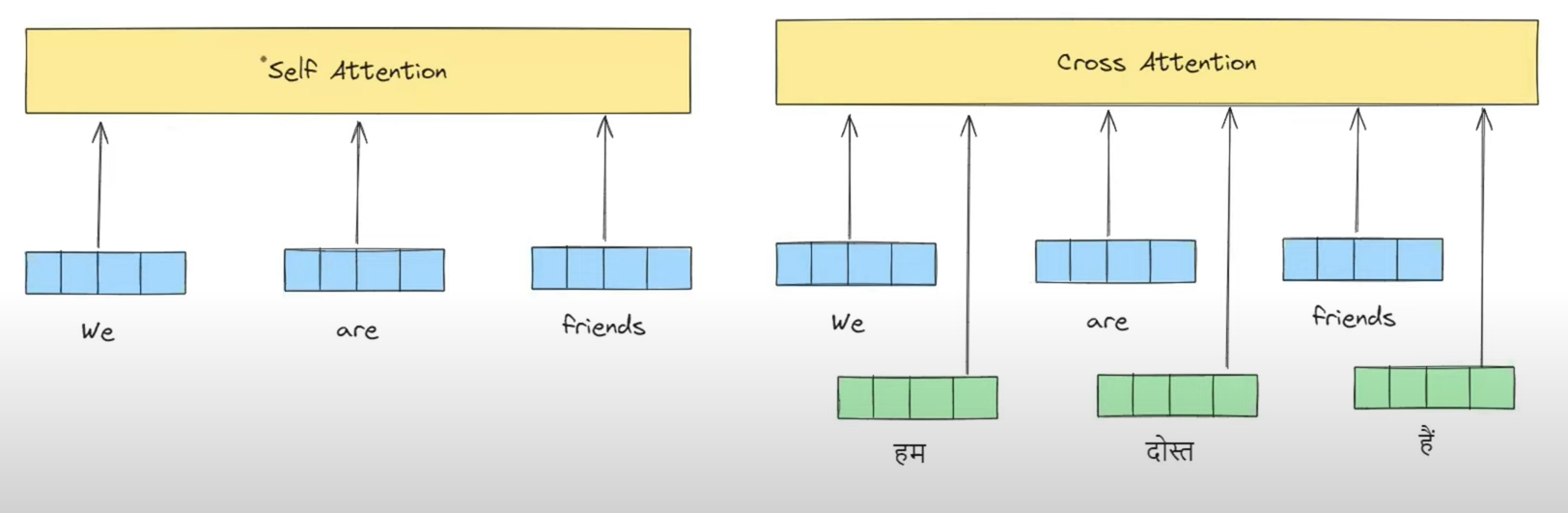
Decoder Role (Generation Engine): Generates output tokens one-by-one autoregressively. It uses masked self-attention to preserve causality over generated tokens and cross-attention to selectively query the encoder representations.
Asymmetric Information Routing: The decoder's query vectors dynamically interrogate the encoder's keys and values, dynamically aligning source concepts with target generation at each step.
Q10What is a key-value memory representation in the context of Feed-Forward networks?
FFN Two-Layer Structure: The Transformer Feed-Forward Network $\text{FFN}(\mathbf{x}) = \text{Activation}(\mathbf{x} W_1 + \mathbf{b}_1) W_2 + \mathbf{b}_2$ operates as an associative key-value memory store (Geva et al., 2021).
$W_1$ as Pattern Keys: The first linear layer acts as memory keys: each neuron detects specific textual patterns, grammatical structures, or semantic concepts in the token representation.
$W_2$ as Concept Values: The second linear layer acts as memory values: activating a key neuron retrieves a corresponding value vector that updates the token's representation with specific factual knowledge.
Q11What is the unified framework concept in deep learning brought by Transformers?
Universal Token Representation: All data modalities are unified into linear sequences of discrete/continuous tokens: subword text tokens, flattened $16 \times 16$ image patches (ViT), audio mel-spectrogram slices (Whisper), and protein residues (AlphaFold).
Shared Architecture & Kernels: The exact same core building blocks (Multi-Head Attention, MLP, LayerNorm, Residuals) process any token sequence, enabling universal optimization routines and specialized hardware accelerators.
Native Multimodal Synthesis: Structural homogeneity makes it natural to train multimodal models (e.g., Gemini, GPT-4o) in a single shared representation space without fragile modality-specific handcrafting.
Q12How does AlphaFold 2 leverage Transformer architectures for protein folding?
Evoformer Block Architecture: AlphaFold 2 replaces standard 1D attention with 2D axial attention across Multiple Sequence Alignments (MSA) and residue pair representations.
Geometric Reasoning via Attention: Attention maps directly learn co-evolutionary patterns and spatial constraints between amino acids, predicting inter-residue distances and orientations without manual physics heuristics.
Atomic 3D Coordinate Projection: Invariant Point Attention (IPA) directly refines 3D backbone rotations and translations in physical Euclidean space, achieving sub-angstrom structural accuracy.
Q13What are the main disadvantages or computational challenges of Transformers?
$O(N^2)$ Quadratic Bottleneck: Materializing the full attention matrix requires $O(N^2)$ memory and compute, making ultra-long contexts computationally demanding without specialized tiling (FlashAttention) or linear approximations.
Inference KV-Cache Memory Bandwidth: Autoregressive decoding requires caching past Key and Value tensors in GPU memory ($O(B \cdot N \cdot d)$), transforming generation into a memory-bandwidth-bound rather than compute-bound operation.
Absence of Inductive Biases: Unlike CNNs (which enforce translational invariance and locality), standard Transformers have minimal structural bias, necessitating substantial pre-training data to learn fundamental relationships.
Q14What is the impact of model scaling (laws of scaling) on Transformer performance?
Empirical Power Laws: Kaplan et al. (2020) and Chinchilla / Hoffmann et al. (2022) established that cross-entropy loss scales predictably as a power law: $L \propto N^{-\alpha_N}, D^{-\alpha_D}, C^{-\alpha_C}$ across parameters ($N$), tokens ($D$), and compute ($C$).
Chinchilla Compute-Optimal Frontier: To minimize loss for a given compute budget, model parameters and training dataset size must be scaled in equal 1:1 proportion (rather than prioritizing parameter count alone).
Emergent Reasoning: Scaling past specific thresholds leads to qualitative performance jumps in multi-step deductive reasoning, mathematical problem solving, and in-context tool usage.
Q15What are multi-modal Transformers, and how do they integrate different data modalities?
Patch and Feature Projection: Continuous sensory signals (pixels, audio waveforms) are linearly projected into $d_{model}$-dimensional token embeddings that interleave directly with text token sequences.
Early Fusion / Joint Self-Attention: All modalities are processed within a unified attention matrix, allowing text tokens to attend directly to visual or audio tokens in the same forward pass.
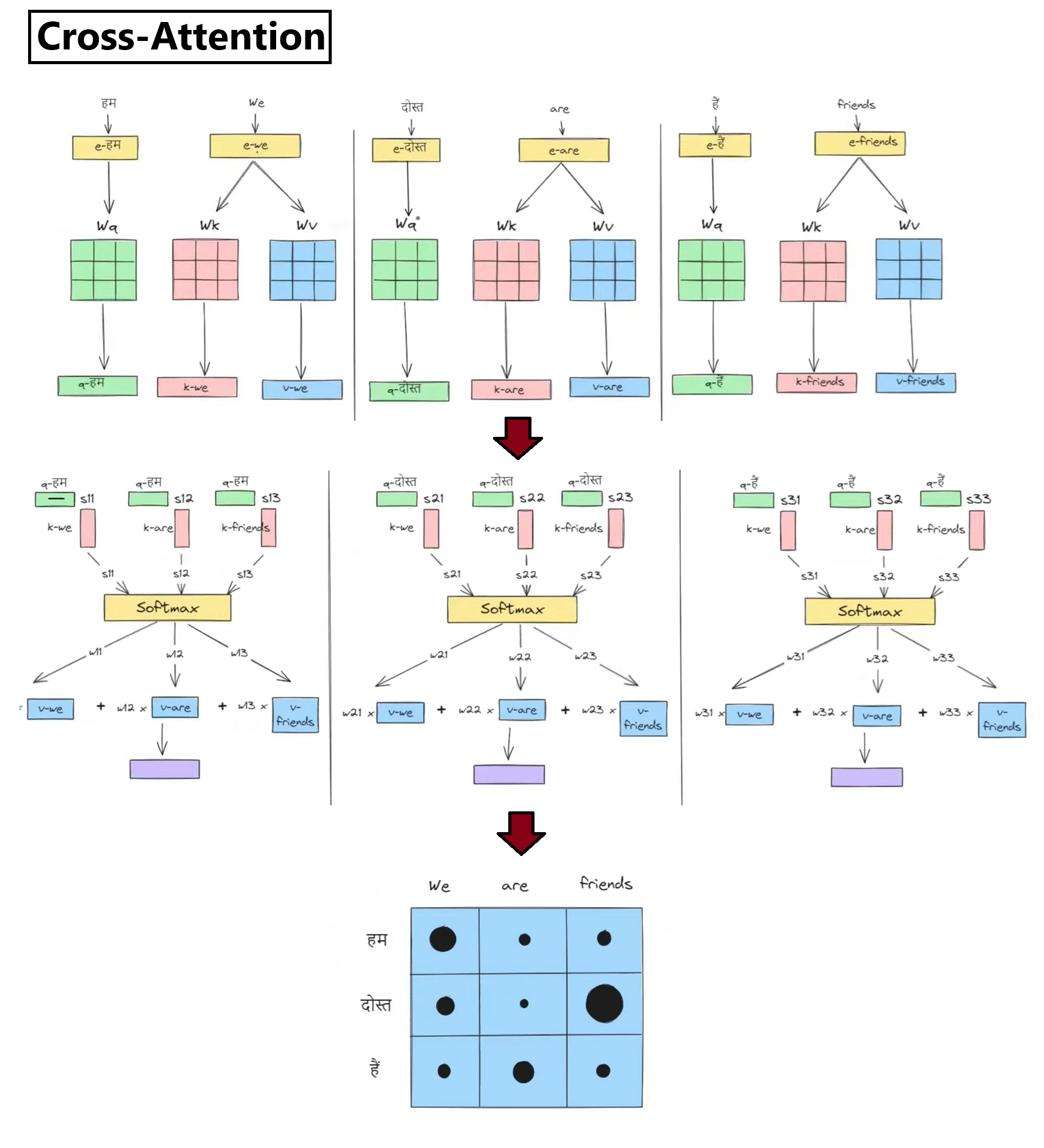
Cross-Attention Gated Projection: Alternatively, lightweight cross-attention layers bridge a frozen vision encoder with a frozen language model (e.g., Flamingo, BLIP-2), conditioning text generation on dense visual features.
02 - What is Self Attention?
⭐ Overview
🔴 The Core NLP Problem: How do we represent human language as numbers in a way that captures meaning?
🔴 Static vs. Dynamic: Static embeddings (Word2Vec, GloVe) assign a single fixed vector to each word, failing to capture context (e.g., "apple" the fruit vs. "Apple" the company).
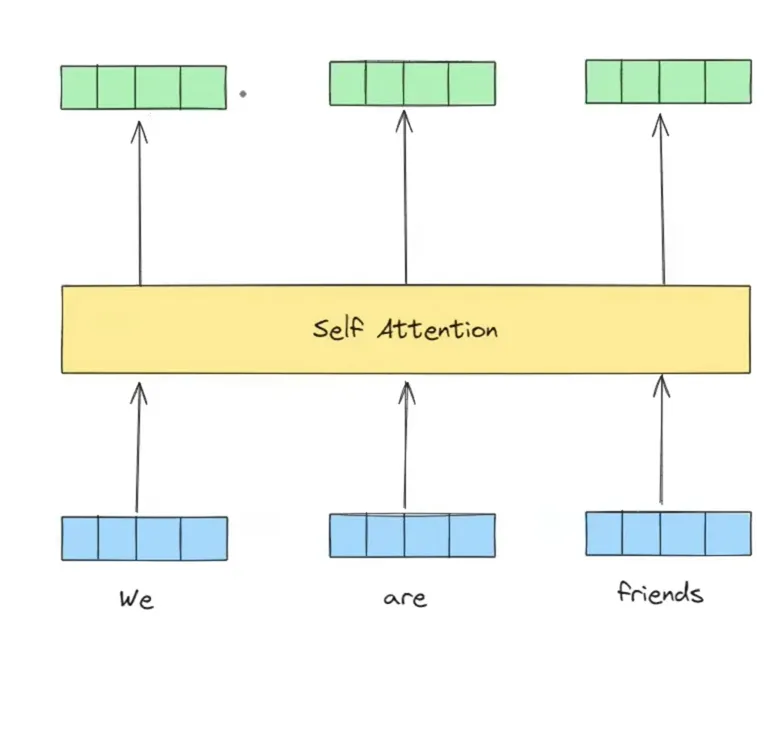
🔴 Self-Attention Breakthrough: Self-attention takes static embeddings and dynamically computes contextual embeddings based on neighboring tokens in the sequence.
1. The Fundamental NLP Problem
Numeric Translation: Computers process numbers, not raw text. NLP models require projecting words into a mathematical vector space (vectorization).
Contextual Ambiguity: Human language is highly contextual. A single word's meaning can change completely depending on the surrounding tokens (homonyms and polysemy).
2. Evolution of Word Vectorization Techniques
Before modern deep learning, three primary vectorization methods were used to represent text:
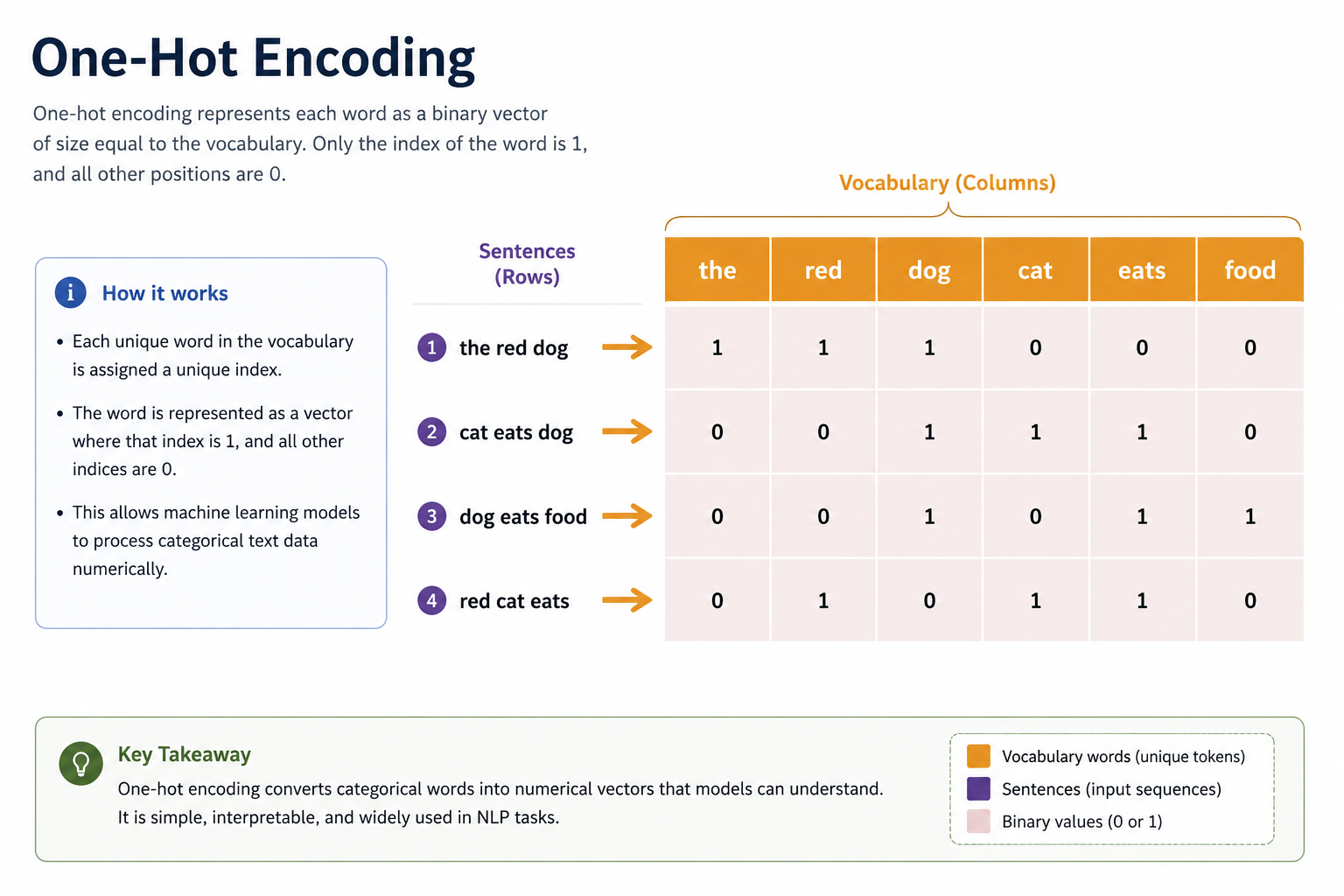
One-Hot Encoding
Mechanism: Maps each unique word to a sparse binary vector whose size equals the vocabulary size, containing a single 1 at the word's index.
Limitations: High-dimensional, extremely sparse (mostly zeros), and captures zero semantic similarity or relationships between words.
Bag of Words (BoW)
Mechanism: Counts occurrences of each word in a document or sentence.
Limitations: Discards word order, grammar rules, context, and semantic similarity.
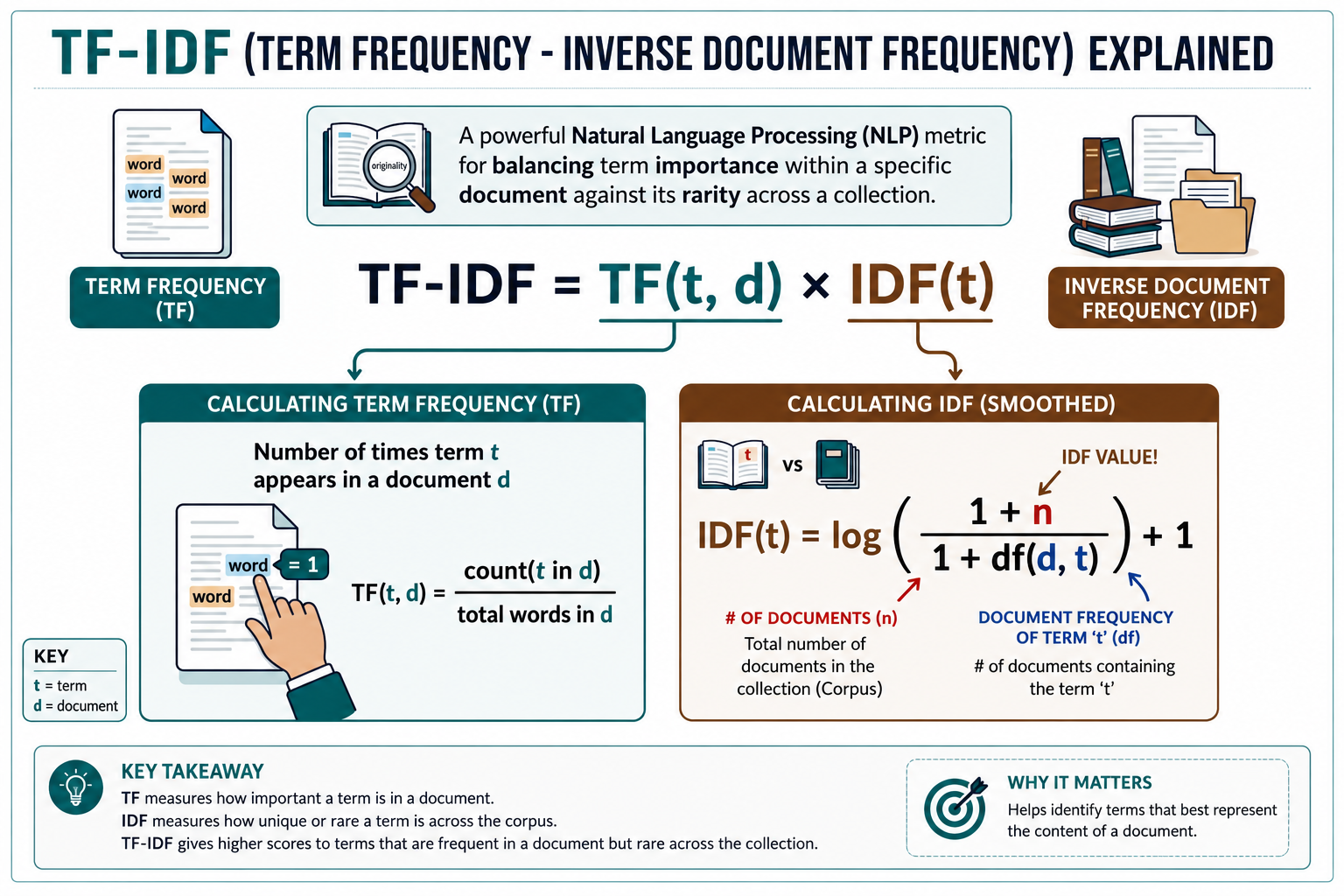
Mechanism: Weights words by multiplying term frequency (local occurrence) by inverse document frequency (global rarity).
Limitations: Excellent for search and retrieval, but still treats words as isolated entities without contextual understanding.
3. Static Word Embeddings & Their Limits
Dense Vectors: Static embeddings (e.g., Word2Vec, GloVe) map words to low-dimensional, continuous dense vectors (e.g., 300 dimensions).
Semantic Proximity: Words with similar meanings sit close together in geometric space (e.g., the vectors for king and queen are close).
The Static Constraint: A word always receives the same fixed vector representation, regardless of context. For example:
In "Apple launched a new phone" and "I ate a green apple", the vector for apple is identical, resulting in an "average" meaning that mixes technology and fruit.
4. Self-Attention: Dynamic Contextual Embeddings
Dynamic Mapping: Self-attention solves the static constraint by generating **contextual embeddings** on the fly.
Interaction: Takes static embeddings for the entire sentence simultaneously, computes mutual dependencies, and outputs contextually adjusted vectors.
Ambiguity Resolution: In "Apple launched a new phone", self-attention maps the connection between Apple, launched, and phone to dynamically boost "technology" features and dampen "fruit" features of the Apple vector.
5. Real-World Applications of Self-Attention
Large Language Models (LLMs): Powers models like ChatGPT, Claude, and Gemini to generate coherent, context-rich text.
Machine Translation: Translates fluidly by resolving syntactic dependencies and homonyms.
Text Summarization & Sentiment Analysis: Accurately extracts key concepts and detects emotional tone by analyzing text globally.
Code Generation: Maps programming syntax and descriptions to construct working scripts.
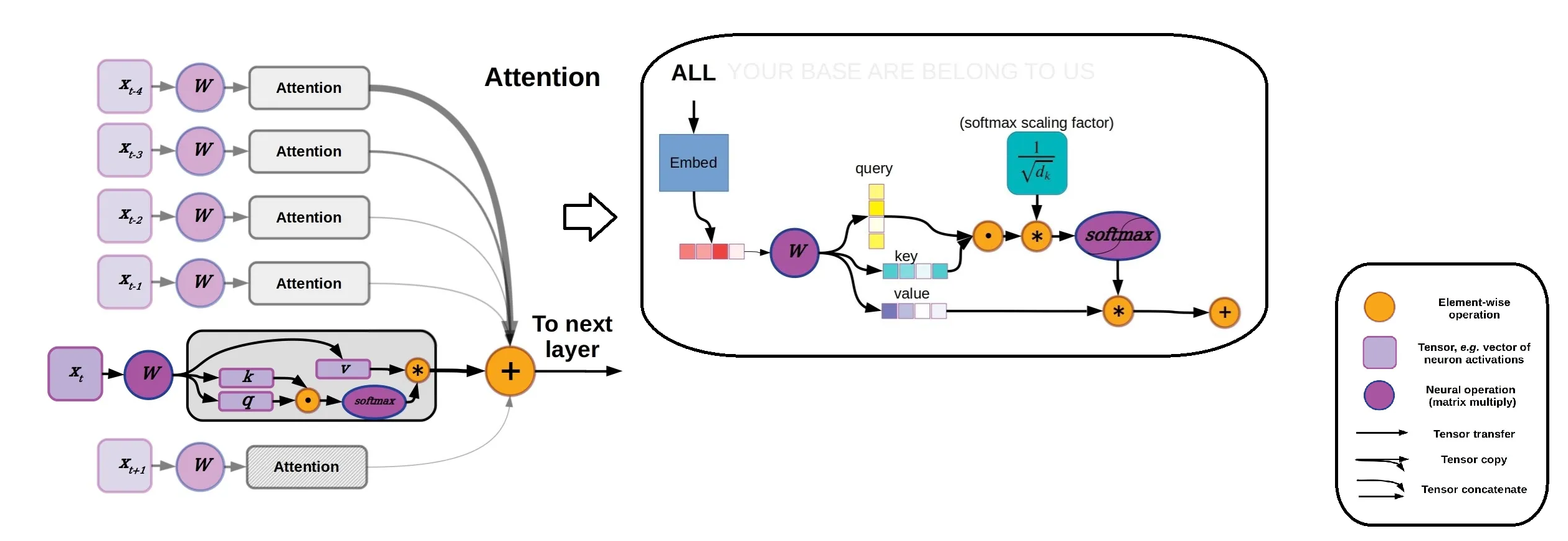
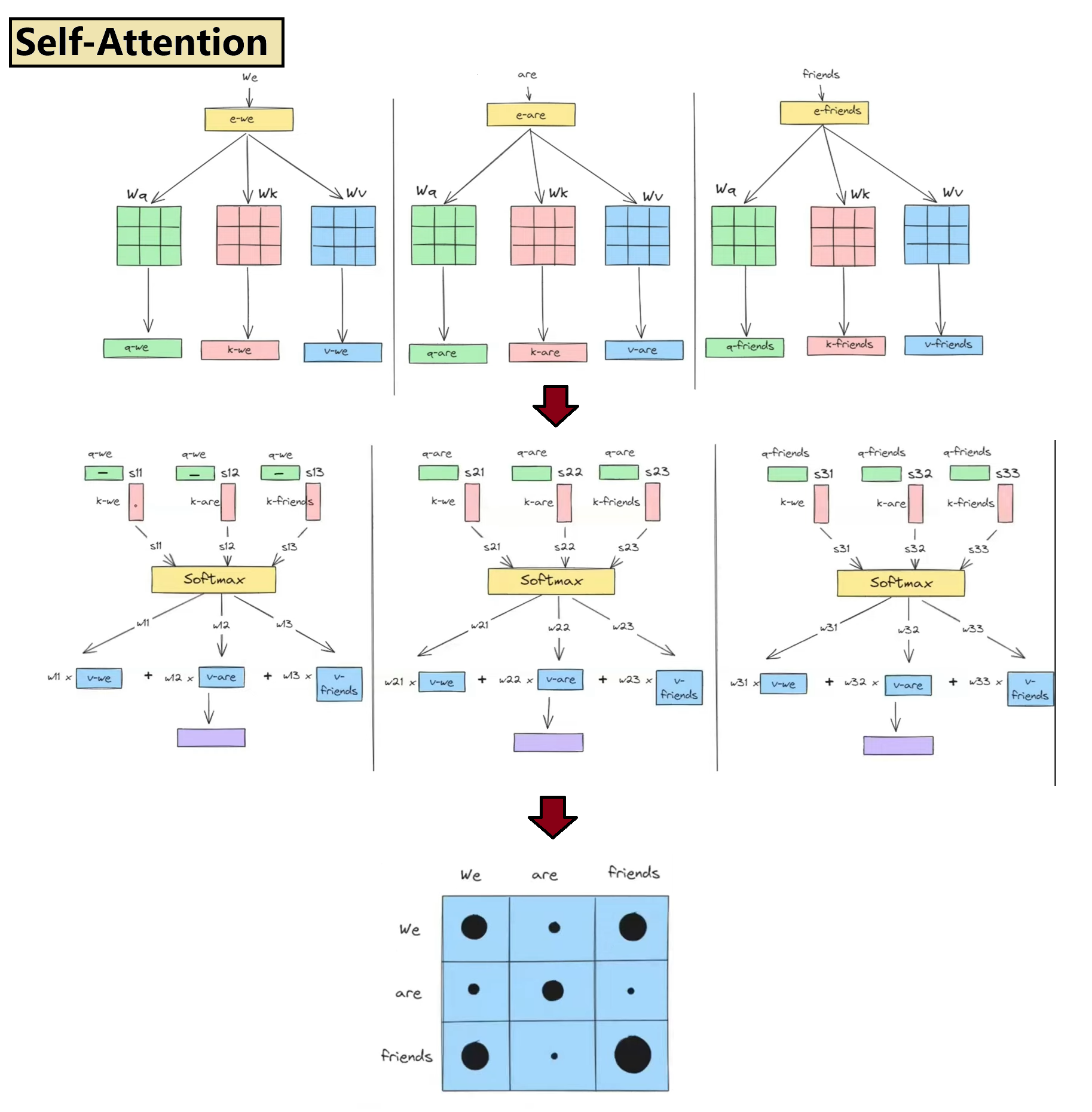
Performs calculations using query, key, and value vectors to adjust static embeddings based on neighboring words in a sentence.
Generates dynamic embeddings that understand specific word contexts and resolve ambiguity.
Requires complex mathematical calculations.
Yes
Dynamic contextual embeddings
Transformers, Large Language Models (LLMs), Generative AI, Machine Translation
Word Embeddings (Static)
Neural networks trained on large datasets to convert words into n-dimensional vectors based on semantic similarity.
Captures semantic meaning; similar words occupy similar positions in geometric space.
Represents an "average meaning"; cannot distinguish between different meanings of the same word based on context.
No
n-dimensional dense vectors (e.g., 64, 256, 512)
Sentiment analysis, Named Entity Recognition (NER), general NLP tasks
TF-IDF
Weights the importance of words by multiplying Term Frequency by Inverse Document Frequency.
Improves upon Bag of Words by considering word importance across an entire document corpus.
Does not capture semantic meaning or contextual nuances.
No
Sparse vectors (weighted)
Document classification, information retrieval
Bag of Words (BoW)
Counts the frequency of each unique word within a specific document or sentence.
Captures word frequency, offering an improvement over binary one-hot representation.
Lacks semantic understanding and context; remains a relatively simple representation.
No
Sparse vectors (counts)
Simple NLP applications, sentiment analysis
One-Hot Encoding
Assigns a unique vector where one index is 1 and all others are 0 based on the presence of a word in a fixed vocabulary.
Simple and original method for converting words to numerical representations.
Inefficient for large vocabularies; creates high-dimensional, sparse vectors.
No
Sparse vectors (binary)
Basic vectorization in early NLP tasks
7. Practice Questions & Concept Intuitions
Q1What is the fundamental NLP problem of word representations in varying contexts?
Discrete Symbols vs Continuous Semantics: Raw words are discrete categorical symbols without intrinsic mathematical proximity. Machine learning models require continuous vector representations where semantic similarity corresponds to geometric proximity.
Contextual Polysemy: Natural words change their semantic and syntactic meaning depending on surrounding words (e.g., "apple" fruit vs tech giant, "bank" river vs financial institution).
Representational Modality: A static lookup table assigns one fixed vector per word, whereas a truly effective representation must dynamically morph based on the surrounding sentence structure.
Q2Explain how One-Hot Encoding works and why it fails to capture semantic meaning.
Mechanics of One-Hot Vectors: Each word in vocabulary $V$ is represented as a sparse vector of dimension $|V|$, with a 1 at its vocabulary index and 0 elsewhere.
Orthogonality & Zero Semantic Proximity: Because every one-hot vector is an orthogonal basis vector, the dot product between any two distinct words is always zero: $\mathbf{u} \cdot \mathbf{v} = 0$. The representation fails to reflect that "cat" is closer to "dog" than to "submarine".
Memory Inefficiency: As vocabulary grows to tens or hundreds of thousands of words, vector dimensionality explodes ($|V| \ge 50,000$), wasting memory on extremely sparse vectors.
Q3What is the Bag-of-Words (BoW) model, and what are its primary limitations?
Frequency Multiset Formulation: BoW represents a text as a vector of word counts or frequencies, discarding all word order, syntax, and sentence grammar.
Loss of Sequence & Order: Completely fails to distinguish sentences with opposite meanings that share words, such as "dog bites man" vs "man bites dog".
Sparsity and Frequency Bias: High-frequency words (e.g., "the", "is") dominate the feature space without providing discriminative topical or semantic signal.
Q4How does TF-IDF improve upon Bag-of-Words representation?
Mathematical Formulation: Weighs terms by Term Frequency times Inverse Document Frequency: $\text{TF-IDF}(t, d, D) = \text{TF}(t, d) \times \log\left(\frac{|D|}{1 + |\{d \in D : t \in d\}|}\right)$.
Stop-Word Suppression: Scales down common words that appear in almost all documents (low IDF) while scaling up domain-specific keywords that characterize a document (high IDF).
Remaining Shortcomings: Despite reweighting, TF-IDF remains sparse, high-dimensional, completely order-blind, and incapable of capturing synonymy or polysemy.
Q5What are static word embeddings (e.g., Word2Vec, GloVe), and what is their major limitation?
Dense Distributed Semantic Space: Word2Vec (Skip-gram, CBOW) and GloVe map words to low-dimensional continuous vectors ($d \in [100, 300]$) where vector geometry captures analogies (e.g., $\vec{v}_{\text{King}} - \vec{v}_{\text{Man}} + \vec{v}_{\text{Woman}} \approx \vec{v}_{\text{Queen}}$).
Single Vector Per Token: Every word possesses exactly one fixed vector in a static lookup matrix $E \in \mathbb{R}^{|V| \times d}$.
Polysemy Conflation: Because the vector is fixed regardless of sentence context, the word "apple" has the identical vector in "eating an apple" and "investing in Apple stock", conflating distinct concepts into an averaged point.
Q6How does self-attention generate dynamic, context-dependent word representations?
Pairwise Dynamic Affinity: Self-attention computes attention weights $\alpha_{ij}$ between every token $i$ and token $j$ based on their content Query-Key compatibility.
Convex Value Combination: The contextual representation is calculated as a weighted sum of Value vectors: $\mathbf{y}_i = \sum_{j=1}^{N} \alpha_{ij} \mathbf{v}_j$.
Continuous Semantic Migration: The base embedding of token $i$ is blended with the feature vectors of its surrounding modifiers and subjects, creating a unique context-tailored vector at each layer.
Q7What does "permutation invariance" mean in the context of self-attention?
Order-Insensitive Operation: Standard self-attention evaluates pairs of vectors based solely on their content dot products: $\mathbf{q}_i \cdot \mathbf{k}_j$. The calculation contains no dependency on the indices $i$ or $j$.
Equivariance Under Permutation: Permuting the input sequence permutes the output sequence by the exact same permutation: $\text{Attention}(P X) = P \text{Attention}(X)$.
Necessity of Positional Encodings: Without explicit positional signals (sinusoidal or learned), self-attention treats sequences as unordered bags of vectors, unable to distinguish sentence word orders.
Q8Give a concrete example of how self-attention resolves polysemy (e.g., "bank").
Query Projection of "bank": In the sentence "The river bank was muddy", the token "bank" generates a Query vector $\mathbf{q}_{\text{bank}}$.
Alignment with Context Keys: $\mathbf{q}_{\text{bank}}$ forms strong dot products with $\mathbf{k}_{\text{river}}$ and $\mathbf{k}_{\text{muddy}}$ because their learned subspaces reflect natural geographic co-occurrence.
Hydrological Value Aggregation: As a result, $\alpha_{\text{bank}, \text{river}}$ and $\alpha_{\text{bank}, \text{muddy}}$ are high, pulling features from $\mathbf{v}_{\text{river}}$ into the final vector of "bank", moving its vector far away from financial concepts.
Q9How does self-attention differ from sequential context processing in LSTMs?
Direct Global Pathways ($O(1)$ vs $O(N)$): Self-attention compares any two tokens across the entire window in a single dot-product step, whereas an LSTM must propagate information sequentially through hidden states step-by-step.
Selective Content-Addressable Routing: Self-attention can assign near-zero weight to intervening filler words while focusing exclusively on a distant subject and verb, whereas LSTMs must continuously manage forget/input gates at every single intermediate token.
Bidirectional Visibility: In encoder self-attention, all past and future tokens are visible simultaneously, whereas standard unidirectional LSTMs only see preceding context.
Q10What is the semantic relationship captured by the dot product of two word vectors?
Geometric Formulation: The dot product is defined as $\mathbf{u} \cdot \mathbf{v} = \|\mathbf{u}\| \|\mathbf{v}\| \cos(\theta)$, where $\theta$ is the angle between the two vectors in high-dimensional space.
Directional & Magnitude Alignment: If two vectors point in similar directions (small $\theta$, $\cos\theta \approx 1$), their dot product is large and positive, indicating high semantic compatibility.
Orthogonality & Negative Values: Orthogonal vectors ($\theta = 90^\circ$) have a dot product of 0, signifying semantic independence; vectors pointing in opposite directions produce negative dot products.
Q11How does self-attention compute the relevance of a token to all other tokens in a sequence?
Linear Subspace Projections: The sequence matrix $X$ is multiplied by projection matrices to generate Queries ($Q = X W^Q$) and Keys ($K = X W^K$).
Compatibility Matrix: The inner product matrix $S = Q K^T / \sqrt{d_k}$ evaluates all pairwise affinities simultaneously across all $N \times N$ token combinations.
Row-wise Softmax Normalization: Applying $\text{softmax}$ across each row converts raw affinity scores into a probability distribution where $\sum_{j=1}^N \alpha_{ij} = 1$, expressing the exact percentage of attention token $i$ pays to token $j$.
Q12Why is self-attention considered a "bag-of-words" model when positional signals are absent?
Absence of Spatial Geometry: Content similarity $\mathbf{q}_i \cdot \mathbf{k}_j$ depends entirely on vector values, not their index distance $|i - j|$ in the sentence array.
Permutation Equivariance: Shuffling words randomly yields an identical set of attention weights mapped to the newly shuffled positions, with no penalty for distance.
Role of Positional Encoding: Adding unique position vectors to word embeddings breaks this symmetry, giving the model positional awareness (relative and absolute).
Q13What are the real-world applications where contextual embeddings are highly critical?
Coreference Resolution: Determining which antecedent entity a pronoun refers to (e.g., in "The trophy didn't fit in the suitcase because it was too big", "it" refers to the trophy).
Named Entity Recognition (NER): Disambiguating whether "Washington" refers to a person (George Washington), a geographic state, or a government entity depending on syntax.
Semantic Search and Cross-Lingual Alignment: Matching user query intent with document concepts rather than brittle literal keyword matches.
Q14How does the similarity scoring mechanism in self-attention enable global context modeling?
Global Attention Graph: Because every token interacts with every other token, self-attention constructs a fully connected directed graph over the sequence in every layer.
No Receptive Field Constraints: Unlike Convolutional Neural Networks (which require stacking many layers to expand their receptive field), self-attention covers the entire sequence in layer 1.
Multi-Scale Feature Capture: Attention weights can simultaneously capture tight grammatical dependencies (adjective-noun agreement) and long-range topical themes (document topic alignment).
Q15How do word vectors "migrate" or change positions in the vector space after self-attention is applied?
Initial Vector State: Words enter layer 1 as context-free static embeddings (plus positional encoding) placed in their base dictionary clusters.
Contextual Shift via Attention & FFN: Self-attention computes $\mathbf{y}_i = \sum_j \alpha_{ij} \mathbf{v}_j$, which is added via residual connection: $\mathbf{x}_i^{(l+1)} = \mathbf{x}_i^{(l)} + \mathbf{y}_i$.
Hyperspace Displacement: This vector addition physically shifts the token's coordinate toward the centroid of its contextual cluster, dynamically specializing its meaning layer by layer.
03 - Self Attention in Transformers
⭐ Overview
🔴 Dynamic Transformation: Self-attention generates context-aware vectors on the fly, allowing each token's representation to evolve based on its neighbors.
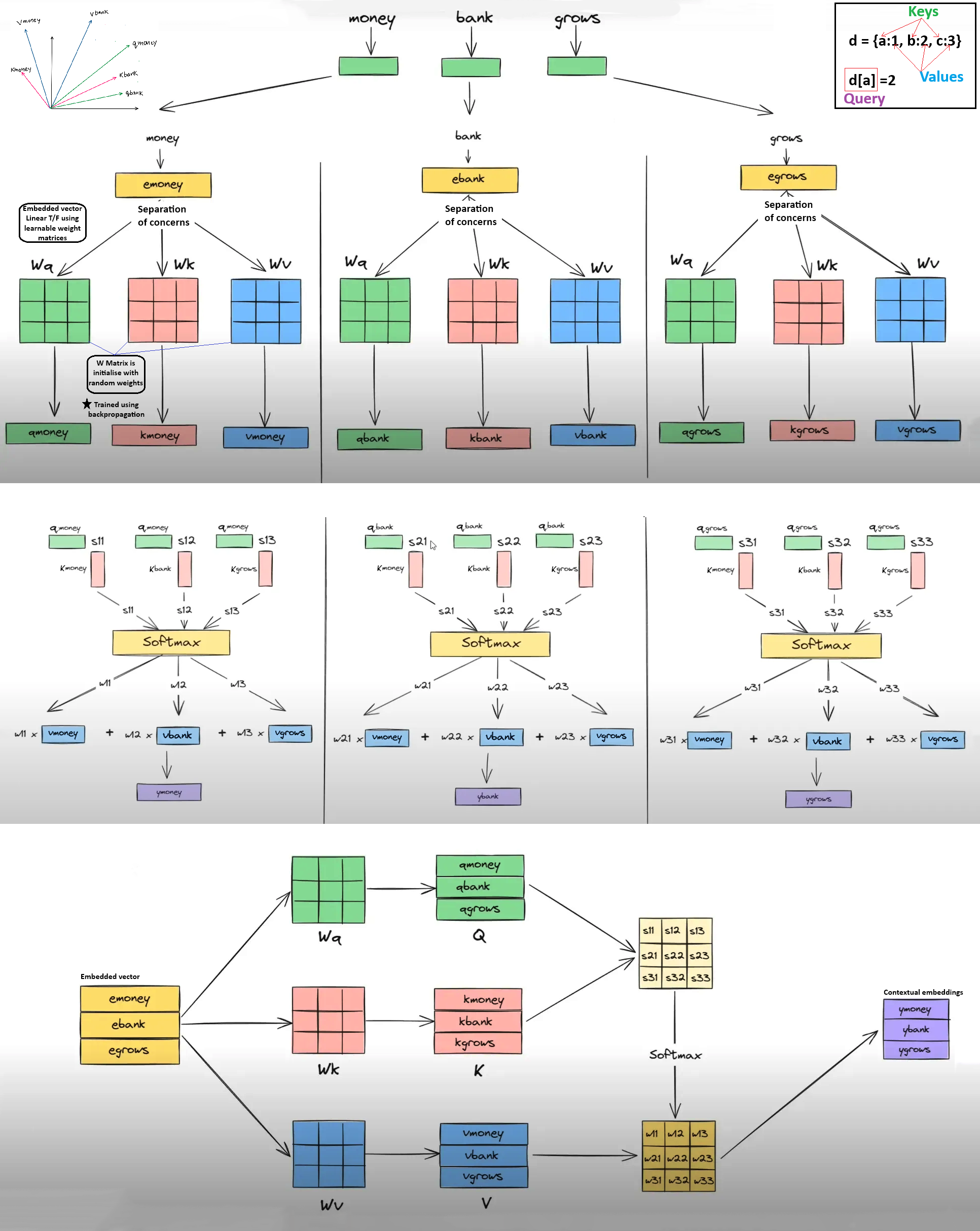
🔴 Separation of Concerns: By projecting the input embedding into Queries, Keys, and Values (Q, K, V), the network isolates the search criteria, the matching profile, and the actual content.
🔴 Task Adaptability: Learnable parameter matrices (\(W_Q, W_K, W_V\)) are refined during backpropagation, enabling the attention mechanism to specialize for specific downstream NLP tasks.
1. How Self-Attention Transforms Embeddings
Context-Aware Refinement: Unlike static word vectors, self-attention allows words to interact dynamically. For example, if "bank" is near "river", it pulls semantic context from the water-related dimension.
Global Affinity: Computes pairwise similarity scores between all tokens in a sentence using dot products, evaluating how strongly every word relates to every other word.
Normalized Weights: Raw similarity scores are passed through a Softmax function to convert them into positive attention weights that sum to 1.0.
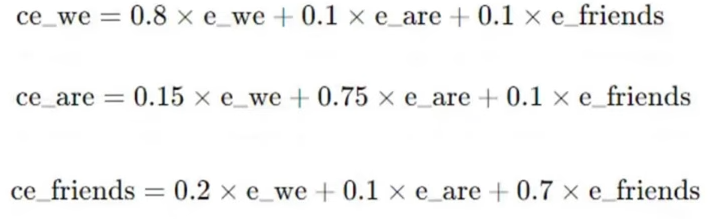
Weighted Aggregation: The final contextual embedding is a weighted sum of the sequence's word vectors.
2. The Roles of Queries, Keys, and Values
To enable flexible and learnable context-extraction, each input token projects its embedding into three distinct vectors:
Query (Q) — The "Searcher": Represents the word's current search criteria. It "asks questions" of other words in the sentence to determine what context is relevant.
Key (K) — The "Responder": Acts as a descriptive profile or label for the word, matching against incoming Queries to evaluate relevance.
Value (V) — The "Information Provider": Contains the raw semantic information of the word. Once Q and K determine the relevance weights, the Values are scaled and summed.
Component Name
Description
Mathematical Representation
Role in Mechanism
Analogy Example
Learnable Parameters
Query (Q)
A transformed vector representing the word's search criteria or 'questions' it asks of other words.
qi = ei · WQ
Used to calculate similarity scores by performing dot products with key vectors of all words in the sequence.
The 'Search' criteria on a matrimonial site (e.g., looking for a partner with specific traits).
Yes (Weight matrix WQ)
Key (K)
A transformed vector representing the word's profile or characteristics against which queries are matched.
ki = ei · WK
Acts as a reference for queries to determine how much attention should be paid to this specific word.
The 'Profile' on a matrimonial site that other users see when they are searching.
Yes (Weight matrix WK)
Value (V)
A transformed vector containing the actual information of the word that will be aggregated into the final output.
vi = ei · WV
Represents the 'content' of the word; it is weighted by attention scores to form the contextual embedding.
The 'Match' or actual interaction/personality shared once a connection is established.
Yes (Weight matrix WV)
Contextual Embedding (Output)
The final dynamic representation of a word that incorporates information from its surroundings.
yi = Σj (wij · vj)
Provides a task-specific, context-aware vector that resolves ambiguities (e.g., distinguishing 'river bank' from 'money bank').
The refined understanding of a person after matching and filtering information through specific preferences.
No (Result of learned weights WQ, WK, WV)
Static Embedding (Input)
The initial numerical representation of a word that captures semantic meaning but lacks context.
Vector ei
Acts as the starting point for the transformation; the raw material from which Q, K, and V vectors are derived.
A person's raw information or life story as detailed in their autobiography.
Yes (Weights in embedding layer)
Dot Product (Similarity)
A mathematical operation used to quantify the relationship between a query and a key.
sij = qi · kj
Determines the raw attention score or affinity between words in a sequence.
Checking compatibility between a search query and a person's profile on the website.
No (Fixed mathematical operation)
Softmax
An activation function that normalizes raw similarity scores into probabilities that sum to 1.
wij = exp(sij) / Σk exp(sik)
Ensures the attention weights are positive and normalized, defining the percentage of influence each word has.
Allocating a finite amount of interest/attention across different potential profiles.
No (Fixed mathematical operation)
3. Learnable Projections & The Linear Formulas
Linear Projections: Multiplying raw static embeddings by weight matrices yields task-specific Query, Key, and Value representations.
Weight Matrices: The projection parameters (\(W_Q, W_K, W_V\)) are learned dynamically through training, allowing the model to adapt Q, K, and V distributions to the specifics of translation, classification, or generation tasks.
Q=WQ⋅X,K=WK⋅X,V=WV⋅X
4. Practice Questions & Concept Intuitions
Q1How does self-attention project input embeddings into Query, Key, and Value vectors?
Linear Transformations: Given input token embedding matrix $X \in \mathbb{R}^{N \times d_{\text{model}}}$, self-attention computes three separate linear projections using learned weight matrices: $W^Q, W^K \in \mathbb{R}^{d_{\text{model}} \times d_k}$ and $W^V \in \mathbb{R}^{d_{\text{model}} \times d_v}$.
Projection Equations: $Q = X W^Q$, $K = X W^K$, and $V = X W^V$, where each row of $Q, K, V$ represents the query, key, and value vector of a specific token.
Functional Specialization: These distinct projections allow a single token to assume different roles: formulating questions ($Q$), indexing capabilities ($K$), and broadcasting content ($V$).
Q2What is the conceptual analogy of Query, Key, and Value in a database retrieval system?
Database Analogy: In a database or search engine, you submit a Query (e.g., search text), which is matched against Keys (document titles or index tags), returning the corresponding Values (document content).
Soft Differentiable Lookup: Classical databases perform hard lookups (matching one exact key). Self-attention performs a soft, continuous lookup: the Query matches against all Keys probabilistically via dot products, returning a weighted sum of all Values.
End-to-End Trainability: Because the matching and value retrieval are continuous and differentiable, the system can learn optimal querying strategies via standard backpropagation.
Q3Why do we need learnable weight matrices (\(W_Q, W_K, W_V\)) in the attention mechanism?
Decoupling Diverse Roles: Without projection matrices, self-attention would compute $X X^T$, forcing the similarity between two tokens to be strictly symmetric ($\mathbf{x}_i \cdot \mathbf{x}_j = \mathbf{x}_j \cdot \mathbf{x}_i$).
Asymmetric Relationships: Grammatical relationships are inherently asymmetric (a verb governs a noun object, but the object does not govern the verb). Learnable $W^Q$ and $W^K$ enable asymmetric directed routing ($\mathbf{q}_i \cdot \mathbf{k}_j \ne \mathbf{q}_j \cdot \mathbf{k}_i$).
Separating Content from Routing: $W^V$ transforms the raw lexical embedding into a message payload tailored for downstream task representation, separated from the routing logic.
Q4What is the mathematical formula for computing self-attention?
Standard Matrix Formulation: $\text{Attention}(Q, K, V) = \text{softmax}\left(\frac{Q K^T}{\sqrt{d_k}}\right) V$.
Component Dimensions: $Q, K \in \mathbb{R}^{N \times d_k}$, $V \in \mathbb{R}^{N \times d_v}$. The product $Q K^T \in \mathbb{R}^{N \times N}$ produces an $N \times N$ affinity matrix.
Output Dimension: Multiplying the normalized attention weights ($N \times N$) by $V$ ($N \times d_v$) produces an output matrix of size $N \times d_v$ containing contextualized vectors for all $N$ tokens.
Q5Explain step-by-step how the raw attention scores are computed.
Step 1 (Pairwise Dot Products): Compute matrix multiplication $S = Q K^T$. Entry $S_{ij} = \mathbf{q}_i \cdot \mathbf{k}_j$ measures the unnormalized affinity between token $i$'s query and token $j$'s key.
Step 2 (Scaling): Divide every element by $\sqrt{d_k}$ to prevent variance explosion and keep softmax inputs in a numerically stable range: $S_{\text{scaled}} = S / \sqrt{d_k}$.
Step 3 (Optional Masking): For causal autoregressive decoding or padding exclusion, set disallowed positions to $-\infty$.
Step 5 (Value Aggregation): Compute weighted sum of values $\mathbf{o}_i = \sum_{j=1}^N \alpha_{ij} \mathbf{v}_j$.
Q6What is the role of the Softmax function in self-attention?
Probability Distribution Transformation: Exponentiates raw logits and normalizes across rows, guaranteeing that all attention weights are non-negative ($\alpha_{ij} \ge 0$) and sum to unity ($\sum_j \alpha_{ij} = 1$).
Convex Value Combination: Ensures the contextualized output vector $\mathbf{o}_i$ lies strictly inside the convex hull of the input Value vectors.
Non-Linear Dynamic Gating: Softmax acts as a soft argmax, allowing the model to focus strongly on one or two dominant tokens while softly maintaining background awareness of others.
Q7How does Softmax normalization handle negative similarity scores?
Natural Exponential Mapping: Softmax applies the exponential function $\exp(z)$ to each score. Because $\exp(z) > 0$ for all real numbers $z \in (-\infty, +\infty)$, negative dot products are mapped smoothly to small positive values.
Relative Differentiation: If score $z_1 = -5$ and $z_2 = -1$, $\exp(-1) \approx 0.368$ while $\exp(-5) \approx 0.0067$, cleanly differentiating negative affinities without producing negative probabilities.
Numerical Stability: Subtracting the maximum row value prior to exponentiation ($\exp(z_i - \max(\mathbf{z}))$) prevents floating-point overflow while preserving exact probability ratios.
Q8What is the physical interpretation of the Value vector weighting process?
Information Aggregation: While $Q$ and $K$ serve as the control plane (computing who talks to whom), $V$ is the data payload (what is actually communicated).
Feature Blending: The output for token $i$ is an interpolated blend of the feature vectors of all tokens in the sequence, weighted by their semantic relevance.
Selective Propagation: Irrelevant tokens receive near-zero attention weights, filtering out noise and focusing representational capacity on syntactically and semantically related concepts.
Q9How do Query, Key, and Value projections allow a single token to serve different roles?
Role Triality: Consider the word "bank" in a sentence. Its Query $\mathbf{q}_{\text{bank}}$ asks: "What kind of bank am I? Who modifies me?".
Key Role: Its Key $\mathbf{k}_{\text{bank}}$ announces: "I am a noun, direct object at position 4". Other tokens (like a governing verb "deposit") match against this key.
Value Role: Its Value $\mathbf{v}_{\text{bank}}$ carries the semantic payload: financial concepts, banking features, and entity tags to pass up to higher layers.
Q10Why would a token have a high similarity score with itself in self-attention?
Identity & Feature Retention: In self-attention, the diagonal entry $S_{ii} = \mathbf{q}_i \cdot \mathbf{k}_i$ allows a token to preserve its own lexical identity while incorporating surrounding context.
Contextual Anchoring: If a token only attended to external tokens, it would dilute its base meaning. Attending to itself maintains a stable semantic anchor across layer transformations.
Complementary Skip Connections: Residual connections further ensure that a token's identity is never completely overwritten by attention aggregation.
Q11How does self-attention enable the model to establish syntactic dependencies (e.g., matching verbs to nouns)?
Subspace Alignment via Backpropagation: Training on billions of tokens tunes $W^Q$ and $W^K$ so that queries from singular verbs align with keys from singular subjects across intervening prepositional phrases.
Direct Long-Distance Linkage: Because attention evaluates all token pairs directly in $O(1)$ operations, a subject at position 1 and a verb at position 40 can form a sharp attention peak without suffering decay.
Specialized Multi-Head Projections: Individual attention heads often specialize into specific grammatical detectors (e.g., direct object detector head, coreference head).
Q12What would happen if we set \(W_Q, W_K, W_V\) to identity matrices?
Symmetric Attention Matrix: $Q K^T$ would become $X X^T$, making the attention matrix strictly symmetric ($S_{ij} = S_{ji}$). Token $i$ would be forced to attend to token $j$ with the exact same weight that $j$ attends to $i$.
Loss of Asymmetric Syntax: Directional language rules (e.g., an adjective modifying a noun, a preposition governing an object) would become impossible to model.
Representational Stagnation: Values would equal raw inputs ($V = X$), preventing the model from transforming and extracting abstract features across layers.
Q13How does self-attention scale computationally with the sequence length?
Quadratic Compute ($O(N^2)$): Computing the pairwise dot products $Q K^T$ requires $N \times N$ dot products of length $d_k$, scaling quadratically with sequence length $N$.
Quadratic Memory Footprint: Storing the $N \times N$ attention probability matrix during training forward passes (to compute gradients during backward passes) demands $O(N^2)$ GPU VRAM.
Hardware Tiling (FlashAttention): Modern optimizations tile the computation in SRAM to avoid materializing the full $N \times N$ matrix in high-bandwidth memory (HBM), reducing memory overhead to linear while compute remains quadratic.
Q14How does the projection dimension (\(d_k\)) affect the representational capacity of Q, K, and V?
Subspace Expressiveness: A higher $d_k$ allows projection vectors to capture finer-grained semantic distinctions and higher rank interactions between tokens.
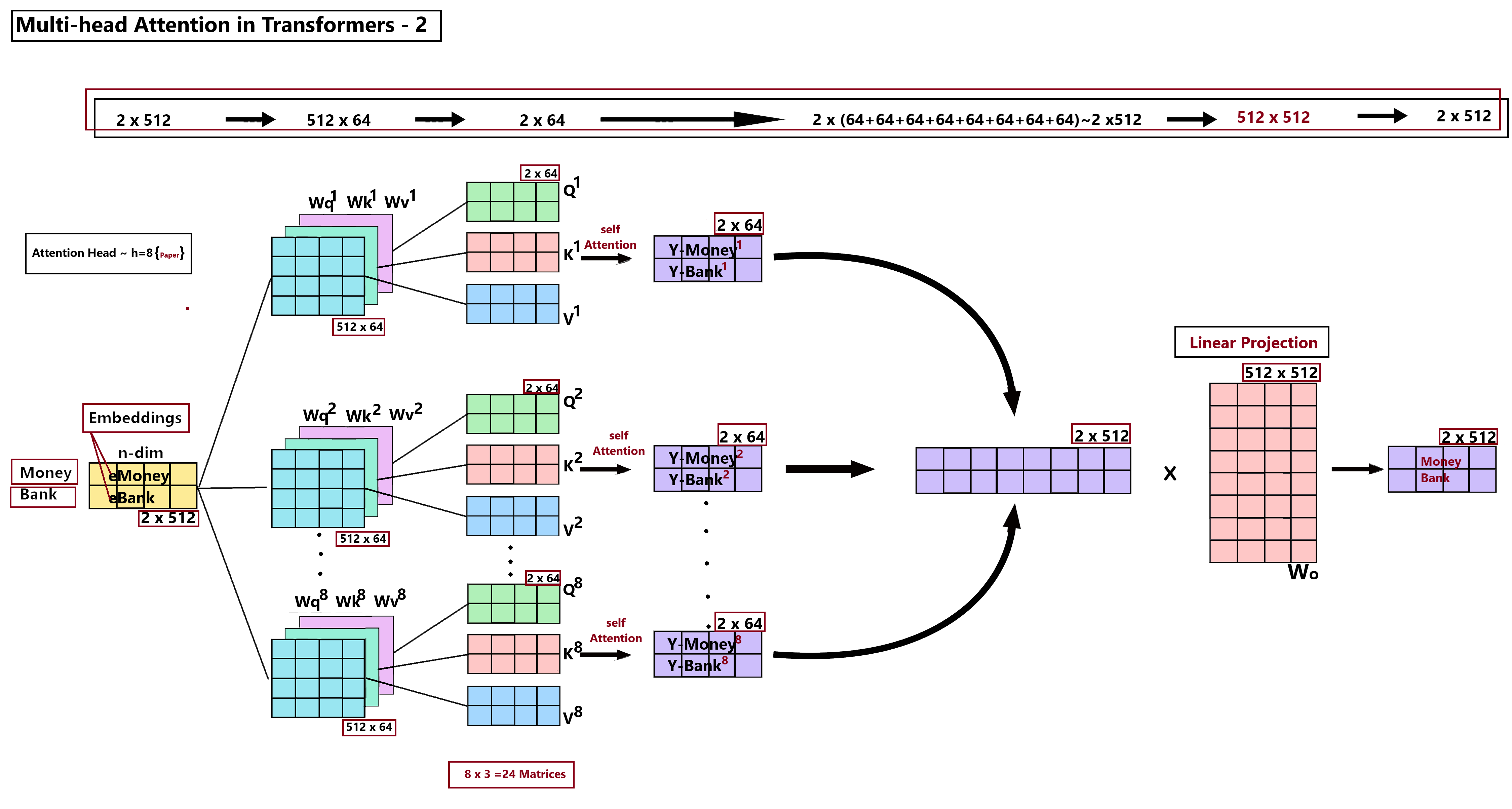
Multi-Head Decomposition: In practice, Transformers split $d_{\text{model}}$ across $h$ heads such that $d_k = d_{\text{model}} / h$ (e.g., $512 / 8 = 64$), striking an optimal balance between capacity and parallel diversity.
Variance Scaling Interplay: As $d_k$ increases, dot product variance scales linearly ($d_k$), making the scaling factor $1/\sqrt{d_k}$ critical to prevent softmax gradient vanishing.
Q15How do Queries, Keys, and Values interact to dynamically route information?
Control Plane vs Data Plane: Queries ($Q$) and Keys ($K$) act as the control plane, dynamically computing a soft routing topology $\alpha_{ij}$ tailored specifically to the current sequence.
Information Transport: Values ($V$) act as the data plane, transporting transformed semantic representations along the newly established attention routes.
Input-Conditioned Weights: Unlike fixed-weight convolutions or linear layers, self-attention's effective weights are dynamic functions of the input tokens themselves, enabling adaptable context-dependent computation.
04 - Scaled Dot Product Attention
⭐ Overview
Scaled Dot-Product Attention is the core computational kernel of the Transformer architecture. It computes relationships between Queries and Keys, normalizes the scores, and aggregates Values. Crucially, it scales the dot products to maintain numerical stability during training.
💡
Problem:
High
variance is a problem because as the dimensionality
(dk) of the vectors increases, the variance of
the dot product also increases.This
causes the softmax function to assign very high probabilities to
large values and very low probabilities to small values. During
training, when updating the weight matrices (WQ,
WK, WV) using backpropagation, the
gradients are calculated to adjust the parameters. However,
backpropagation focuses more on larger values, assigning them
higher importance while ignoring smaller values. As a result,
some corresponding parameters experience vanishing gradients,
meaning their gradient values become extremely small. If these
gradients become too small, the parameters will not be updated
effectively, preventing proper learning. This leads to a poor
training process and an unstable self-attention mechanism.
Fix:
Scale the dot product
by dividing with √dk (dimension of key
vectors) to stabilize variance, ensuring balanced softmax
probabilities and gradients, preventing vanishing gradients.
1. The Scaling Factor in Self-Attention
Variance Control: The scaling factor \(1 / \sqrt{d_k}\) stabilizes the variance of the dot product results, preventing them from growing uncontrollably as the dimension \(d_k\) scales up.
Balanced Softmax: By curbing score magnitudes, the scaling factor keeps the Softmax operation from concentrating weight entirely on a single token, which would crush other values.
Gradient Stability: Helps prevent vanishing gradients, ensuring all parameters receive meaningful updates during backpropagation.
Attention(Q,K,V)=softmax(dkQ.KT)V
Here is a breakdown of why and how scaling is used:
Preventing Softmax Saturated Regions: As the key dimensionality \(d_k\) grows, the dot products grow in magnitude, producing high-variance distributions. Without scaling, Softmax outputs map to extreme probabilities (1.0 or 0.0), saturating the activation function.
Mitigating Vanishing Gradients: Saturated Softmax regions have near-zero local derivatives. Normalizing scores ensures that gradients flow back smoothly to Query, Key, and Value projection weights.
Variance Normalization: Dividing by \(\sqrt{d_k}\) scales the variance of the dot product back to exactly 1.0, keeping the distribution stable.
2. How Vector Dimensionality Affects Attention
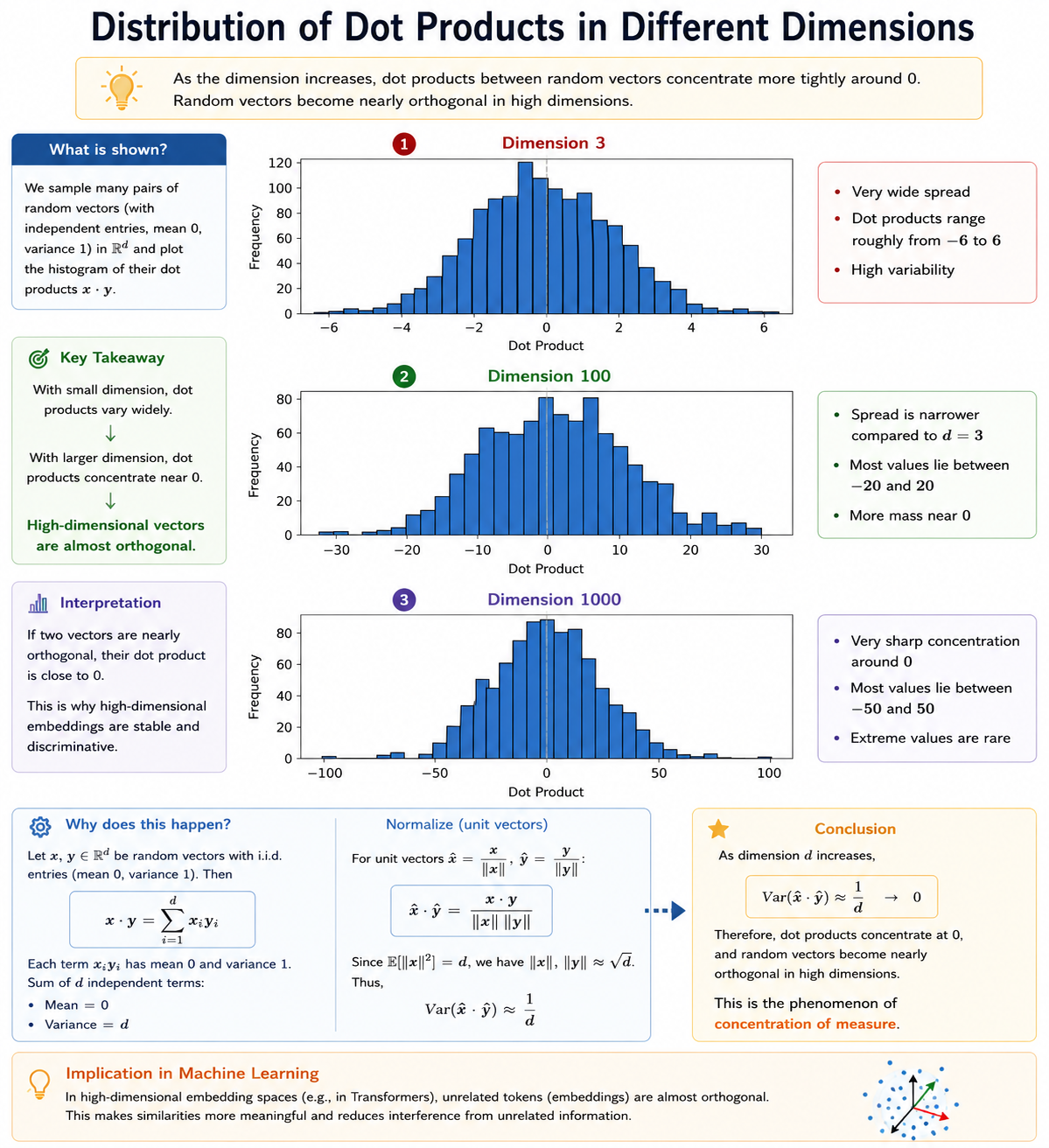
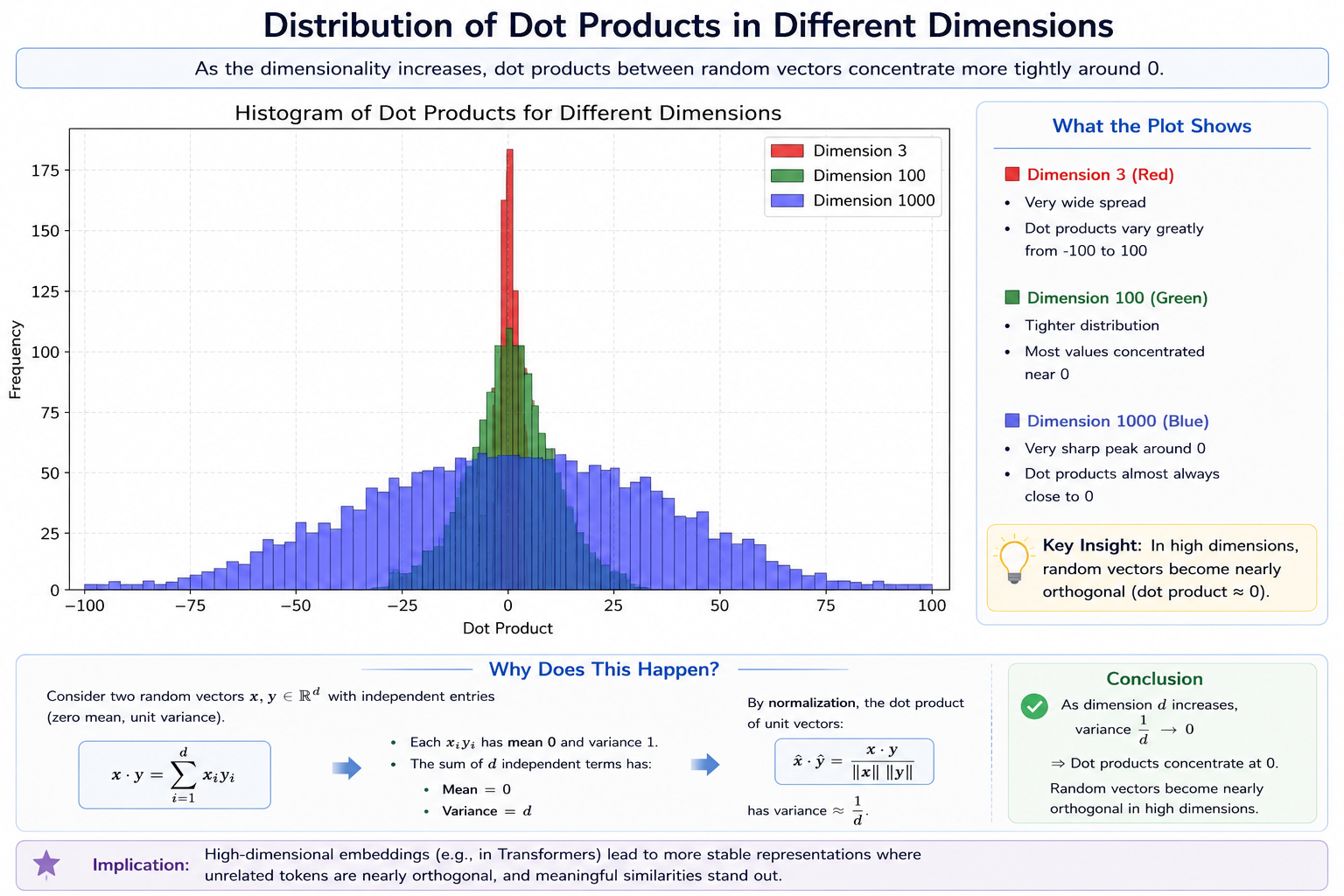
The vector dimension \(d_k\) directly scales the range of raw dot products. Higher dimensions increase representation capacity but introduce statistical variance:
Low Dimension (e.g., \(d_k = 3\)): Dot products stay close to 0 with low variance, allowing Softmax to distribute attention weights evenly.
Medium Dimension (e.g., \(d_k = 100\)): The variance expands slightly, but Softmax remains active across multiple tokens.
High Dimension (e.g., \(d_k = 1000\)): Without scaling, dot products exhibit high variance. Extreme values dominate, leading to training instabilities.
3. High Dimensionality and Training Instability
The technical concept comparison table below details the interactions between dimensionality, variance, and the Softmax function:
Concept
Symbol
Definition
Role in Self-Attention
Mathematical Impact
Scaling
Factor
1 / √dk
The
factor used to divide the dot product scores
before applying the softmax function.
Stabilizes the variance of
the attention scores regardless of
dimensionality.
By dividing by
√dk, the variance
is brought back to a constant level, preventing
extreme softmax values and the vanishing
gradient problem.
Vector
Dimensionality
dk
The
dimensionality of the key vectors (and
query/value vectors in simplified setups).
Determines the complexity
and information capacity of the representations.
As dk increases,
the variance of the dot product
Q · KT increases
linearly (roughly dk times the
variance of a 1D vector).
Softmax
Function
softmax
An
activation function that converts a vector of
scores into a probability distribution totaling
1.
Normalizes attention scores
to determine the weights applied to the Value
matrix.
In the presence of high
variance, it assigns near 100% probability to
large values and near 0% to others, causing
vanishing gradients for smaller values.
Dot Product
Variance
Var(Q · KT)
The
statistical spread of the values resulting from
the dot product of high-dimensional vectors.
Indicates the range of
attention scores before scaling and softmax.
High variance leads to
extreme values (very large or very small), which
negatively impacts the softmax function's
behavior.
Vanishing Gradient
Problem
—
A
training issue where gradients become extremely
small, preventing parameter updates.
Result of extreme softmax
outputs caused by unscaled high-dimensional dot
products.
Training focuses only on
large values while small values are ignored,
leading to unstable or ineffective learning.
Key Matrix
K
A
matrix formed by stacking key vectors
(dk-dimensional) derived from
embeddings and the WK parameter
matrix.
Serves as the reference
against which queries are compared.
Its dimensionality
(dk) directly influences the variance
of the dot product; its transpose is multiplied
by Q.
Query
Matrix
Q
A
matrix formed by stacking query vectors
generated from the dot product of word
embeddings and the WQ parameter
matrix.
Used to interact with the
Key matrix to calculate attention scores.
Acts as the first operand
in the dot product operation to determine how
much attention one word should pay to others.
Value
Matrix
V
A
matrix consisting of value vectors that store
the actual information to be extracted.
Provides the content that
is weighted by the attention scores.
Multiplied by the result of
the softmax function to produce the final
contextual embeddings.
4. Probability Theory and the Variance Proof
Below is the detailed step-by-step mathematical proof of why dot product variance scales linearly with vector dimensionality, and how division by \(\sqrt{d_k}\) stabilizes it:
Probability theory regarding the variance
of a
scaled random variable:
Step-by-Step Explanation
Step 1:
Definition of Variance
The
variance of a
random variable X
is given by:
Var(X)=E[(X−E[X])2]
where:
E[X]
is the expected value (mean) of X
E[(X−E[X])2]
represents the expected squared deviation
from the
mean.
Step 2:
Define the Scaled Random Variable
We define
a new
random variable Y
as:
Y=cX
where
c
is a constant.
Step 3:
Compute the Mean of Y
Using the
linearity of expectation:
E[Y]=E[cX]=cE[X]
Step 4:
Compute the Variance of YY
By
definition:
Var(Y)=E[(Y−E[Y])2]
Substituting
Y=cXand
E[Y]=cE[X],
we get:
Var(cX)=E[(cX−cE[X])2]
Factor out
c:
Var(cX)=E[c2(X−E[X])2]
Since
expectation
is linear, we can take c2
outside:
Var(cX)=c2E[(X−E[X])2]
Since the
expectation inside is just the definition of variance:
Var(cX)=c2Var(X)
This
result shows
that when a random variable is scaled by a constant c,
its variance is scaled by c2,
which has applications in machine learning, deep learning,
and
signal processing.
Scaling
Key Mathematical Concepts:
Linear Growth of Variance:
The variance of
the dot
product of two random vectors scales
linearly with
the dimensionality d.
If
Var(x) is the
variance of
the dot product in one
dimension, then
in d dimensions:
Var(w⊤⋅x)=d⋅Var(x)
This
follows from the sum of
independent
random variables, assuming each
dimension contributes
additively.
Scaling Rule for Variance:
If
a random
variable x has
variance
Var(x), scaling by
a
constant c results
in:
Var(cx)=c2Var(x)
This is
fundamental in understanding
normalization techniques.
Justification for Scaling by
d1
:
Since
variance grows linearly with
d, normalizing by
d1
ensures that the variance
remains
stable:
Var(d1w⊤x)=d1⋅d⋅Var(x)=Var(x)
This is
commonly applied in
weight
initialization
(e.g.,
Xavier/Glorot initialization in
neural
networks) to keep activations
balanced.
5. Practice Questions & Concept Intuitions
Q1What is the core mathematical function of Scaled Dot-Product Attention?
Mathematical Formulation: Defined as $\text{Attention}(Q, K, V) = \text{softmax}\left(\frac{Q K^T}{\sqrt{d_k}}\right) V$.
Component Roles: $Q \in \mathbb{R}^{N \times d_k}$ and $K \in \mathbb{R}^{N \times d_k}$ are the query and key matrices; $V \in \mathbb{R}^{N \times d_v}$ is the value matrix; $d_k$ is the dimensionality of the key vectors.
Variance Stabilization: The division by $\sqrt{d_k}$ stabilizes the variance of the inner products prior to softmax exponentiation, preventing gradients from vanishing during backpropagation.
Q2Why is the scaling factor \(\sqrt{d_k}\) introduced in self-attention?
Variance Explosion Phenomenon: If the components of $\mathbf{q}$ and $\mathbf{k}$ are independent random variables with zero mean and unit variance, their dot product $\mathbf{q} \cdot \mathbf{k} = \sum_{i=1}^{d_k} q_i k_i$ has a mean of 0 and a variance equal to $d_k$.
Magnitude Growth: As $d_k$ grows large (e.g., $d_k = 64$ or $128$), the standard deviation reaches $\sqrt{d_k} = 8$ to $11.3$, pushing dot product values into large positive or negative magnitudes.
Variance Normalization: Dividing by $\sqrt{d_k}$ scales the variance of the dot product back to exactly $1.0$, keeping the inputs to the softmax in a sensitive, well-behaved dynamic range.
Q3What is "softmax saturation" and how does it relate to vector dimensionality?
Softmax Saturation Dynamics: Softmax computes $\alpha_i = \frac{\exp(z_i)}{\sum_j \exp(z_j)}$. When inputs $z$ have large differences (e.g., $z_1 = 20, z_2 = 5$), $\exp(20) \approx 4.85 \times 10^8$ dwarfs all other terms.
One-Hot Collapse: The largest entry is driven to almost exactly $1.0$ while all other entries collapse to near $0.0$, saturating the activation.
Dimensional Sensitivity: Without scaling, higher vector dimensions $d_k$ inherently produce larger dot product spreads, worsening softmax saturation as models scale up.
Q4How does softmax saturation lead to the vanishing gradient problem?
Softmax Derivative Equation: The partial derivative of softmax output $s_i$ with respect to logit $z_j$ is $\frac{\partial s_i}{\partial z_j} = s_i (\delta_{ij} - s_j)$, where $\delta_{ij} = 1$ if $i = j$ else $0$.
Gradient Vanishing at Saturation: When the distribution is saturated ($s_i \to 1$ and $s_j \to 0$ for $j \ne i$): for $i = j$, $\frac{\partial s_i}{\partial z_i} = 1 \cdot (1 - 1) = 0$; for $i \ne j$, $\frac{\partial s_i}{\partial z_j} = 1 \cdot (0 - 0) = 0$.
Training Stagnation: Because the Jacobian of softmax is nearly zero everywhere, error gradients cannot propagate back to update projection weights $W^Q$ and $W^K$, completely freezing learning.
Q5Outline the core assumption in the proof that the dot product variance is \(d_k\).
Independent Random Variables: Assume the components $q_i$ and $k_i$ ($i = 1, \dots, d_k$) are independent and identically distributed (i.i.d.) random variables.
Zero Mean and Unit Variance: $\mathbb{E}[q_i] = \mathbb{E}[k_i] = 0$ and $\text{Var}(q_i) = \text{Var}(k_i) = 1$.
Sum of Variances: The variance of the product is $\text{Var}(q_i k_i) = \mathbb{E}[q_i^2 k_i^2] - (\mathbb{E}[q_i k_i])^2 = \mathbb{E}[q_i^2] \mathbb{E}[k_i^2] - 0 = 1 \times 1 = 1$. By independence, the variance of the sum is the sum of variances: $\text{Var}(\sum_{i=1}^{d_k} q_i k_i) = \sum_{i=1}^{d_k} 1 = d_k$.
Q6Why does a variance of \(d_k\) cause the inputs to the softmax function to have large magnitudes?
Standard Deviation Scaling: With a variance of $d_k$, the standard deviation is $\sigma = \sqrt{d_k}$. For $d_k = 64$, $\sigma = 8$; for $d_k = 128$, $\sigma \approx 11.31$.
Gaussian Tail Dispersal: In a zero-mean distribution with $\sigma = 8$, approximately $32\%$ of values lie beyond $\pm 8$, and values can routinely reach $\pm 16$ or $\pm 24$.
Exponential Asymmetry in Softmax: When exponentiating, $\exp(16) \approx 8.88 \times 10^6$ while $\exp(-16) \approx 1.12 \times 10^{-7}$, generating extreme ratios that instantly saturate the probability distribution.
Q7How does scaling the dot product by \(1/\sqrt{d_k}\) affect the variance?
Scalar Scaling Property of Variance: For any random variable $X$ and constant $c$, $\text{Var}(c X) = c^2 \text{Var}(X)$.
Dimensional Invariance: The variance of the scaled logits remains strictly equal to $1.0$ regardless of whether $d_k$ is 16, 64, 128, or 256.
Q8Why not scale by \(d_k\) instead of \(\sqrt{d_k}\)?
Variance Over-Damping: If we divided by $d_k$, the variance would become $\text{Var}\left(\frac{\mathbf{q} \cdot \mathbf{k}}{d_k}\right) = \frac{1}{d_k^2} \cdot d_k = \frac{1}{d_k}$.
Collapse to Near-Zero Range: For $d_k = 64$, the variance would drop to $\frac{1}{64} \approx 0.0156$ with standard deviation $\sigma = 0.125$. All dot products would be squashed into a tiny band around zero $[-0.25, +0.25]$.
Uniform Distribution Degeneration: Softmax on inputs with nearly identical values outputs an almost uniform distribution ($\alpha_{ij} \approx 1/N$), rendering the model unable to focus attention on key tokens.
Q9What is the physical role of the Value matrix in Scaled Dot-Product Attention?
Payload Carriers: The Value vectors carry the actual semantic information that flows forward through the network.
Contextual Reconstruction: The output representation $\mathbf{o}_i = \sum_j \alpha_{ij} \mathbf{v}_j$ is a synthesized composite created from the Value vectors of all attended tokens.
Decoupled Space: Values reside in their own projection space ($d_v$), allowing the network to encode factual details independently of how tokens find each other ($Q$ and $K$ space).
Q10How does Scaled Dot-Product Attention handle variable sequence lengths?
Padding Mask Application: Sentences in a batch are padded to the maximum sequence length with a special <PAD> token. An attention mask sets padding logit positions to $-\infty$ before softmax.
Zero Attention Allocation: Because $\exp(-\infty) = 0$, padding positions receive an exact attention weight of $\alpha_{ij} = 0$, preventing padding tokens from contributing to value aggregation.
Batch Parallel Consistency: Masks ensure that GPU matrix multiplications can be executed across uniform tensor dimensions while preserving exact per-sequence semantics.
Q11Explain the numerical overflow and underflow risks in unscaled attention.
Floating-Point Overflow (FP16/BF16): In half-precision (FP16), maximum representable value is $65,504$. Any logit $z > 11.1$ causes $\exp(z)$ to overflow to +Infinity, generating NaN values during softmax normalization.
Underflow of Context Tokens: Large positive outliers in a row drive non-maximal logits into extreme negative territories, causing $\exp(z)$ to underflow to exact zero, losing subtle gradient signals.
Log-Sum-Exp Stabilization: Implementations subtract the row-wise maximum: $\text{softmax}(\mathbf{z})_i = \frac{\exp(z_i - \max(\mathbf{z}))}{\sum_j \exp(z_j - \max(\mathbf{z}))}$, but scaling by $1/\sqrt{d_k}$ remains essential to keep relative differences within an expressive gradient range.
Q12How is Scaled Dot-Product Attention computed in parallel using GPU tensors?
Batched Matrix Multiplications: Computed as two highly parallel GEMM (General Matrix Multiply) tensor operations: $S = \text{bmm}(Q, K^T) / \sqrt{d_k}$ and $O = \text{bmm}(\text{softmax}(S), V)$.
GPU Tensor Core Acceleration: Modern architectures (NVIDIA Hopper/Blackwell) execute these matrix multiplications in high-throughput systolic arrays utilizing FP16 and BF16 Tensor Cores.
FlashAttention Tiling: Loads tiles of $Q, K, V$ into fast on-chip SRAM, computing scaling, online softmax, and value aggregation without writing the intermediate $N \times N$ attention matrix to slow high-bandwidth memory (HBM).
Q13How does the scaling factor affect convergence rate during training?
Healthy Gradient Magnitudes: Keeping logit variance at $1.0$ places softmax inputs within the linear, high-gradient slope region of the sigmoid/exponential function.
Stable Early Epochs: In early training when weights are randomly initialized, unscaled attention quickly causes weights to oscillate or collapse into degenerate local minima.
Learning Rate Robustness: Properly scaled attention allows the use of significantly higher learning rates with Adam/AdamW, leading to faster and more reliable convergence.
Q14Describe an alternative scaling method to \(1/\sqrt{d_k}\) and its trade-offs.
Learnable Temperature (\(\tau\)): Scaling by a learnable parameter: $\text{softmax}(Q K^T / \tau)$. Allows the model to adaptively sharpen or soften attention distributions, but can become unstable if $\tau$ becomes too small.
Cosine Attention: Computes cosine similarity between normalized queries and keys: $S = \frac{Q}{\|Q\|} \frac{K^T}{\|K\|} \times \frac{1}{\tau}$. Bounds logits strictly to $[-1, 1]$ before temperature scaling, frequently used in Vision Transformers (e.g., Swin v2) to stabilize deep architectures.
Trade-off: Vector normalization incurs additional per-token computation compared to the single scalar division of Vaswani et al.
Q15How does key dimensionality scale in massive LLMs (e.g., LLaMA), and why is scaling critical there?
Standardization to \(d_k = 128\): Modern foundation LLMs (such as LLaMA 3, Gemma, Mistral) consistently set individual head dimension to $d_k = 128$ (e.g., $d_{\text{model}} = 4096$, $h = 32 \implies d_k = 128$).
Scale Factor Value: With $d_k = 128$, the scaling factor is $1/\sqrt{128} = \frac{1}{8\sqrt{2}} \approx 0.088388$.
Critical for Low-Precision Training: Because massive models are trained in BF16 or FP8 to conserve memory, without the $\approx 0.0884$ scaling factor, unscaled dot products would exceed $\pm 40$, resulting in complete divergence and catastrophic training collapse.
05 - Self-Attention Geometric Intuition
⭐ Overview
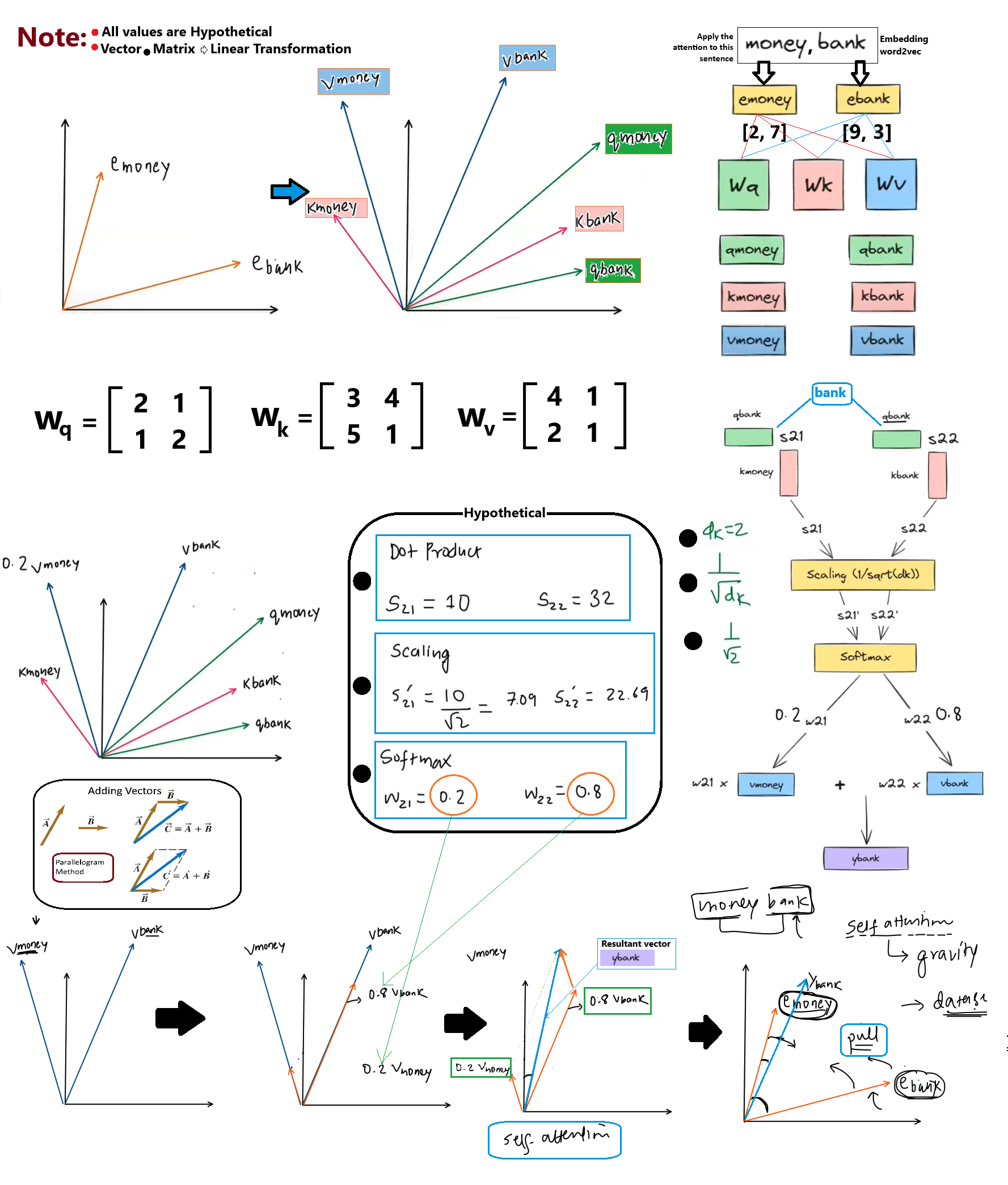
Self-attention operates as a geometric transformer in multi-dimensional space. By projecting word embeddings into Query, Key, and Value spaces, it measures angular alignments and constructs contextual representations through vector addition.
The "river bank" example demonstrates how the static representation of a word dynamically shifts toward relevant neighboring vectors based on context.
Concept
Vector/Matrix Symbol
Role in Self-Attention
Geometric Description
Mathematical Operation
Word Embeddings
E (e.g.,
Emoney, Ebank)
Initial
numerical representation of words serving as the starting point
for the mechanism.
Vectors
in a multi-dimensional space where semantic meaning is captured
by position.
Extracted via techniques like Word2Vec; plotted as points or
arrows in space.
Transformation Matrices
WQ,
WK, WV
Learnable parameters used to project word embeddings into
specific functional spaces (Query, Key, Value).
Act as
operators for linear transformation, moving or rotating vectors
to new locations.
Matrix
Multiplication (Dot Product with the embedding vector).
Query, Key, and Value
Vectors
q,
k, v (e.g.,
qmoney, kbank)
Functional components: Query searches, Key is matched against,
and Value contains the actual content.
Six new
vectors generated from the original word embeddings through
linear projection.
q = E · WQ;
k = E · WK;
v = E · WV
Similarity/Attention
Scores
s (or Score)
Measures the relevance or relatedness between words in the
sentence.
Based on
the angular distance between vectors; smaller angles result in
higher scores.
Dot
product of Query and Key vectors (q · k).
Scaling and Normalization
Softmax,
∑w = 1
Prevents vanishing/exploding gradients and converts similarity
scores into probabilistic weights.
Mapping
raw scores to a range that determines how much "pull" one word
has on another.
Division by √dk followed by the
Softmax function.
Weighted Sum/Attention
Output
y (e.g.,
ybank)
The
final contextual embedding of a word, influenced by all other
words in the sequence.
Resultant vector from scaling Value vectors and adding them;
acts like "gravity" pulling words toward relevant contexts.
Scalar
multiplication of Value vectors by weights, followed by Vector
Addition (Parallelogram/Triangle Law).
1. Word Embeddings in Multi-Dimensional Space
Given the sentence “money, bank”, the words are mapped to initial static vectors:
Semantic Coordinates: Each word exists as a vector pointing away from the origin in a high-dimensional space.
Initial Distance: Because "money" and "bank" are semantically distinct, their initial vectors (\(e_{\text{money}}\) and \(e_{\text{bank}}\)) point in different directions.
2. Transformation Matrices & Linear Projection
To compute attention, static embeddings are projected into functional spaces via linear transformations:
Linear Projections: Multiplying embeddings by these learnable matrices rotates, scales, and shears the vectors.
Query Space: Maps embeddings to \(q_{\text{money}}\) and \(q_{\text{bank}}\).
Key Space: Maps embeddings to \(k_{\text{money}}\) and \(k_{\text{bank}}\).
Value Space: Maps embeddings to \(v_{\text{money}}\) and \(v_{\text{bank}}\).
3. Geometric Meaning of Queries, Keys, and Values
Query (Q) — The Search Direction: Points in the direction of the information the word is actively seeking.
Key (K) — The Semantic Profile: Represents the word's characteristics. The alignment between a Query vector and a Key vector measures their contextual relevance.
Value (V) — The Content Payload: Represents the raw semantic information that will be blended to form the final contextual representation.
4. Attention Scores & Dot Product Alignment
We compute similarity scores for the word "bank" by measuring its Query alignment with all Keys:
Geometric Proximity: The dot product calculates the angular alignment between Query and Key vectors.
Self-Attention Bias: Since \(s_{22} > s_{21}\), \(q_{\text{bank}}\) is more aligned with \(k_{\text{bank}}\), meaning it initially pays more attention to itself.
5. Scaling and Softmax Normalization
Dividing by \(\sqrt{d_k} = \sqrt{2}\) normalizes the attention scores prior to Softmax:
Vector Blending: The resulting contextual vector \(y_{\text{bank}}\) points closer to \(v_{\text{bank}}\) in space, but is pulled slightly in the direction of \(v_{\text{money}}\).
Gravity Analogy: Attention acts as semantic gravity. Tokens with high Query-Key alignment pull the final representation toward their semantic coordinates.
7. Practice Questions & Concept Intuitions
Q1How do we interpret word embeddings geometrically in multi-dimensional space?
Points and Directional Rays in $\mathbb{R}^d$: Each word embedding is a point or directional vector in a high-dimensional vector space (e.g., $d = 512$ or $4096$).
Semantic Proximity: Concepts with shared semantic features cluster close together in Euclidean distance and form small angles (high cosine similarity) with each other.
Subspace Axes: Individual linear combinations of dimensions often correspond to latent conceptual properties (such as tense, gender, plurality, or sentiment).
Q2What is the geometric meaning of linear projection using matrices \(W_Q, W_K, W_V\)?
Rotation, Scaling, and Shearing: Multiplying embedding vectors by weight matrices applies linear transformations that rotate, scale, and shear the original space into specialized task subspaces.
Dimensional Subspace Mapping: In multi-head attention, $W$ projects the global representation space into lower-dimensional sub-manifolds ($d_{\text{model}} \to d_k$), isolating distinct relational aspects.
Dynamic Coordinate Reorientation: Projections reorient tokens so that geometric alignment in the Query-Key space reflects functional interaction rather than static lexical proximity.
Q3Geometrically, what does the Query vector represent?
A Directional Probe in Subspace: The Query vector $\mathbf{q}_i$ acts as a directional search beam cast into the key space, pointing toward the coordinates of information needed by token $i$.
Target Search Region: It defines a hyper-plane perpendicular to its direction: keys that align closely with this beam receive maximal positive dot products.
Contextual Intent: The Query vector's orientation changes dynamically depending on the token's current surrounding context and layer depth.
Q4Geometrically, what does the Key vector represent?
An Advertising Coordinate: The Key vector $\mathbf{k}_j$ specifies the exact position in the metric space where token $j$ offers its attributes and syntactic identity.
Matching Target: If a query's search ray points along $\mathbf{k}_j$, the two vectors form an acute angle, maximizing their inner product.
Role Specialization: Keys are geometrically decoupled from Values, meaning a token can advertise an address in key-space while storing entirely different features in value-space.
Q5Why is the dot product used as a similarity measure in self-attention?
Geometric Projection Magnitude: The dot product $\mathbf{q} \cdot \mathbf{k} = \|\mathbf{q}\| \|\mathbf{k}\| \cos(\theta)$ measures the length of the projection of $\mathbf{q}$ onto $\mathbf{k}$ scaled by the magnitude of $\mathbf{k}$.
Directional and Magnitude Sensitivity: It rewards both angular alignment (pointing in the same conceptual direction) and confidence (vector magnitude).
High Hardware Efficiency: Inner products can be computed simultaneously across all tokens via matrix multiplication ($Q K^T$), which is maximally optimized on GPU Tensor Cores.
Q6How does the dot product relate to the angle between two vectors?
Cosine Law Connection: The dot product is directly proportional to $\cos(\theta)$: $\mathbf{q} \cdot \mathbf{k} = \|\mathbf{q}\| \|\mathbf{k}\| \cos(\theta)$.
Magnitude Modulation: Unlike pure cosine similarity (which normalizes vectors to unit length), the dot product allows vectors with larger norms to exert stronger influence on attention scores.
Q7What does a negative dot product mean geometrically, and how does Softmax handle it?
Obtuse Angle Geometry: A negative dot product occurs when the angle between $\mathbf{q}$ and $\mathbf{k}$ is obtuse ($\theta \in (90^\circ, 180^\circ]$), indicating opposing directional orientations in feature space.
Softmax Exponential Mapping: Softmax applies the exponential function: for negative logits $z < 0$, $\exp(z) \in (0, 1)$. Large negative scores are mapped smoothly towards zero.
Geometric Suppression: Tokens with opposing geometry are naturally filtered out, receiving near-zero probability mass in the convex combination.
Q8Geometrically, what does the Value vector represent?
Position in the Semantic Output Manifold: The Value vector $\mathbf{v}_j$ represents the physical feature coordinate that token $j$ transmits to the rest of the network.
Payload Space: The set of all Value vectors ${\mathbf{v}_1, \dots, \mathbf{v}_N}$ forms the basis points spanning the output representation space for the current layer.
Transformation Target: The layer output is synthesized as a point situated strictly within the convex hull spanned by these Value vectors.
Q9How is the final contextual vector computed geometrically?
Convex Combination of Vectors: The output is $\mathbf{o}_i = \sum_{j=1}^N \alpha_{ij} \mathbf{v}_j$, where $\alpha_{ij} \ge 0$ and $\sum_j \alpha_{ij} = 1$.
Center of Mass (Centroid): Geometrically, $\mathbf{o}_i$ is the center of mass of the points $\{\mathbf{v}_j\}$, where each point's mass is proportional to its attention weight $\alpha_{ij}$.
Barycentric Coordinates: The attention distribution $\boldsymbol{\alpha}_i$ acts as barycentric coordinates locating the new token representation inside the simplex formed by the Value vectors.
Q10What is the "parallelogram law of vector addition" and how does it apply to self-attention?
Parallelogram Law Definition: When two vectors $\mathbf{a}$ and $\mathbf{b}$ are added, their resultant vector $\mathbf{a} + \mathbf{b}$ forms the diagonal of the parallelogram defined by $\mathbf{a}$ and $\mathbf{b}$.
Residual Connection Geometry: In Transformers, the attention output is added to the original token representation: $\mathbf{x}_{\text{new}} = \mathbf{x}_{\text{old}} + \mathbf{o}$.
Contextual Displacement: Geometrically, this completes a parallelogram, displacing the original word vector $\mathbf{x}_{\text{old}}$ along the direction of the contextual vector $\mathbf{o}$, preserving base identity while integrating context.
Q11Explain the concept of semantic "gravity" or "pull" in self-attention.
Gravitational Analogy: Tokens with strong mutual attention exert an attractive force on each other's representations.
Migration Toward Cluster Centroids: If "bank" attends strongly to "river" and "water", its output vector is pulled toward the semantic cluster of aquatic features.
Multi-Body Dynamics: Self-attention functions as a multi-body simulation where each token vector's trajectory across layers is governed by the gravitational pull of all other tokens in the sequence.
Q12How do linear projections prevent the attention mechanism from being a simple, static nearest-neighbor search?
Beyond Static Proximity: If attention operated directly on raw embeddings ($X X^T$), tokens could only attend to words that are already semantically similar in the static vocabulary.
Relational Subspace Mapping: Projections $W^Q$ and $W^K$ learn to rotate completely different concepts into alignment (e.g., aligning a verb like "wrote" with its agent "Shakespeare" and patient "Hamlet").
Functional Reconfiguration: Projections allow the model to measure grammatical, semantic, or positional relationships entirely independent of static Euclidean distance.
Q13What happens to the geometry if two key vectors are orthogonal to a query vector?
Zero Dot Product (\(\mathbf{q} \cdot \mathbf{k}_1 = 0, \mathbf{q} \cdot \mathbf{k}_2 = 0\)): When two key vectors lie in the hyper-plane perpendicular to $\mathbf{q}$, their raw attention logits are both zero.
Equal Baseline Weights: Prior to interaction with other tokens, both receive $\exp(0) = 1$ in the softmax numerator.
No Discriminative Preference: The query has zero directional preference between them; any differentiation must come from other tokens or positional signals.
Q14How does the dimensionality of the vector space influence the geometric separation of concepts?
Blessing of Dimensionality: In high dimensions (e.g., $d = 4096$), an exponentially large number of mutually nearly-orthogonal directions exist.
Disentangled Concept Representations: High dimensions allow the model to encode thousands of nuanced semantic and factual features simultaneously without interference or crosstalk.
Concentration of Measure: Random vectors in high dimensions are almost always nearly orthogonal ($\theta \approx 90^\circ$), ensuring that intentional directional alignment created by learned projections provides a strong, discriminative signal.
Q15Geometrically, how does self-attention resolve lexical ambiguity (e.g., distinguishing "river bank" vs "money bank")?
Initial Ambiguous Coordinate: In the embedding lookup space, the word "bank" starts at a fixed vector coordinate equidistant from finance and nature clusters.
Differential Steering via Context: In "river bank", the query vector forms an acute angle with $\mathbf{k}_{\text{river}}$, steering attention towards river concepts. In "money bank", it forms an acute angle with $\mathbf{k}_{\text{money}}$.
Divergent Trajectories in Hyperspace: After value aggregation and residual addition, the vector for "bank" in the two sentences is shifted into completely different regions of the vector space, successfully resolving the lexical ambiguity.
Multi-Head Attention extends self-attention by performing the attention operation in parallel across multiple lower-dimensional subspaces. This allows the model to simultaneously process different perspectives of a sequence.
Mechanism Name
Key Objective
Weight Matrices Used
Handling of Perspectives
Output Dimension Compatibility
Main Advantage
Limitations
Self-Attention
To generate
contextual embeddings by capturing semantic meaning and word
relationships within a sentence.
One set
of weight matrices: \(W_Q\) (Query), \(W_K\) (Key), and \(W_V\)
(Value).
Captures only a single perspective or interpretation of a
document or sentence.
Produces a single contextual
representation; shape typically matches the input embedding.
Generates
contextual embeddings that solve the problem of static
embeddings where words have the same value regardless of
context.
Inability to
capture multiple linguistic perspectives or handle ambiguity
simultaneously.
Multi-Head
Attention
To capture
multiple different perspectives or hidden meanings in a sentence
simultaneously by using parallel attention modules.
Multiple
sets of \(W_Q\), \(W_K\), and \(W_V\) matrices (one set per
head) and a final output matrix \(W_O\).
Manages multiple perspectives by having each "head" focus on
different semantic or syntactic relationships.
Outputs from all heads are concatenated and
linearly transformed using \(W_O\) to match the input dimension.
Allows the
model to focus on different positions and perspectives at once;
improves summarization and disambiguation with high
computational efficiency.
Requires final
linear projection overhead (\(W_O\)) and additional parameter
calculation layers.
1. Dimension Changes & Vector Shapes
Input Embeddings: Words (e.g., "Money", "Bank") are mapped to standard \(d_{\text{model}} = 512\) vectors. For a sequence length of 2, the input matrix has a shape of \(2 \times 512\).
Subspace Projection: Input embeddings are multiplied by three projection matrices per head: \(W_Q, W_K, W_V\).
Head Dimension Splits: For \(h = 8\) heads, each head projects vectors to \(d_k = d_{\text{model}} / h = 64\) dimensions. Thus, projection matrices have shape \(512 \times 64\), yielding outputs of shape \(2 \times 64\) per head.
Concatenation: The \(2 \times 64\) outputs from all 8 heads are concatenated side-by-side, restoring the original dimension size: \(2 \times (64 \times 8) = 2 \times 512\).
Final Projection: The concatenated output is multiplied by a learnable matrix \(W^O\) of shape \(512 \times 512\) to blend the representations from all heads back into the final contextual sequence.
2. Computational & Memory Efficiency
Subspace Computation: Splitting vectors into 8 independent heads of 64 dimensions is computationally identical in terms of floating-point operations (FLOPs) to computing a single 512-dimensional attention head.
Complexity Math: A single large attention computation scales as \(O(d_{\text{model}}^2)\). For Multi-Head Attention, computing \(h\) independent operations yields:
This reduces dot-product calculation overhead by a factor of \(h\), freeing up memory.
GPU Parallelization: Because attention heads are independent, GPUs compute all head projections in parallel, accelerating training and inference.
3. Multi-Perspective Semantic Capture
Subspace Specialization: Different heads specialize in different relational aspects:
Head 1: Tracks local subject-verb syntax (e.g., matching "cat" to "sat").
Head 2: Tracks long-range pronouns (e.g., linking "mat" to "it").
Head 3: Evaluates modifier-noun relationships.
Lexical Disambiguation: Multiple heads allow the model to capture polysemy (e.g., distinguishing between a financial "bank" and a river "bank" simultaneously by attending to different surrounding context tokens).
4. Limitations of Self-Attention Resolved
Avoiding Over-Smoothing: Single-head self-attention tends to blend all syntactic and semantic relationships into a single average vector. Multi-head splits prevent feature homogenization.
Short and Long Range Tracking: Multi-head attention resolves the struggle of a single head to track both local grammatical relationships and global document structure at the same time.
Unresolved Quadratic Scaling: Although Multi-Head Attention optimizes dimension computation, the pairwise token comparisons still scale quadratically as \(O(N^2)\) with sequence length \(N\).
5. Practice Questions & Concept Intuitions
Q1What is the fundamental difference between single-head Self-Attention and Multi-Head Attention?
Single-Head Averaging Constraint: A single attention head produces a single attention distribution per token, forcing the model to average all different types of relational dependencies into one set of weights.
Concurrent Multi-Focal Reasoning: Enables the model to attend simultaneously to different types of information at different positions (e.g., one head tracks syntactic subjects, another tracks semantic coreference, another tracks local adjacent modifiers).
Q2Why do we project the input embeddings into lower-dimensional subspaces for each head?
Dimensional Efficiency ($d_k = d_{\text{model}} / h$): In the original Transformer ($d_{\text{model}} = 512, h = 8$), each head operates on vectors of dimension $d_k = 64$.
Computational Cost Invariance: Computing $h$ heads with dimension $d_{\text{model}}/h$ costs approximately the same total compute ($O(N^2 \cdot d_{\text{model}})$) as a single full-dimensional head of size $d_{\text{model}}$.
Disentangled Feature Spaces: Projecting into orthogonal or distinct subspaces allows individual heads to focus on isolated linguistic phenomena without interference from other signals.
Q3What are the mathematical shapes of Query, Key, and Value matrices for each attention head?
Projection Weights Per Head ($i = 1, \dots, h$): $W_i^Q \in \mathbb{R}^{d_{\text{model}} \times d_k}$, $W_i^K \in \mathbb{R}^{d_{\text{model}} \times d_k}$, and $W_i^V \in \mathbb{R}^{d_{\text{model}} \times d_v}$.
Per-Head Projected Tensors: For input batch sequence $X \in \mathbb{R}^{B \times N \times d_{\text{model}}}$, each head's projections have shape: $Q_i, K_i, V_i \in \mathbb{R}^{B \times N \times d_k}$.
Batched Multi-Head Tensor: Typically computed in one large GEMM as $\mathbb{R}^{B \times h \times N \times d_k}$, enabling parallel execution across all heads simultaneously.
Q4How do the outputs of all attention heads combine to match the original hidden dimension size?
Concatenation Step: Each head outputs a matrix $\text{head}_i \in \mathbb{R}^{N \times d_v}$. The $h$ heads are concatenated horizontally along the feature dimension: $\text{Concat}(\text{head}_1, \dots, \text{head}_h) \in \mathbb{R}^{N \times (h \cdot d_v)}$.
Dimension Matching: Since $d_v = d_{\text{model}} / h$, the concatenated tensor has width $h \cdot (d_{\text{model}} / h) = d_{\text{model}}$.
Linear Projection ($W^O$): Multiplied by output projection matrix $W^O \in \mathbb{R}^{d_{\text{model}} \times d_{\text{model}}}$ to blend information from all heads into the final representation.
Q5What is the role of the final linear projection matrix \(W^O\) in Multi-Head Attention?
Cross-Head Information Fusion: Concatenation merely places head outputs side-by-side without any interaction between them. $W^O$ linearly mixes features across all heads.
Synthesizing Multi-Perspective Signals: It integrates grammatical cues from head 1, coreference links from head 2, and positional context from head 3 into unified token embeddings.
Dimensional Standardization: Ensures the output has the exact required shape for the subsequent residual addition: $\mathbf{x}_{\text{out}} = \mathbf{x}_{\text{in}} + \text{MultiHead}(Q, K, V) W^O$.
Q6Why doesn't Multi-Head Attention increase the total parameter count compared to a single large head?
Exact Mathematical Equivalence: For $h$ heads with projection dimension $d_k = d_{\text{model}}/h$, the projection matrix for each head has size $d_{\text{model}} \times (d_{\text{model}}/h)$.
Sum Over All Heads: Summing across all $h$ heads gives: $h \times \left(d_{\text{model}} \times \frac{d_{\text{model}}}{h}\right) = d_{\text{model}}^2$ parameters for $W^Q$, $W^K$, and $W^V$ respectively.
Identical Parameter Count: This matches the $d_{\text{model}}^2$ parameters of a single full-sized projection matrix $W \in \mathbb{R}^{d_{\text{model}} \times d_{\text{model}}}$, providing multi-perspective representation with zero parameter penalty.
Q7Explain the concept of "multi-perspective semantic capture."
Diverse Relational Probes: Natural language tokens possess multiple concurrent relationships: morphological, syntactic, topical, and rhetorical.
Simultaneous Specialization: In the sentence "The chef who won the contest prepared a feast": Head 1 can link "chef" to "prepared" (subject-verb), Head 2 links "chef" to "contest" (relative clause modifier), and Head 3 links "chef" to "feast" (semantic domain association).
Ensemble-Like Expressiveness: Functions like an internal ensemble of specialized attention mechanisms operating in parallel.
Q8How does Multi-Head Attention resolve word-sense disambiguation (polysemy)?
Partitioned Attention Allocation: When encountering an ambiguous word (e.g., "crane"), a single-head model must commit to one dominant interpretation or blur them together.
Parallel Disambiguation: One head checks nearby nouns ("construction", "steel") to detect mechanical senses, while another head scans for biological terms ("bird", "wetland", "feather").
Targeted Value Routing: The output projection $W^O$ selects and amplifies the correct sense's Value features based on which head found strong contextual alignment.
Empirical Proof via Probing: Research (e.g., Clark et al., "What Does BERT Look At?") confirms that distinct attention heads naturally specialize into specific syntactic dependency roles without explicit grammar supervision.
Observed Head Specializations: Specific heads consistently track: (1) direct objects to their verbs, (2) prepositions to their noun objects, (3) pronouns to their coreferent antecedents, and (4) determiners to their modified nouns.
Pure Gradient Emergence: These structures emerge organically because minimizing next-token cross-entropy loss requires internalizing the underlying syntax of language.
Q10How does Multi-Head Attention exploit GPU architecture for parallel processing?
Fused Multi-Head Projections: Instead of $h$ separate matrix multiplications, all heads are computed in a single large batched GEMM: $X \in \mathbb{R}^{B \times N \times d} \times W_{QKV} \in \mathbb{R}^{d \times 3d}$.
Tensor Reshaping & Striding: Reshaped in GPU memory to shape $[B, h, N, d_k]$ with a simple pointer transpose without copying data.
Hardware Parallelism Across Heads: GPUs execute attention across batches, heads, and sequence length concurrently across streaming multiprocessors (SMs).
Q11What is "head collapse" in attention mechanisms and how does it occur?
Definition of Head Collapse: Occurs when multiple attention heads learn redundant or identical projection weights, generating identical attention distributions and wasting capacity.
Causes: Can result from poor weight initialization, excessive head count ($h$ too large for task complexity), or lack of diversity regularization.
Mitigation Strategies: Addressed via random orthogonal weight initialization, dropout applied directly to attention matrices, and architectural techniques like Grouped-Query Attention.
Q12How does Multi-Head Attention scale with sequence length \(N\) compared to hidden dimension \(d\)?
Scaling with Sequence Length $N$: Computing the attention logits matrix scales as $O(N^2 \cdot d_{\text{model}})$, exhibiting quadratic growth with sequence length.
Scaling with Hidden Dimension $d$: Linear projections and FFN layers scale as $O(N \cdot d_{\text{model}}^2)$, exhibiting quadratic growth with model width.
Regime Dominance: For short sequences ($N < d_{\text{model}}$), projection compute dominates; for long sequences ($N \gg d_{\text{model}}$), the $N^2$ attention matrix compute and memory dominate.
Q13What are Multi-Query Attention (MQA) and Grouped-Query Attention (GQA), and what trade-offs do they offer?
Multi-Query Attention (MQA, Shazeer 2019): All $h$ query heads share a single key head and a single value head ($h_K = h_V = 1$), reducing the KV cache memory bandwidth during inference by a factor of $h$ with minor quality degradation.
Grouped-Query Attention (GQA, Ainslie et al. 2023): Divides $h$ query heads into $G$ groups, where each group shares 1 key and 1 value head ($1 < G < h$, e.g., 8 groups for 32 query heads).
SOTA Industry Adoption: GQA is the modern standard (LLaMA 3, Mistral, Gemma 2), delivering near-full MHA quality while slashing inference KV-cache VRAM consumption and boosting throughput.
Q14Why is a final projection matrix \(W^O\) necessary after concatenating head outputs?
Inter-Head Communication: Each head outputs an isolated vector in its own subspace. Without $W^O$, features in head 1 could never mathematically interact with features in head 2.
Recombination into Latent Space: Multiplies the concatenated tensor by $W^O \in \mathbb{R}^{d_{\text{model}} \times d_{\text{model}}}$, computing learned linear combinations across all heads.
Interface with Subsequent Layers: Produces a unified tensor matching the input dimension of the LayerNorm and FFN sub-layers.
Q15Explain why Multi-Head Attention does *not* solve the quadratic complexity \(O(N^2)\) limitation of self-attention.
Quadratic Work per Head: Each individual head $i$ still computes an $N \times N$ attention matrix ($Q_i K_i^T / \sqrt{d_k}$), costing $O(N^2 \cdot d_k)$ compute and $O(N^2)$ memory.
Total Complexity: Summing over all $h$ heads: $h \times O(N^2 \cdot d_k) = O(N^2 \cdot (h \cdot d_k)) = O(N^2 \cdot d_{\text{model}})$.
Structural Preservation: Multi-Head Attention decomposes the feature dimension $d_{\text{model}}$, not the sequence dimension $N$. Solving the $N^2$ bottleneck requires alternative linear attention or sparse/windowed attention approximations.
07 - Positional Encoding in
Transformers
⭐ Overview
🔴 The Core Purpose: Unlike sequential architectures (RNNs/LSTMs), Transformers process all input tokens in parallel. They are permutation-invariant and require an external positional signal to understand the order of tokens in a sequence.
🔴 Vector Combination: The final input representation is formed by adding the word embedding and the positional encoding vector element-wise: Input = Embedding + PE. Each token carries both semantic and location context.
🔴 Sinusoidal Foundation: The original architecture utilizes deterministic sine and cosine functions of varying frequencies to generate bounded, continuous, and relative-position-friendly coordinates.
1. What Is Positional Encoding and Why Do We Need It?
Recurrence-Free Parallelism: Because the self-attention mechanism processes all tokens simultaneously, it lacks an inherent sequence order. It acts as a "bag-of-words" model unless location signals are introduced.
Word-Order Disambiguation: Without positional signals, the representation for "man bites dog" and "dog bites man" would be identical. Positional encoding adds order context to help the model learn syntactic patterns.
Blended Vector Spaces: Positional coordinates are added directly to word embeddings before the first encoder block. The resulting vector contains two separate, decipherable signals:
Semantic Signal: Represents the word's conceptual meaning.
Positional Signal: Represents the word's physical position in the sequence.
2. The Naïve Approach: Simple Counting & Its Pitfalls
The Linear Counter (1, 2, 3...): Assigning absolute sequential integers directly to tokens introduces three major limitations:
Unbounded Values: For long sequences (e.g., books with 10,000+ tokens), coordinates grow extremely large, causing numerical instability and exploding gradients during backpropagation.
No Relative Distance Representation: Absolute numbers do not inherently inform the model about the relative distance between tokens.
The Normalized Counter (0 to 1): Dividing the index by the total sentence length keeps values bounded but introduces inconsistency:
The same position has different values across sentences of different lengths (e.g., position 2 is 1.0 in a 2-word sentence, but 0.33 in a 6-word sentence).
The Trigonometric Solution: Using periodic waves like sine and cosine resolves these issues:
Boundedness: Values oscillate strictly within [-1, 1], ensuring stable gradients.
Continuity: Gradual, smooth transitions are differentiable and optimization-friendly.
Relative Position Capture: Trigonometric identity shifts allow the model to query offsets linearly.
📐 Mathematics of Relative Encoding:
For a frequency \(\omega_k = \frac{1}{10000^{2k/d_{\text{model}}}}\), the trigonometric addition formulas show that a position shift \(\Delta\) is a linear transformation:
This linear property allows the self-attention mechanism (which relies on dot products and linear projections) to easily learn query patterns that evaluate the relative distance between tokens.
3. The Sinusoidal (Sine–Cosine) Positional Encoding Approach
The Core Equation: For a given position pos and dimension index i, the sinusoidal encodings are defined as:
pos: the token's position in the sequence (0, 1, 2, ...).
i: the dimension index (0 to \(d_{\text{model}}/2 - 1\)).
d_model: the model dimension size (e.g., 512).
Why Sine and Cosine Pairs? Using both functions maps a position into a 2D rotation system rather than a single scalar:
Resolves Ambiguity: Because trigonometric functions are periodic, a single sine wave would map different positions to the exact same value. Combining sine and cosine provides a unique coordinate signature.
Rotation Compatibility: By pairing sine and cosine at each frequency band, a shift by \(\Delta\) behaves mathematically as a rotation, which is represented in matrix form:
4. Determining the Frequency: The Role of the Denominator
The Wavelength Scaling Factor: The denominator \(10000^{\frac{2i}{d_{\text{model}}}}\) acts as an exponential scaling factor that adjusts the frequency for each dimension pair:
Low Dimension Indices (small \(i\)): High frequency (short wavelength). The sine and cosine waves oscillate rapidly, capturing **local position changes** (e.g., distinguishing adjacent tokens).
High Dimension Indices (large \(i\)): Low frequency (long wavelength). The waves oscillate slowly, preserving **global sequence context** and long-range dependencies.
Why Exponential Scaling? Using a base of 10000 ensures that wavelengths span from \(2\pi\) (for \(i=0\)) to \(20000\pi\) (for \(i = d_{\text{model}}/2 - 1\)). This huge range gives the model a multi-scale positional signature.
Example: Frequency Components for \(d_{\text{model}} = 6\):
Index \(i\)
Frequency Formula
Wavelength
Description
0
\(1 / 10000^{0/6} = 1.0\)
\(2\pi \approx 6.28\)
High frequency; rapid changes for local transitions.
1
\(1 / 10000^{2/6} \approx 0.046\)
\(\approx 135.4\)
Medium frequency.
2
\(1 / 10000^{4/6} \approx 0.002\)
\(\approx 2915.5\)
Low frequency; slow changes for global structure.
5. Concrete Example: Encoding "River" and "Bank" (\(d_{\text{model}} = 6\))
Let's calculate the encodings for a 2-word phrase "River" (\(pos=0\)) and "Bank" (\(pos=1\)) using an embedding dimension of \(d_{\text{model}} = 6\) (where \(i \in \{0, 1, 2\}\)):
Determinism: The positional encoding is entirely deterministic (non-trainable) and pre-calculated. In PyTorch, it is stored using register_buffer so it remains in the module's state but is skipped during parameter updates.
Dimensionality: For a sequence length of 50 and \(d_{\text{model}} = 128\), the resulting encoding tensor shape is (50, 128) (one 128-dimensional vector per token position).
positional_encoding.py
Python · PyTorch
import torch
import numpy as np
import matplotlib.pyplot as plt

class PositionalEncoding(torch.nn.Module):
    def __init__(self, d_model, max_len=100):
        """
        d_model: Embedding dimension
        max_len: Maximum sequence length (default=100)
        """
        super(PositionalEncoding, self).__init__()

        # Create a matrix of shape (max_len, d_model)
        pos = torch.arange(max_len).unsqueeze(1)  # Shape: (max_len, 1)
        div_term = torch.exp(torch.arange(0, d_model, 2) * (-np.log(10000.0) / d_model))  # Shape: (d_model/2)

        # Compute PE(pos, 2i) = sin(pos / (10000^(2i/d_model)))
        # Compute PE(pos, 2i+1) = cos(pos / (10000^(2i/d_model)))
        pe = torch.zeros(max_len, d_model)
        pe[:, 0::2] = torch.sin(pos * div_term)  # Apply sine to even indices
        pe[:, 1::2] = torch.cos(pos * div_term)  # Apply cosine to odd indices

        # Register as a buffer to avoid updating during training
        self.register_buffer('pe', pe.unsqueeze(0))  # Shape: (1, max_len, d_model)

    def forward(self, x):
        """
        x: Input tensor of shape (batch_size, seq_len, d_model)
        """
        seq_len = x.size(1)  # Extract sequence length from input
        return x + self.pe[:, :seq_len, :]

# Example Usage
d_model = 128   # Embedding size
seq_len = 50    # Number of tokens (positions)
pe_layer = PositionalEncoding(d_model, max_len=50)

# Create a dummy input tensor (batch_size=1, seq_len=50, d_model=128)
dummy_input = torch.zeros(1, seq_len, d_model)
output = pe_layer(dummy_input)  # Apply positional encoding

print("Positional Encoding Output:\n", output.squeeze(0))

# Visualization
plt.figure(figsize=(20, 4))  # Set the figure size
plt.imshow(pe_layer.pe.squeeze(0), cmap='coolwarm', aspect='auto')
plt.colorbar(label="Encoding Value")
plt.xlabel("Embedding Dimension")
plt.ylabel("Position")
plt.title("Positional Encodings (Sinusoidal)")
plt.show()
# Example Usage
d_model = 128   # Embedding size
seq_len = 10, 50, 100, 500    # Number of tokens (positions)
📊 Understanding the Heatmap:
Axes Definition:
X-axis (Embedding Dimension 0-128): low-index columns on the left represent high-frequency waves; high-index columns on the right represent low-frequency waves.
Y-axis (Token Position 0-50): represents sequential token indexes in the sentence.
Color Coding Signatures: Red indicates values closer to +1, Blue indicates values closer to -1, and White represents zero crossings.
Continuous Mapping: The smooth color gradient as we move down the Y-axis shows that nearby positions share similar coordinates, allowing the model to generalize position distances continuously rather than via abrupt jumps.
Signal Conflation: Since the inputs are \(X = X_{\text{embedding}} + PE\), the projections \(Q\) and \(K\) contain both semantic and location signals. The dot product \(Q K^T\) can be expanded into four terms:
Word × Word: Semantic similarity (what they mean).
Word × Position: Semantic-to-location bias (which words appear where).
Position × Word: Location-to-semantic bias.
Position × Position: Relative distance bias (how far apart they are).
Linguistic Ordering: This expansion allows the self-attention layer to differentiate grammatical order (e.g., matching a verb to its preceding subject) without any sequential recurrence or convolution.
8. Why Addition Instead of Concatenation?
Computational Efficiency:
Addition: overlaying \(PE\) directly onto \(X_{\text{embedding}}\) preserves the original embedding dimension (e.g., 512). The size of projections \(W_Q, W_K, W_V\) remains small.
Concatenation: merging them would double the input size to 1024. This increases weight matrix parameters, multiplying GPU memory requirements and slowing down training.
Signal Preservation: Although adding vectors mixes their values, high-dimensional spaces allow the model to easily isolate the distinct frequency patterns of the fixed sinusoidal wave from the learned semantic coordinates.
9. Mathematical Rotation: Capturing Relative Position
Linear Shift Invariance: For a fixed distance \(\Delta\), the encoding at position \(pos + \Delta\) is a linear transformation (rotation) of the encoding at position \(pos\).
Rotation Matrix: By applying a block-diagonal rotation matrix to the sine and cosine components, the model can query coordinates at a relative distance without needing absolute anchors.
Extrapolative Advantage: The relative offset pattern is sequence-length independent, allowing the self-attention mechanism to generalize over different sequence lengths.
Semantic Ambiguity: Consider the word bank in two contexts:
Sentence A: "The river bank is steep." (Physical edge of a river).
Sentence B: "The bank approved the loan." (Financial institution).
Without Positional Encoding: The model only has access to the word embedding for bank, which is identical in both cases. It cannot use context order to resolve the ambiguity.
With Positional Encoding:
In Sentence A, the relative shift between river and bank is captured mathematically: \(\Delta = pos_{\text{bank}} - pos_{\text{river}} = 1\).
The sine-cosine patterns embed this shift, allowing self-attention to align bank with its neighbor river, immediately clarifying that it refers to a river bank.
In Sentence B, the lack of a neighboring water-related term and the presence of financial terms in specific relative positions align to trigger the financial meaning.
Decision Map: Different architectures choose how to represent position based on extrapolation capacity, parameter efficiency, and mathematical simplicity.
Sinusoidal Choice: Bounded, parameter-free, and generalizes well to long sequences.
Learned vs. Relative: Modern large language models often choose Rotary Position Embeddings (RoPE) or relative encodings to align absolute indexing with self-attention directly.
Proposed Solution
Approach Description
Key Advantages
Identified Limitations
Mathematical Functions Used
Data Representation Type
Positional Relationship Type
Sinusoidal Positional Encoding (Attention Is All You Need)
A multi-dimensional vector where each dimension corresponds to a sine or cosine wave of varying frequencies (wavelengths).
Unique values for long sequences; captures relative position via linear transformations; matches embedding dimensionality (\(d_{\text{model}}\)) allowing for addition instead of concatenation.
Complex to conceptualize compared to basic counting; requires specific frequency scaling logic.
Sine-cosine pairs with varying frequencies (\(10000\) base exponent)
Vector(\(d_{\text{model}}\) dim)
Absolute & Relative
Learnable Positional Embeddings (BERT, GPT)
Assigns a unique trainable parameter vector to each absolute position index.
Learned directly from data; allows custom shapes matching task layout.
Cannot extrapolate to sequences longer than max training length; introduces many extra parameters to optimize.
None (lookup weights learned via backpropagation)
Vector(\(d_{\text{model}}\) dim)
Absolute Only
Relative Position Encoding (T5, Transformer-XL)
Injects relative distance offsets directly into self-attention logit calculations.
Highly shift-invariant; generalizes better to sequence length variations.
Adds computational complexity to attention logit matrices.
Learned or sinusoidal relative shifts
Scalar(bias term)
Relative Only
Rotary Position Embeddings (RoPE - LLaMA, Mistral)
Applies a 2D rotation matrix representing absolute positions directly to Query and Key projections.
Pure relative dot products; smooth extrapolation; excellent decay over distance.
Slightly more complex mathematical formulation (requires complex number or rotation matrix multiplication).
Trigonometric rotation matrix
Vector(\(d_{\text{model}}\) dim)
Absolute & Relative
Simple Counting Method (Naïve Approach)
Assigns a linear scalar index (e.g., 1, 2, 3...) to each word.
Extremely simple to compute.
Unbounded magnitudes cause unstable gradients; discrete transitions; does not model distance features natively.
Linear integer indexing
Scalar(\(\mathbb{R}\))
Absolute Only
12. Final Takeaways
Ordering Layer: Positional encoding is the Transformer input's essential ordering layer. Without it, the network behaves as a bag-of-words.
Trigonometric Benefits: Sine and cosine frequencies resolve legacy pitfalls: keeping values bounded within [-1, 1], enabling continuous differentiability, and establishing linear relative rotation matrices.
Embedding Blend: Element-wise addition is highly efficient, saving parameter size while exploiting high-dimensional sparsity to prevent word embedding corruption.
Mental Model: Input word embeddings answer what token is this?, while positional encodings answer where is this token?.
13. Practice Questions & Concept Intuitions
Q1Why is positional encoding necessary in Transformer models?
Permutation Invariance of Attention: Pure self-attention computes $\mathbf{q}_i \cdot \mathbf{k}_j$ based strictly on vector contents, with no awareness of the index positions $i$ and $j$.
Loss of Word Order Without Encoding: Without positional signals, the sentences "cat chased dog" and "dog chased cat" produce identical attention matrices mapped to permuted coordinates, treating sentences as unordered bags of words.
Injecting Spatial Structure: Positional encoding adds unique position-dependent geometric coordinates to the token embeddings, breaking permutation symmetry.
Q2Why does the Transformer use both sine and cosine functions in positional encoding?
Complementary Quadrature Basis: Pairing $\sin$ and $\cos$ at each frequency forms an orthogonal 2D coordinate system: $(PE_{(pos, 2i)}, PE_{(pos, 2i+1)}) = (\sin(\omega_i \cdot pos), \cos(\omega_i \cdot pos))$.
Linear Relative Shift Property: By trigonometric angle-addition formulas: $\sin(\omega (pos + k)) = \sin(\omega \cdot pos) \cos(\omega k) + \cos(\omega \cdot pos) \sin(\omega k)$, meaning $PE_{pos+k}$ can be computed from $PE_{pos}$ via a linear rotation matrix $M_k$.
Constant Norm: For each frequency pair, $\sin^2(\omega \cdot pos) + \cos^2(\omega \cdot pos) = 1$, ensuring positional vectors maintain a stable Euclidean norm across all sequence positions.
Q3Why is the denominator \(10000^{\frac{2i}{d}}\) used in the formula?
Geometric Progression of Frequencies: The term $\omega_i = \frac{1}{10000^{2i/d}}$ defines frequencies spanning from $\omega_0 = 1$ (wavelength $\lambda = 2\pi \approx 6.28$) down to $\omega_{d/2-1} = \frac{1}{10000}$ (wavelength $\lambda = 20000\pi \approx 62832$).
Multi-Scale Temporal Resolution: High-frequency dimensions (small $i$) change rapidly with each token, tracking fine local syntax and neighboring words. Low-frequency dimensions (large $i$) change slowly, encoding global sentence-level positions.
Binary Counter Analogy: Operates analogously to a continuous binary counter, where least significant bits toggle rapidly and most significant bits change slowly, uniquely identifying positions.
Q4How does the Transformer use positional encodings during training and inference?
Element-Wise Addition: At the very bottom of the model, positional encoding vectors are added directly to token embeddings: $\mathbf{x}_i^{(0)} = \mathbf{e}_{\text{token}, i} + PE_i$.
Static Deterministic Generation: For sinusoidal encodings, the values are precomputed up to a maximum length and added without learnable parameters.
Propagation Through Layers: Residual connections propagate these positional signals up through all layers, allowing higher-level attention heads to compute position-aware queries and keys.
Q5What are alternative approaches to sinusoidal positional encoding?
Learned Absolute Embeddings (e.g., BERT, GPT-2): Trains a lookup matrix $P \in \mathbb{R}^{L_{\max} \times d}$. Simple and flexible, but completely incapable of generalizing beyond the pre-trained maximum length $L_{\max}$.
Relative Position Encodings (e.g., Shaw et al., T5 Relative Bias): Injects position biases directly into attention logits based on relative distance $(i - j)$ rather than absolute positions.
Rotary Position Embedding (RoPE, Su et al. 2021): Modern standard (LLaMA, Mistral, Gemma) that rotates query and key vectors in complex pairs, combining absolute representation with relative decay.
Q6What is the advantage of sinusoidal positional encoding over learnable positional embeddings?
Zero Parameter Overhead: Sinusoids require zero learned parameters, reducing memory overhead and eliminating the risk of overfitting position indices.
Theoretical Length Extrapolation: Because sinusoidal functions are mathematically continuous and defined for all $pos \in [0, \infty)$, the model can generate encodings for sequence lengths unseen during training.
Preserved Distance Symmetries: Inner products between sinusoidal vectors naturally decay smoothly with increasing relative distance $|i - j|$.
Q7How do positional encodings affect attention scores in self-attention?
Four Component Interactions: (1) Content-to-Content, (2) Content-to-Position, (3) Position-to-Content, and (4) Position-to-Position.
Composite Routing: Allows the model to attend to a token because of what it says (content), where it is located (position), or a specific combination of both.
Q8How does positional encoding interact with padding tokens?
Additive Application to All Tokens: In a padded batch, positional vectors are added to padding tokens identical to normal tokens.
Attention Mask Suppression: However, the attention mask sets padding key positions to $-\infty$ before softmax, ensuring padding positional vectors never contribute to output attention representations.
Independent Generation: Prevents padding length from corrupting the positional coordinates of active semantic tokens.
Q9Can a model distinguish between absolute position and relative distance using sinusoidal encodings?
Absolute Position Encoding: The raw vector $PE_i$ is unique for every absolute position $i$, allowing the model to detect absolute markers (such as the first token or sentence boundaries).
Relative Distance via Inner Products: The dot product $PE_i \cdot PE_j$ depends strictly on the relative displacement $|i - j|$ because: $\sum_{k} (\cos(\omega_k i)\cos(\omega_k j) + \sin(\omega_k i)\sin(\omega_k j)) = \sum_{k} \cos(\omega_k (i - j))$.
Simultaneous Dual Awareness: The model simultaneously has access to absolute coordinates and relative distance metrics.
Q10What is the effect of changing the frequency base (e.g., 10,000 to 100,000) in sinusoidal encoding?
Wavelength Expansion: Increasing the base from $10,000$ to $500,000$ (as in LLaMA 3) or $1,000,000$ increases the maximum wavelength across high dimensions.
Context Window Extension: Prevents positional encodings from repeating or suffering from aliasing when scaling context lengths from 4K tokens to 32K or 128K tokens.
Interpolation vs Extrapolation: Higher base frequencies slow down rotation speeds, allowing the model to extrapolate smoothly to much longer context windows.
Q11Why is adding positional encoding directly to the input embeddings mathematically equivalent to applying a shift in representation?
Vector Addition as Translation: Adding $PE_i$ to $\mathbf{e}_i$ performs an affine translation in $\mathbb{R}^{d_{\text{model}}}$, translating the semantic vector along a position-specific displacement vector.
Preservation of Linear Separability: Since addition is linear, dot products with linear projection matrices distribute: $(\mathbf{e}_i + PE_i) W = \mathbf{e}_i W + PE_i W$.
Orthogonal Separation: In high dimensions ($d = 512+$), random semantic embeddings and structured sinusoids occupy largely distinct subspaces, minimizing interference.
Q12How does the model preserve semantic identity when positional vectors are added directly (corrupting the word embedding)?
Embedding Norm Dominance: Learned word embedding vectors are scaled by $\sqrt{d_{\text{model}}}$ before addition (e.g., $\sqrt{512} \approx 22.6$), ensuring the semantic signal's magnitude significantly outweighs the unit-norm positional sinusoidal values.
Subspace Disentanglement: In high dimensions, projection matrices learn to project the semantic signal and positional signal into orthogonal subspaces.
Empirical Validation: Cosine similarity between same-word tokens at different positions remains very high ($> 0.8$), proving semantic identity is fully preserved.
Q13What is "out-of-domain length extrapolation" and how does sinusoidal encoding handle it compared to learned embeddings?
Definition: The capability of a model trained on sequences of length $L_{\text{train}}$ (e.g., 512 tokens) to successfully evaluate sequences of length $L > L_{\text{train}}$ at test time.
Learned Embeddings Failure: Learned lookup tables have no defined vectors for positions $> L_{\text{train}}$, causing immediate execution crashes.
Sinusoidal Robustness: Sinusoids evaluate gracefully for any arbitrary position, but out-of-domain performance can degrade without modern techniques (e.g., RoPE scaling / NTK-aware scaling).
Q14Explain the difference between absolute position embeddings and relative position encodings.
Absolute Position Encodings: Assign a fixed coordinate vector to each index $0, 1, 2, \dots$ and add it to the input token (e.g., original Transformer, BERT, GPT-2).
Relative Position Encodings: Model spatial relationships purely as the distance between pairs of tokens: $\delta = (i - j)$. Instead of encoding "token at index 5", it encodes "token $j$ is 3 steps to the left of token $i$".
Superior Extrapolation: Relative encodings (like T5 and ALiBi) generalize better to arbitrary lengths because relative grammatical relations (e.g., adjective next to noun) are invariant to absolute position.
Q15How does RoPE (Rotary Position Embedding) differ from traditional sinusoidal addition?
Multiplicative Complex Rotation vs Additive Shift: Instead of adding vectors to inputs, RoPE rotates the Query and Key vectors in 2D complex pairs: $\tilde{\mathbf{q}}_m = R_{\Theta, m} \mathbf{q}_m$ and $\tilde{\mathbf{k}}_n = R_{\Theta, n} \mathbf{k}_n$.
Exact Relative Dot Product: The inner product satisfies $\langle R_{\Theta, m} \mathbf{q}, R_{\Theta, n} \mathbf{k} \rangle = g(\mathbf{q}, \mathbf{k}, m - n)$, depending strictly on the relative distance $(m - n)$ while operating on absolute coordinates.
Natural Decay with Distance: As relative distance $|m - n|$ grows, the inner product naturally decays, capturing locality without ad-hoc masking (standard in modern LLMs).
08 - Layer Normalization in
Transformers
⭐ Overview
🔴 Numerical Stability: Normalization keeps activations within a stable numerical range, preventing values from exploding or vanishing across deep Transformer stacks.
🔴 Layer Normalization Choice: Transformers use Layer Normalization (LN) rather than Batch Normalization (BN) because LN normalizes each token independently across its hidden features, removing dependencies on batch size and sequence padding.
🔴 Add & Norm Blocks: Layer Normalization is applied around residual connections (skip connections) in both the Encoder and Decoder blocks, providing a clean pathway for gradient flow.
1. What Is Normalization and Why Is It Useful in Deep Learning?
Scale Equalization: Normalization rescales activations or input features into a shared, predictable numerical range (often mean 0 and standard deviation 1).
Optimization Benefits: Equalizing scales keeps gradients balanced during backpropagation, leading to faster training convergence and less sensitivity to parameter initialization.
Activation Bounds: In deep networks, repeated matrix multiplications can cause vector magnitudes to drift. Normalization bounds these intermediate values.
Common Pre-processing Methods:
Min-Max Scaling: Maps data linearly into a fixed range (typically [0, 1]):
Xnorm=Xmax−XminX−Xmin
For example, scaling a house size of 2500 sq ft in a range of 500 to 5000:
Xnorm=5000−5002500−500=45002000≈0.44
Z-Score Standardization: Scales data to have zero mean (\(\mu = 0\)) and unit variance (\(\sigma = 1\)):
Xstandardized=σX−μ
2. What Are the Different Types of Normalization?
A. Core Mathematical Scaling Techniques:
Min-Max Scaling: Bounds data points into [0, 1] or [-1, 1].
x′=max(x)−min(x)x−min(x)
Example (scaling value 50 in range 20-100):
x′=100−2050−20=8030=0.375
Z-Score Standardization: Re-centers data around the mean using standard deviation.
x′=σx−μ
Example (standardizing value 8 with mean 6 and std 2.83):
x′=2.838−6≈2.832≈0.71
Decimal Scaling: Normalizes by moving the decimal point of values based on the maximum absolute value in the dataset.
Unit Vector Normalization (Vector Norm): Rescales a vector to have a length of 1.0 (unit circle projection):
x′=∥x∥x
where the Euclidean norm is:
∥x∥=x12+x22+⋯+xn2
Example (normalizing vector [3, 4]):
x′=[53,54]=[0.6,0.8]
Robust Scaling: Uses median and Interquartile Range (IQR) to normalize data containing heavy outliers:
x′=IQRx−median(x)
Example (scaling value 70 with median 50 and IQR 20):
x′=2070−50=2020=1
B. Neural Network Activation Normalization:
Batch Normalization (BN): Normalizes across the batch dimension for each channel independently. It maintains running estimates of mean and variance during training, which are frozen during inference:
Mean:
μB=m1i=1∑mxi
Variance:
σB2=m1i=1∑m(xi−μB)2
Standardize:
x^i=σB2+ϵxi−μB
Scale & Shift:
γx^i+β
Layer Normalization (LN): Normalizes across all hidden features (embedding dimensions) for each individual token independently:
x^=σlayer2+ϵx−μlayer
Instance Normalization (IN): Normalizes per channel per sample, removing style signatures (widely used in generative style transfer).
Group Normalization (GN): Divides channels into smaller groups and normalizes activations within each group (highly effective for small batch sizes).
3. What Is Internal Covariate Shift and How Does Normalization Address It?
The Concept: As weights in early layers change during training, the distribution of inputs to later layers shifts continuously. Later layers must constantly readjust to these changes, slowing down convergence.
The Fix: Normalizing activations at each layer ensures their mean and variance remain constant (typically 0 and 1) regardless of parameter updates.
Standardization:
x^=σbatchx−μbatch
Scale and Shift (Gamma & Beta): To prevent normalization from limiting layer expressiveness (e.g., forcing activations into the linear region of a Sigmoid), trainable parameters scale and shift the distribution:
y=γx^+β
The model can learn to undo the standardization if necessary (e.g., if identity mapping is optimal).
4. Why Batch Normalization Struggles with Sequential Data
Batch Size Sensitivity: BN relies on calculating mean and variance over a mini-batch of samples. If the batch size is small (e.g., during training on large models or during single-sample inference), these statistics become noisy and unstable.
Variable Sequence Lengths: Text sequences vary in length. Normalizing across the batch at a specific token position includes padded tokens for shorter sentences, distorting the true mean and variance.
Autoregressive Mismatch: During generation (inference), tokens are decoded one-by-one. Since there is no batch context at test time, BN must rely on frozen training statistics, which mismatch the generation state and degrade performance.
5. Why Layer Normalization Is Preferred in Transformers
Sequence-Length Agnostic: LN normalizes across the feature dimension of a single token. It does not look at other tokens in the batch or sequence, making it completely immune to padding and length variations.
Batch Independence: Since calculations are done per token, LN behaves identically whether batch size is 1 or 1000, aligning perfectly with online autoregressive generation.
Self-Attention Compatibility: LN preserves token identity. If one token has very high activation magnitudes, LN scales it down individually, preventing it from dominating the attention dot product.
Concept
Batch Normalization
Layer Normalization
Statistics
axis
Across batch
examples for each feature.
Across hidden
features inside one token/sample.
Batch-size
dependency
Sensitive to
mini-batch size and composition.
Independent of
batch size.
Sequence/padding
behavior
Can be distorted by
variable lengths and padding.
Stable for each
token representation.
Transformer
suitability
Usually not
preferred for standard NLP Transformers.
Default
normalization choice in Transformer blocks.
6. Layer Normalization in Transformers: Key Takeaways
Pre-LN vs. Post-LN:
Post-LN (Original): Normalization is placed *after* the residual addition (LayerNorm(x + SubLayer(x))). While it can achieve higher accuracy, it suffers from vanishing gradients at initialization, requiring a strict learning rate warm-up.
Pre-LN (Modern Standard): Normalization is placed *before* the sub-layer (x + SubLayer(LayerNorm(x))). This stabilizes gradient flow directly through the residual shortcut, allowing for much easier training and eliminating the warm-up requirement.
RMSNorm Efficiency: Modern architectures (like LLaMA) replace LayerNorm with RMSNorm (Root Mean Square Normalization), which skips calculating the mean entirely, scaling activations by their root mean square. This saves up to 10% of training time with no loss in accuracy.
7. Practice Questions & Concept Intuitions
Q1What exactly do you normalize in deep learning, and how does it prevent gradient issues?
Normalization Targets: Normalization scales intermediate activation tensors (hidden layer states) across neural layers rather than just normalizing initial inputs.
Standard Normal Mapping: Shifts and scales activations so they follow a controlled zero-mean, unit-variance distribution: $\hat{x} = \frac{x - \mu}{\sqrt{\sigma^2 + \epsilon}}$.
Preventing Saturation & Explosion: Restricts activation vectors to a bounded dynamic range, preventing vanishing gradients in saturating activations and preventing exploding activations in deep stacks.
Q2What is Internal Covariate Shift (ICS), and how does normalization mitigate it?
Moving Target Problem: During training, parameter updates in early layers continually change the distribution of inputs received by subsequent layers, forcing later layers to constantly readapt to shifting distributions.
Stabilizing Distribution Statistics: Normalization bounds the mean and variance of layer inputs to consistent values, fixing the input landscape seen by subsequent layers.
Higher Learning Rates: With stabilized feature distributions, optimization trajectories become smoother and more predictable, enabling the use of significantly higher learning rates.
Q3How does Batch Normalization work step-by-step with a concrete numerical example?
Batch Normalization Axis: Computes statistics across the batch dimension $B$ for each individual feature coordinate independently: $\mu_j = \frac{1}{B} \sum_{b=1}^B x_{b, j}$.
Numerical Walkthrough: Suppose a specific feature across a mini-batch of 3 samples has values $[7, 2, 9]$:
3. Standard Deviation (\(\sigma\)): $\sigma = \sqrt{8.667} \approx 2.944$.
4. Normalized Value for 7: $\hat{z}_1 = \frac{7 - 6.0}{2.944} = \frac{1.0}{2.944} \approx 0.340$.
Learnable Affine Transform: Finally applies scale and shift: $y_i = \gamma \hat{z}_i + \beta$ to preserve network representational capacity.
Q4Why does Batch Normalization use learnable scale (\(\gamma\)) and shift (\(\beta\)) parameters?
Preserving Representational Expressiveness: Strictly forcing activations to $\mathcal{N}(0, 1)$ would constrain non-linear activations (e.g., sigmoid or tanh) strictly to their linear central regions, eliminating the network's non-linear expressive power.
Adaptive Distribution Shaping: Learnable scale $\gamma$ and shift $\beta$ permit the network to adaptively expand, compress, or shift the distribution as needed for task performance.
Identity Mapping Capability: If standard normalization is sub-optimal for a layer, setting $\gamma = \sigma$ and $\beta = \mu$ recovers the exact original input representation ($y = x$).
Q5How does Layer Normalization work step-by-step with a concrete numerical example?
Layer Normalization Axis: Computes mean and variance across the hidden feature dimension $d$ for a single token independently: $\mu = \frac{1}{d} \sum_{k=1}^d x_k$.
Numerical Walkthrough: Consider a single token vector with 3 features $[7, 5, 3]$:
Batch & Sequence Independence: Notice that this computation depends entirely on the features of this single token, with zero dependence on batch size or other sequence positions.
Q6What is the main difference between Batch Normalization and Layer Normalization axes?
Batch Normalization (Horizontal Slice): Normalizes across the batch dimension $(B)$ for each feature coordinate independently. Ties the representation of one sample to all other samples in the mini-batch.
Layer Normalization (Vertical Slice): Normalizes across all hidden features $(d_{\text{model}})$ for each individual token independently. Operates identically whether batch size is 1 or 1,024.
Sequence Suitability: Because NLP sequences have variable lengths and autoregressive inference uses batch size 1, Layer Normalization's per-token independence makes it the natural choice for Transformers.
Q7Why does Batch Normalization fail when sequences are padded with zero tokens?
Corrupted Batch Statistics: In variable-length batches, shorter sequences are padded with zeros. Batch Normalization computes feature means and variances across the entire batch column, causing padding zeros to severely skew the statistics.
Discrepancy at Inference: At test time, Batch Normalization relies on running historical averages computed during training. Variable sequence lengths and padding distributions make these running averages inaccurate.
Inter-Sample Dependency: A sentence's normalized values would change depending on what other random sentences happened to be in the same mini-batch.
Q8Explain the difference between Pre-LN and Post-LN architectures.
Post-LN (Original Transformer 2017): Normalization is applied on the residual sum: $\mathbf{x}_{l+1} = \text{LayerNorm}(\mathbf{x}_l + \text{SubLayer}(\mathbf{x}_l))$. Normalizes the residual highway itself.
Pre-LN (Modern Standard): Normalization is applied directly to the sub-layer input before processing: $\mathbf{x}_{l+1} = \mathbf{x}_l + \text{SubLayer}(\text{LayerNorm}(\mathbf{x}_l))$.
Gradient Flow Advantage: Pre-LN maintains an unnormalized identity path $\mathbf{x}_L = \mathbf{x}_0 + \sum_{l=0}^{L-1} \text{SubLayer}(\text{LayerNorm}(\mathbf{x}_l))$, enabling gradients to propagate directly without decaying in deep models.
Q9Why does Post-LN require a learning rate warm-up phase during training?
Gradient Instability at Initialization: In Post-LN, backpropagation through the normalization layer scales inversely with layer depth, causing gradients in early layers to be orders of magnitude smaller or unstable.
Catastrophic Divergence Without Warm-Up: Using a full learning rate initially causes the Adam optimizer's momentum estimates to explode or diverge before stable directions are found.
Warm-Up Stabilization: Gradually ramping the learning rate from 0 over the first several thousand steps prevents early divergence, whereas Pre-LN trains stably even without warm-up.
Q10What is RMSNorm (Root Mean Square Normalization), and why is it used in models like LLaMA?
Formulation: RMSNorm (Zhang & Sennrich, 2019) normalizes by the root-mean-square without mean centering: $\text{RMS}(\mathbf{x}) = \sqrt{\frac{1}{d} \sum_{i=1}^d x_i^2 + \epsilon}$, computing $\bar{\mathbf{x}} = \frac{\mathbf{x}}{\text{RMS}(\mathbf{x})} \odot \boldsymbol{\gamma}$.
Hypothesis: Research revealed that LayerNorm's regularization benefits stem almost entirely from scaling invariance rather than mean-shifting.
Compute & Speed Gains: Dispensing with mean calculation eliminates two vector reduction passes, accelerating forward and backward passes by 10% to 50% without loss of model accuracy (standard in LLaMA, Mistral, Gemma).
Q11How does Group Normalization work, and when is it preferred over Batch Normalization?
Group Partitioning: Divides the channel/feature dimension $C$ into $G$ sequential groups (e.g., $G = 32$), computing mean and variance across the channels within each group independently.
Intermediate Generalization: Sits conceptually between LayerNorm ($G = 1$, all channels in one group) and InstanceNorm ($G = C$, each channel is its own group).
Computer Vision Standard: Highly effective in vision architectures (detection, segmentation) where small batch sizes (e.g., 2 images per GPU) destabilize Batch Normalization.
Q12Does Layer Normalization have an effect during autoregressive inference (text generation)?
Per-Token Independence: Yes, LayerNorm executes on every newly generated token, normalizing its hidden vector across $d_{\text{model}}$ dimensions.
Identical Training & Test Behavior: Unlike Batch Normalization (which switches from batch statistics to running averages at test time), Layer Normalization applies the exact same deterministic formula during training and inference.
KV-Cache Compatibility: When generating token $t$, normalizing token $t$'s representation requires zero knowledge of future tokens or other batch items.
Q13How does the small constant \(\epsilon\) prevent division by zero in normalization?
Numerical Safeguard: In the denominator $\sqrt{\sigma^2 + \epsilon}$, $\epsilon$ is a tiny positive scalar (typically $10^{-5}$ or $10^{-6}$).
Preventing Division by Zero: If all features of a token are identical (variance $\sigma^2 = 0$) or extremely close to zero, $\epsilon$ ensures the denominator never evaluates to zero.
Gradient Clamping: Prevents exploding derivatives in $\frac{1}{\sqrt{\sigma^2 + \epsilon}}$ when variance approaches zero, maintaining numerical stability in low-precision (FP16/BF16) training.
Q14Why do we normalize features to have a mean of 0 and standard deviation of 1 specifically?
Symmetric Dynamic Range: A mean of 0 centers activations symmetrically around the origin, preventing systematic bias accumulation across deep layers.
Unit Variance Geometry: Standard deviation of 1 ensures feature vectors maintain a predictable Euclidean norm, keeping dot products and linear combinations at uniform scale.
Isotropic Conditioning: Makes the loss surface more isotropic (spherical rather than elongated ravines), allowing gradient descent to take direct, rapid steps toward the minimum.
Q15How does Layer Normalization affect self-attention dot product scaling?
Bounded Input Norms: Because LayerNorm bounds the mean and variance of inputs to the projection matrices ($W^Q, W^K$), the resulting Query and Key vectors have controlled Euclidean magnitudes.
Validating the \(1/\sqrt{d_k}\) Proof: The theoretical proof that $\text{Var}(\mathbf{q} \cdot \mathbf{k}) = d_k$ relies on components having zero mean and unit variance—a condition enforced by preceding LayerNorm layers.
Collaborative Stability: LayerNorm and the $1/\sqrt{d_k}$ scaling factor work hand-in-hand to keep softmax logits within an optimal, non-saturating range throughout all layers.
Part 2 · Architecture
Encoder and Decoder Architecture Walkthrough
This part contains the architecture notes. It first describes the encoder, then moves into
decoder training, masked self-attention, cross-attention, inference, softmax, and autoregressive
generation.
Architecture map: the Transformer is built
from two cooperating stacks: the encoder, which reads and
contextualizes the source sequence, and the decoder, which generates
the target sequence step by step.
Encoder job: convert input tokens into
contextual memory vectors that capture meaning, order, and relationships across the
whole input sentence.
Decoder job: use previously generated
target tokens plus encoder memory to predict the next token.
Key distinction: encoder self-attention
can see the full input sequence, while decoder masked self-attention must hide future
target tokens.
Learning path: start with the encoder
flow, then study decoder masking, then cross-attention, then training vs inference
behavior.
Transformer Architecture:
Encoder: Source-Side Understanding Stack
⭐Overview
🔴 Primary Goal: Read the input text and build a deep, mathematical understanding (context-aware embeddings) of every word. The encoder does not generate any text.
🔴 Parallel Processing: Processes the entire sentence simultaneously (in parallel), making it exponentially faster than older models like RNNs.
🔴 Stack Structure: Composed of N = 6 identical layers stacked on top of each other. Each layer refines the understanding.
🔴 Output Sharing: Passes its final representation to the decoder's cross-attention blocks to guide target word predictions.
Bidirectional Reading: The encoder (yellow block, left) reads the full input sequence at once, while the decoder (red block, right) generates the output step-by-step.
Cross-Attention Bridge: The output of the final encoder layer is sent to all decoder layers, allowing the decoder to reference any part of the input sentence.
Skip Connections: Every major sub-layer is wrapped in skip connections and Layer Normalization (Add & Norm) to keep gradient flow stable during backpropagation.
Shared Embedding Weights: In the original Transformer, the encoder's input embedding matrix, the decoder's input embedding matrix, and the decoder's final output projection layer all share the same weight matrix — cutting parameters by millions and improving generalization.
No Position-Dependent Weights: Unlike CNNs, the encoder has no spatially local filters. Self-attention treats every pair of positions identically (modulo positional encoding), making the architecture inherently position-agnostic until you inject order information.
Encoder-Only vs. Encoder-Decoder: Models like BERT use only the encoder stack (no decoder) for classification and understanding tasks. Full encoder-decoder models (like the original Transformer, T5, BART) are used for sequence-to-sequence generation tasks like translation and summarization.
Dropout Regularization: A dropout rate of P_drop = 0.1 is applied at three key points: after the embedding + positional encoding sum, after the attention weights softmax, and after each sub-layer output before the residual addition.
Full Encoder-Decoder Architecture Stack
From Raw Text to Encoder Input: The 4-Step Preprocessing Pipeline
Before text enters the first encoder layer, it goes through a quick 4-step transformation at the bottom of the diagram:
1️⃣ Tokenization: Split the sentence into smaller units. "How are you" => ["How", "are", "you"].
2️⃣ Word Embedding (512 dims): Look up a 512-dimensional vector for each word. Labeled E1, E2, E3. This encodes the semantic meaning of the words.
3️⃣ Positional Encoding (512 dims): Generate a sinusoidal position vector for each slot (labeled P1, P2, P3) to teach the model word order:
Even dimensions: PE(pos, 2i) = sin(pos / 10000^(2i/512))
4️⃣ Element-wise Addition: Add the vectors together: X1 = E1 + P1. This merges word meaning and word order into a single vector. The resulting matrix (labeled X, shape: [3 x 512]) enters Layer 1.
2. Single Encoder Layer: Step-by-Step Tensor Data Flow
Dimensional Match: The layer returns a tensor of the exact same shape (e.g., [seq_len x 512]) that it receives, allowing layers to be stacked easily.
Sublayer 1 (Self-Attention): Mixes context across positions. Every word checks all other words to refine its meaning.
Sublayer 2 (Feed-Forward): Refines the representation of each word independently using a position-wise multi-layer perceptron.
Identity Initialization Intuition: Due to residual connections, a freshly initialized layer (with near-zero weights) approximately computes the identity function — it passes input through unchanged. Training gradually learns to add useful residual corrections on top.
Sub-Layer Formula (Post-LN): Each sub-layer follows the formula: Output = LayerNorm(x + SubLayer(x)). The SubLayer(x) is either Multi-Head Self-Attention or the position-wise FFN.
Self-Attention is a Weighted Average: The output for each token position is literally a weighted sum of all Value vectors in the sequence. The weights are dynamically computed via softmax over scaled dot-product scores — making the representation fully context-dependent.
FFN is Token-Independent: The same FFN weights W1, b1, W2, b2 are applied to every token position independently (no cross-token mixing). This is sometimes called a "1×1 convolution" over the sequence dimension.
Layer-to-Layer Feature Hierarchy: Lower layers tend to capture surface-level patterns (POS tags, morphology), while upper layers encode abstract semantic features (coreference, entailment). This has been confirmed by probing experiments on BERT-style encoders.
Gradient Highway: The residual path creates a direct shortcut from the output of any layer back to the input embedding. During backpropagation, gradients can flow through this highway unattenuated, enabling effective training of 6+ stacked layers.
Inside One Encoder Layer: Tensor Dimensions and Operations
Tracing Data Through the 5 Phases of an Encoder Layer
Phase 1 — Input Matrix (X): Receives vectors X1, X2, X3 of shape [3 x 512] carrying both semantic and order context.
Phase 2 — Multi-Head Self-Attention: The vectors enter parallel attention heads. Words query each other (e.g. "you" links to "How" and "are"). Output is Z1, Z2, Z3 (shape: [3 x 512]).
Phase 3 — First Add & Norm:
Residual Add:Z_skip = Z + X. Adds the input back to preserve original details and keep gradients healthy.
LayerNorm: Stabilizes features to a mean of 0 and variance of 1. Output is Z_norm.
Contract (2048 => 512): Compute Y = Intermediate . W2 + b2 to shrink shape back to 512 dimensions for the residual connection.
Phase 5 — Second Add & Norm: Adds Z_norm back to FFN output (Y + Z_norm) and runs LayerNorm. Output is Y_norm (shape: [3 x 512]). This is passed to Encoder Layer 2.
Q1Why do we use Residual Connections (skip connections) in the Encoder?
Direct Gradient Highways: By implementing $\mathbf{x} + \text{SubLayer}(\mathbf{x})$, gradients flow directly through the identity addition during backpropagation: $\frac{\partial \mathcal{L}}{\partial \mathbf{x}_{\text{in}}} = \frac{\partial \mathcal{L}}{\partial \mathbf{x}_{\text{out}}} (I + \frac{\partial \text{SubLayer}}{\partial \mathbf{x}_{\text{in}}})$.
Preventing Signal Degradation: Prevents representations from degrading or vanishing as depth increases across the 6 stacked encoder layers.
Residual Delta Learning: Allows each sub-layer to focus on learning an incremental delta transformation rather than re-learning the full token representation from scratch.
Q2Why do we need the Feed-Forward Neural Network (FFN) in each layer?
Non-Linear Feature Transformation: Self-attention is fundamentally a linear re-weighting of value vectors (except for softmax). The FFN introduces non-linear activations (ReLU, GELU, or SwiGLU) necessary for universal function approximation.
Position-Wise Independent Processing: Applied identically and separately to each token position: $\text{FFN}(\mathbf{x}) = \max(0, \mathbf{x} W_1 + \mathbf{b}_1) W_2 + \mathbf{b}_2$.
Associative Key-Value Knowledge Store: Functions as an internal factual memory bank (Geva et al., 2021), where the first layer activates conceptual keys and the second layer projects corresponding semantic values.
Q3Why stack exactly 6 Encoder Blocks?
Empirical Trade-off in 2017: Vaswani et al. empirically found 6 layers achieved an optimal balance between translation BLEU score, parameter count (65M base, 213M big), and training stability on available 8-GPU clusters.
Hierarchical Feature Abstraction: Early layers capture low-level syntactic and phrase patterns; middle layers capture sentence structure and coreference; deep layers capture abstract semantic and discourse logic.
Modern Scaling: Modern foundation models scale this depth significantly (e.g., LLaMA-70B stacks 80 layers, GPT-3 stacks 96 layers).
Q4Why is Layer Normalization preferred over Batch Normalization in Transformers?
Variable Sequence Length Robustness: NLP sequences have diverse lengths and padding. Batch Normalization's batch-level statistics are corrupted by zero-padding, whereas LayerNorm normalizes across hidden features per token independently.
Small Batch & Single-Token Invariance: Operates identically during training and autoregressive inference with batch size 1, without needing running mean/variance tracking.
Inter-Sample Independence: Guarantees that a token's representation is unaffected by what other arbitrary sequences are present in the training mini-batch.
Q5Why is Self-Attention in the Encoder unmasked, while the Decoder requires masking?
Bidirectional Comprehension Goal: The encoder's task is understanding the full input sentence. Full bidirectional attention lets tokens look ahead and behind to disambiguate meaning (e.g., reading "bank" while looking ahead to "river").
Preserving Causal Invariance in Decoder: The decoder generates text autoregressively. Masking future tokens ($j > i$) prevents information leakage from future ground-truth tokens during training.
Task Specialization: Encoders are autoencoding representations (full graph); Decoders are autoregressive distributions (directed DAG).
Q6What is the maximum path length between any two tokens in the Encoder, and why does this matter?
$O(1)$ Maximum Path Length: Every token attends directly to every other token in a single self-attention sub-layer, establishing a constant interaction distance of 1.
Comparison with RNNs and CNNs: In RNNs, distant tokens have path length $O(N)$, causing exponential signal decay; in standard CNNs, path length is $O(\log_k N)$ via dilated receptive fields.
Zero Distance Attenuation: Eliminates vanishing long-range dependencies, allowing syntactic and semantic relationships to be captured with equal fidelity across arbitrary distances.
Q7What is the computational complexity of Encoder self-attention, and how does it scale?
Per-Layer Complexity: $O(N^2 \cdot d_{\text{model}})$, where $N$ is sequence length and $d_{\text{model}}$ is hidden dimension.
Matrix Multiplications Breakdown: Computing $Q K^T$ requires $N \times N \times d_k$ operations across $h$ heads ($O(N^2 \cdot d)$), and multiplying attention probabilities by $V$ costs another $O(N^2 \cdot d)$.
Quadratic Scaling Implication: Doubling sequence length quadruples the attention compute and memory requirements.
Q8Why do we project input embeddings into Query (Q), Key (K), and Value (V) vectors instead of using raw embeddings?
Decoupling Asymmetric Functions: A single token needs to ask questions ($Q$), broadcast attributes ($K$), and deliver content ($V$).
Breaking Symmetric Similarity: Raw embeddings would force similarity $X X^T$ to be symmetric, preventing the model from learning directed relationships (e.g., verb $\to$ object).
Subspace Specialization: Linear projection matrices ($W^Q, W^K, W^V$) map tokens into specialized semantic subspaces optimized for relationship matching.
Q9Why is the dot product of Query and Key scaled by dividing by $\sqrt{d_k}$?
Variance Stabilization: The dot product of two independent zero-mean unit-variance vectors of dimension $d_k$ has variance $d_k$. Dividing by $\sqrt{d_k}$ resets the variance to 1.0.
Preventing Softmax Saturation: Unscaled dot products grow large in magnitude, pushing softmax into flat regions where derivatives vanish.
Healthy Gradient Flow: Keeps gradient magnitudes active and stable across all layers throughout training.
Q10Why do we use Multi-Head Attention instead of a single large attention head?
Multi-Perspective Joint Attention: Allows the model to attend simultaneously to different positions and different relational types (syntactic, coreferential, positional).
Preventing Averaging Dilution: A single head averages all attention weights into a single distribution, blurring distinct dependencies.
Constant Parameter & Compute Cost: By setting $d_k = d_{\text{model}} / h$, $h$ parallel heads require the exact same total parameters and compute as a single full-dimensional head.
Q11How is the dimension of each individual attention head ($d_k$) calculated?
Formula: $d_k = d_v = \frac{d_{\text{model}}}{h}$, where $d_{\text{model}}$ is the model's hidden dimension and $h$ is the number of attention heads.
Original Transformer Example: $d_{\text{model}} = 512, h = 8 \implies d_k = 512 / 8 = 64$.
Modern LLM Example: In LLaMA 3 ($d_{\text{model}} = 4096, h = 32$), $d_k = 4096 / 32 = 128$.
Q12What is the purpose of the final linear projection layer ($W^O$) in Multi-Head Attention?
Cross-Head Synthesis: Concatenation simply lines up the $h$ head outputs side-by-side. $W^O$ linearly mixes features from all heads into a unified vector.
Synthesizing Multi-Facet Signals: Fuses grammatical insights from head 1 with topical insights from head 2 into cohesive token embeddings.
Shape Standardization: Maps $\mathbb{R}^{N \times (h \cdot d_v)} \to \mathbb{R}^{N \times d_{\text{model}}}$, perfectly matching the dimension required for the residual addition.
Q13Why are positional encodings added to word embeddings instead of concatenated?
Preserving Hidden Dimensionality ($d_{\text{model}}$): Concatenating positional vectors would reduce the dimensional budget available for semantic features or increase the parameter size across all downstream layers.
Orthogonal Subspaces in High Dimensions: In high-dimensional spaces ($d = 512+$), random semantic vectors and structured sinusoidal frequencies naturally occupy mutually nearly-orthogonal subspaces.
Empirical Equivalence: Vaswani et al. found addition performed equally well as concatenation while avoiding parameter explosion.
Q14Why did the original Transformer use fixed sinusoidal positional encodings instead of learned positional embeddings?
Zero Parameter Footprint: Sinusoids require zero learned parameters, saving GPU memory and preventing positional overfitting.
Inductive Relative Distance Property: Linear trigonometric identity ($PE_{pos+k} = M_k PE_{pos}$) allows attention heads to naturally learn relative distances.
Potential for Length Extrapolation: Defined continuously for any arbitrary integer position $pos \ge 0$, unlike fixed lookup tables.
Q15How does the Encoder handle variable-length sequences in a single batch?
Zero/Token Padding: Shorter sequences in a mini-batch are padded with a designated <PAD> token to match the length of the longest sequence.
Padding Mask Matrix: A binary mask tensor of shape $[B, 1, 1, N]$ marks padding positions with a value of $-\infty$ in the attention logit matrix.
Zero Attention Weight: Exponentiating $-\infty$ in softmax produces an exact attention weight of 0, completely isolating active tokens from padding noise.
Q16What happens if you completely remove the Positional Encoding block from the Encoder?
Degeneration to Permutation Equivariance: The Encoder treats the sequence as an unordered multiset (bag of tokens).
Inability to Recognize Grammar: "The dog bit the man" and "The man bit the dog" produce identical contextual representations (up to permutation of rows).
Failure in Sequence Tasks: Translation, syntax parsing, and natural language understanding fail completely.
Q17What is the difference between Pre-LN and Post-LN architectures, and which is preferred today?
Industry Preference: Pre-LN (and its RMSNorm variant) is universally preferred in modern models (LLaMA, Mistral, GPT-NeoX) due to rock-solid training stability at extreme depths.
Q18What is the output shape of the final Encoder layer, and what does it represent?
Tensor Dimensions: $[B, N, d_{\text{model}}]$, where $B$ is batch size, $N$ is sequence length, and $d_{\text{model}}$ is hidden dimension.
Contextualized Semantic Matrix: Each row is a rich, multi-layered contextual vector representing a token enriched by all surrounding tokens across all 6 encoder blocks.
Cross-Attention Memory: Passed to every decoder layer to be projected into Key ($K$) and Value ($V$) matrices during cross-attention.
Q19How does the Encoder handle Out-of-Vocabulary (OOV) words?
Subword Tokenization (BPE / WordPiece): Decomposes unknown words into frequent subword units, morphemes, or individual characters.
No OOV Information Loss: For example, the rare word "unprecedentedly" is broken into ["un", "precedented", "ly"], all of which exist in the vocabulary.
Full Vocabulary Coverage: BPE with byte-level fallback (BBPE) represents any arbitrary UTF-8 byte stream, guaranteeing zero unhandled tokens.
Q20What is the mathematical shape of the self-attention weight matrix for a sequence of length $T$ with $h$ heads?
Tensor Shape: $[B, h, T, T]$, where $B$ is batch size, $h$ is number of heads, and $T$ is sequence length.
Interpretation: Each $[T, T]$ slice is a stochastic row-normalized matrix where entry $(i, j)$ represents the attention probability token $i$ pays to token $j$ in head $h$.
Memory Footprint: Requires $B \times h \times T^2 \times 4$ bytes in float32, highlighting the quadratic memory bottleneck as $T$ expands.
Q21Where exactly is Dropout applied inside an Encoder layer?
Residual Additions: Applied to the output of each sub-layer (Multi-Head Attention and FFN) immediately before adding to the residual path: $\mathbf{x} + \text{Dropout}(\text{SubLayer}(\mathbf{x}))$.
Attention Weights: Applied directly to the softmax attention probability matrix: $\text{Dropout}(\text{softmax}(Q K^T / \sqrt{d_k})) V$, randomly dropping token communication channels.
Embedding Layer: Applied to the sum of token embeddings and positional encodings before entering the first encoder block.
Q22Can different Encoder layers share their weights, and what are the trade-offs?
Cross-Layer Weight Sharing (e.g., ALBERT): Shares all MHA and FFN projection weights across all $L$ stacked blocks.
Parameter Efficiency: Slashes parameter footprint dramatically (e.g., ALBERT-large has 18M parameters vs BERT-large's 334M parameters).
Trade-offs: Computational cost at inference is unchanged ($O(L \cdot N^2)$ FLOPs remain identical), and representational capacity is slightly lower than fully independent layers.
Q23Why is self-attention $O(T^2)$ in memory complexity?
Pairwise Outer Product: Computing affinity between every query and key requires generating a $T \times T$ matrix for each head.
Backpropagation Storage: During training, the $B \times h \times T \times T$ attention probability matrix must be retained in GPU VRAM to calculate weight gradients with respect to $Q$ and $K$.
FlashAttention Memory Reduction: Recomputes attention activations on-the-fly during the backward pass using online softmax statistics, reducing peak memory complexity from $O(T^2)$ to $O(T)$.
Q24What is the role of the projection matrices $W_Q, W_K, W_V$ in self-attention?
Parametric Learnability: They supply the trainable parameters of the self-attention layer, updated via gradient descent to optimize relationship extraction.
Task-Specific Alignment: Transform static input vectors into dynamic geometric coordinates tailored to query formulation, key advertising, and value transmission.
Subspace Compression: Compress the $d_{\text{model}}$ space down to head dimension $d_k$, enabling efficient multi-head parallelization.
Q25How does the FFN dimension expansion (512 to 2048 to 512) help in feature extraction?
Overcomplete Intermediate Representation: Expanding by $4 \times$ ($d_{\text{model}} \to 4 d_{\text{model}}$) projects features into a higher-dimensional space where complex patterns become linearly separable.
Non-Linear Partitioning: The activation function (ReLU, GELU, SwiGLU) zeroes out or non-linearly reshapes negative activations in the 2048-dimensional manifold.
Bottleneck Compression: The second linear layer ($2048 \to 512$) condenses the filtered non-linear signals back into the model's communication highway.
Q26Does the order of the Multi-Head Attention and FFN sub-layers in the Encoder matter?
Attention First (Communication Phase): Attention mixes information across the sequence (inter-token communication), enabling tokens to gather context from neighbors.
FFN Second (Computation Phase): The FFN operates on each contextualized token individually (intra-token computation), updating internal factual memories and refining features.
Alternating Rhythm: This alternating rhythm (Communicate $\to$ Compute $\to$ Communicate $\to$ Compute) forms the foundational building block of modern deep transformer networks.
Decoder: Target-Side Generation Stack
⭐ Overview
🔴 Primary Goal: Generate output tokens (e.g. translated words) one by one autoregressively, using previously generated tokens and the encoder's input memory.
🔴 Triple Sub-Layers: Unlike the encoder's 2 sub-layers, each decoder layer contains 3 sub-layers:
Masked Self-Attention: Restricts tokens to attending only to preceding target positions.
Cross-Attention: Allows tokens to query all representations in the encoder memory.
Causal Masking: The decoder prevents information leakage by adding a causal mask of -∞ to logits of future tokens before Softmax. These positions resolve to 0 probability weight.
Parallel Training: During training, the mask allows the model to process all target positions in parallel without the risk of "cheating" by copying the correct target word.
Mask Shape: The causal mask is a lower-triangular matrix of shape [T × T]. Position (i, j) is 0 if j ≤ i (allowed) and -∞ if j > i (blocked). After softmax, blocked positions contribute exactly 0 weight.
Mask is Static: Unlike padding masks that change per-batch, the causal mask is fixed and sequence-length-dependent. It can be pre-computed once and reused across all training examples of the same length.
Difference from Encoder: The encoder uses unmasked (bidirectional) self-attention because the entire source is available. The decoder must be causal because at inference time, future tokens literally do not exist yet — masking during training simulates this constraint.
Combined with Padding Mask: In practice, the causal mask is combined (element-wise addition) with a padding mask that also sets <PAD> token positions to -∞, ensuring both future leakage and padding tokens are jointly suppressed.
Autoregressive Property: This masking enforces the autoregressive factorization: P(y₁, y₂, ..., yₜ) = P(y₁) × P(y₂|y₁) × ... × P(yₜ|y₁,...,yₜ₋₁). Each token's prediction is conditioned only on previously generated tokens.
GPT-Family Connection: Decoder-only models (GPT-2, GPT-3, GPT-4, LLaMA) use this exact same causal masking as their sole attention pattern — the entire model is a stack of masked self-attention + FFN layers without any encoder or cross-attention.
Causal Masking in Decoder Self-Attention
2. Cross-Attention: Connecting Encoder and Decoder
Information Bridge: Cross-attention aligns decoder representation targets with source contextual representations.
Subspace Mapping:
Queries (Q): Projected from the decoder's masked self-attention output.
Keys (K) & Values (V): Projected from the final encoder stack output.
Asymmetric Attention Matrix: Unlike self-attention which produces a square [T_dec × T_dec] matrix, cross-attention produces a rectangular [T_dec × T_enc] matrix — each decoder token attends to every encoder token, but not to other decoder tokens.
Encoder K/V are Frozen per Step: The encoder runs once, and its Key and Value projections remain identical across all decoder layers and all autoregressive steps. Only the decoder's Query changes as new tokens are generated.
No Masking Needed: Cross-attention does not use a causal mask because the entire source sentence is always available. The decoder is allowed to look at any source position at any generation step.
Soft Alignment Mechanism: Cross-attention learns a soft, differentiable alignment between source and target words — replacing the hard alignment tables used in classical statistical machine translation (IBM Models 1-5).
Present in Every Decoder Layer: Cross-attention appears in all 6 decoder layers, not just the last one. Each layer re-attends to the encoder memory, allowing lower decoder layers to focus on lexical matches while upper layers handle abstract semantic alignment.
Removed in Decoder-Only Models: Architectures like GPT have no encoder and therefore no cross-attention. All source context must be packed into the input prompt and processed through masked self-attention alone.
Cross-Attention Routing: Decoder Queries vs Encoder Keys and Values
Visual Walkthrough: Self-Attention vs. Cross-Attention Detail
Core Difference: Self-Attention lets tokens within the same sequence talk to each other. Cross-Attention lets tokens in one sequence (decoder / target) query tokens from a different sequence (encoder / source).
Translation Example: The walkthrough uses English ("We are friends") as the source and Hindi ("हम दोस्त हैं") as the target to illustrate how attention bridges two languages.
Reading the Attention Matrix: In the heatmaps below, larger dots = higher attention weight. Each row is a query token; each column is a key token. The pattern reveals which source words each target word focuses on.
Self-Attention (Left Panel): All three projections — Query (Q), Key (K), and Value (V) — originate from the same input sentence. Every word attends to every other word within the same sequence.
Cross-Attention (Right Panel): Q comes from the decoder target (Hindi), while K and V come from the encoder source (English). This bridges two separate sequences.
Attention Matrix Shape: Self-attention produces a square [T_src × T_src] matrix; cross-attention produces a rectangular [T_tgt × T_src] matrix.
Key Insight: The only structural difference between the two is where Q, K, V come from — the dot-product attention formula itself is identical in both cases.
Self-Attention Pipeline (Left): Each source word ("We", "are", "friends") is projected into Q, K, V vectors using learned weight matrices.
Score → Weight → Output: Dot-product scores Q·Kᵀ are computed, scaled by 1/√d_k, passed through softmax to get probability weights, then used to create a weighted sum of V vectors.
Square Attention Matrix: The resulting [3×3] matrix shows every word attending to every other word — including itself. The diagonal typically has high values (self-attention to own position).
Cross-Attention Pipeline (Right): Q vectors come from decoder tokens (हम, दोस्त, हैं), while K and V vectors come from encoder tokens (We, are, friends).
Cross-Lingual Alignment: Each Hindi query word searches the English key sequence, producing a [3×3] cross-lingual attention matrix that maps target words to their most relevant source words.
No Self-Loop: Unlike self-attention, a target token cannot attend to other target tokens here — it only queries the source sequence.
Input → Self-Attention → Output: Input embeddings (blue: e_we, e_are, e_friends) pass through the self-attention layer and produce context-enriched output embeddings (green).
Same Sequence In/Out: Both the inputs and outputs belong to the same language and sequence — the self-attention layer only mixes information within this single sentence.
Contextual Enrichment: Each output embedding now encodes not just the word's own meaning, but also the relationships and relevance of all other words in the sentence.
Weighted Sum Formula: Each output is a weighted combination of all input embeddings. Example: ce_we = 0.8 × e_we + 0.1 × e_are + 0.1 × e_friends.
High Self-Weight: "We" mostly attends to itself (weight 0.8), meaning the word retains most of its own identity while absorbing a small amount of context from neighboring words.
Weights Sum to 1.0: Because attention weights pass through softmax, they always sum to exactly 1.0 per row — forming a proper probability distribution over all source tokens.
Two-Sequence Input: Source embeddings (blue, English) provide Keys (K) and Values (V). Target embeddings (green, Hindi) provide Queries (Q).
Fused Output: The cross-attention layer produces fused output embeddings (pink) that combine both languages' information — each output carries semantic content from the source weighted by relevance to the target.
Decoder's Window into Source: This is how the decoder "reads" the source sentence. Without cross-attention, the decoder would have no access to the input and could only generate text based on previously generated tokens.
Alignment via Weights: Target word "दोस्त" (friends) strongly attends to source word "friends" with weight 0.6, while "हम" (we) focuses on "We" with weight 0.5.
Learned Translation Table: These attention weights act as a soft, differentiable word alignment — the model automatically learns which source word corresponds to which target word during training.
Sparse in Practice: Although cross-attention computes scores over all source positions, the learned weights are typically concentrated on 1–2 source tokens per target token, resembling a sparse lookup rather than a uniform average.
3. Decoder During Training vs. Inference
Training Phase: Teacher Forcing & Parallelism
Teacher Forcing: The decoder is fed the actual ground-truth target sequence shifted right. This parallelizes training and speeds up gradient steps.
Right-Shift Operation: The target sentence "Hum dost hai" becomes decoder input [<START>, Hum, dost, hai]. Each position predicts the next token, so position 0 predicts "Hum", position 1 predicts "dost", etc.
Causal Enforcer: The mask prevents position $i$ from looking at target answers in position $i+1$, preserving learning integrity.
Non-Autoregressive at Training: Thanks to the mask + teacher forcing, all target positions are computed in a single forward pass — no sequential loop is needed.
LSTM Comparison: Traditional LSTM encoder-decoder is autoregressive at both training and inference. The Transformer decoder is autoregressive only at inference time, making training significantly faster.
Loss Computation: Cross-entropy loss is computed at every target position simultaneously: Loss = -Σ log P(y_t | y_<t, x). All T predictions contribute to a single backward pass, making GPU utilization highly efficient.
Label Smoothing: The original Transformer applies label smoothing with ε = 0.1 — instead of assigning probability 1.0 to the correct token, it assigns 0.9 to the correct token and distributes 0.1 uniformly across all other vocabulary tokens. This prevents overconfident predictions and improves BLEU scores.
Exposure Bias Trade-off: Teacher forcing means the model never sees its own mistakes during training. At inference, if it generates a wrong token, all subsequent predictions may degrade because the model was never trained on erroneous prefixes. Techniques like scheduled sampling partially mitigate this gap.
Decoder Training Pipeline Layout: Compares LSTM-based encoder-decoder (sequential) with the Transformer approach (parallel via masked self-attention). Shows how Teacher Forcing feeds ground-truth tokens as input while the model learns to predict the next token at each position.
Step-by-step Execution: At inference, no future target sequence is available. The model must predict output words step-by-step.
Recurrent Loop: The predicted token at time step $t$ is appended back into the input sequence to predict the token at step $t+1$.
Encoder Runs Once: The encoder processes the source sentence a single time. Its output (Keys and Values) is cached and reused at every decoder step.
Stopping Condition: Generation continues until the model emits a special <EOS> (end-of-sequence) token or hits a maximum length limit.
KV Cache Optimization: At each autoregressive step, the Key and Value vectors from all previous decoder positions are cached in GPU memory. Only the new token's Q, K, V need to be computed, reducing redundant computation from O(T²) per step to O(T) per step.
Greedy vs. Beam Search: Greedy decoding picks the single highest-probability token at each step. Beam search maintains the top-B candidate sequences (beams) and selects the overall highest-scoring complete sequence — typically improving translation quality by 1–2 BLEU points at the cost of B× computation.
Temperature & Sampling: Dividing logits by a temperature τ before softmax controls output diversity: τ < 1.0 sharpens the distribution (more deterministic), τ > 1.0 flattens it (more creative/random). Top-k and nucleus (top-p) sampling further truncate the tail for quality control.
Inference Latency Bottleneck: Because each step depends on the previous token, decoder inference is inherently sequential and memory-bandwidth-bound. This is the primary reason LLM serving is expensive — techniques like speculative decoding, continuous batching, and model parallelism are used to mitigate this.
Autoregressive Inference — Step-by-Step Unrolling: Shows 4 decoder passes. Step 1: input is <SOS>, output is "Hum". Step 2: input is <SOS> Hum, output is "dost". Step 3: input is <SOS> Hum dost, output is "hai". Step 4: input is <SOS> Hum dost hai, output is <EOS>. The encoder (left) runs once and feeds all decoder layers via cross-attention.Single Decoder Layer — Full Data Flow (Step 1): Traces the <SOS> token from embedding + positional encoding, through masked self-attention (only self since it is the first token), Add & Norm, then cross-attention (queries the encoder's K/V from "We are friends"), another Add & Norm, FFN (expand 512 → 2048 → contract back to 512), final Add & Norm, Linear layer, and Softmax to predict "Hum".Single Decoder Layer — Full Data Flow (Step 2): Now two tokens enter: <SOS> and "Hum". The masked self-attention computes a 2×2 causal matrix ("Hum" can see <SOS> but not future tokens). Cross-attention queries all 3 encoder positions. Note: only the last position's output ("Hum" → "dost") is used for the final prediction at this step.
Incorporate preceding output context without cheating.
Cross-Attention
Decoder output
Encoder output memory
Retrieve relevant information from the source sequence.
Feed-Forward (FFN)
Layer inputs
Layer inputs (independent)
Introduce non-linear pattern mappings and database lookups.
5. Practice Questions & Concept Intuitions
Q1Why does the Decoder need a causal mask, while the Encoder does not?
Preventing Information Leakage: At inference, the decoder generates tokens autoregressively from left to right; future tokens do not yet exist. During parallel training, the causal mask prevents token $i$ from "cheating" by looking ahead at ground-truth future tokens $j > i$.
Autoregressive Consistency: Ensures that training conditions match inference conditions, compelling the model to predict the next token based strictly on preceding context.
Encoder Freedom: The encoder processes the full source prompt, where bidirectional context (reading both past and future words) improves understanding without causal risk.
Q2Where do the Q, K, V come from in Cross-Attention?
Queries ($Q$) from Decoder: Projected from the preceding masked self-attention sub-layer of the decoder ($Q = H_{\text{dec}} W^Q$). They express what the decoder currently needs to generate the next target token.
Keys ($K$) and Values ($V$) from Encoder: Projected from the final output representation of the encoder stack ($K = H_{\text{enc}} W^K$, $V = H_{\text{enc}} W^V$).
Asymmetric Cross-Sequence Routing: Allows target-language queries to dynamically scan across all source-language positions to extract relevant source semantics.
Q3What is Teacher Forcing and why can't we use it at inference?
Teacher Forcing Mechanism: During training, the decoder receives the ground-truth target sequence shifted right as input, allowing all next-token predictions to be computed simultaneously in a single forward pass.
Unavailable at Inference: At test time, ground-truth future tokens are unknown. The model must feed its own generated tokens back into the input for subsequent generation steps.
Exposure Bias Risk: Because the model is trained with perfect ground truth inputs, it may struggle to recover if it generates an incorrect token during inference.
Q4Why does inference take O(T) steps while training takes only 1 forward pass?
Parallel Training (Single Pass): Causal masking allows the entire target sequence of length $T$ to be processed in parallel on GPUs, computing all $T$ next-token loss terms in one forward pass.
Sequential Inference ($T$ Iterations): At inference, token $t$ depends strictly on the model's actual sampled output at step $t-1$. Step $t$ cannot be executed until step $t-1$ finishes, demanding $T$ sequential forward passes.
Inference Speed Bottleneck: This sequential dependency makes generation memory-bandwidth bound, driving the necessity of KV caching.
Q5What is the purpose of the final Linear + Softmax layers after the Decoder?
Linear Vocabulary Projection: Projects the final decoder hidden state $\mathbf{h} \in \mathbb{R}^{d_{\text{model}}}$ to vocabulary logits $\mathbf{z} \in \mathbb{R}^{|V|}$ using an unembedding matrix $W_{\text{vocab}} \in \mathbb{R}^{d_{\text{model}} \times |V|}$.
Probability Distribution: Softmax converts raw vocabulary logits into a normalized probability distribution over all words in vocabulary $V$: $P(w_i) = \frac{\exp(z_i)}{\sum_{j=1}^{|V|} \exp(z_j)}$.
Sampling or Greedy Selection: Enables the model to choose the next token via greedy decoding (argmax), top-$k$, top-$p$ (nucleus) sampling, or beam search.
Q6What is Exposure Bias in Transformer Decoder training?
Training vs Test Discrepancy: During training, the model always conditions on perfect ground-truth prefixes (Teacher Forcing). At test time, it conditions on its own potentially flawed historical predictions.
Error Compounding: If the model generates a suboptimal word at step 3, it enters a state space it was never exposed to during training, often causing errors to cascade down the remainder of the sentence.
Mitigations: Addressed via scheduled sampling, beam search, reinforcement learning with human feedback (RLHF), and Direct Preference Optimization (DPO).
Q7What does the causal mask matrix look like for a 4-token sequence?
Additive Mask Form: In the attention logit matrix before softmax, allowed positions are $0$ and prohibited future positions are $-\infty$:
Post-Softmax Weights: After softmax, $\exp(-\infty) = 0$, producing a strictly lower-triangular probability matrix.
Temporal Guarantee: Token 1 only attends to token 1; token 2 attends to tokens 1 and 2; token 4 attends to tokens 1, 2, 3, and 4.
Q8How does the "right-shift" operation work in decoder input preparation?
Prepending Start Token: The ground-truth target sequence $[y_1, y_2, \dots, y_T]$ is shifted right by prepending a start-of-sequence token <BOS> (or <SOS>): $[\text{<BOS>}, y_1, y_2, \dots, y_{T-1}]$.
Target Prediction Alignment: When position 1 receives <BOS>, the model is trained to predict $y_1$. When position 2 receives $y_1$, it predicts $y_2$, and so on.
Preserving Causality: Ensures the decoder never sees the token it is currently tasked with predicting.
Q9Why does the decoder have 3 sub-layers while the encoder only has 2?
The Missing Link: Cross-attention is the dedicated bridge allowing the generative stack to continuously condition its translation or summary on the source text.
Q10What would happen if you removed the causal mask during decoder training?
Trivial Identity Cheating: At position $t$, the self-attention layer would directly look up ground-truth token $y_t$ in the future input positions and copy it with 100% confidence.
Near-Zero Training Loss: The training loss would immediately plummet to near zero, but the model would learn zero actual predictive reasoning.
Catastrophic Test Failure: At inference time, since future tokens are not available, the unmasked decoder would produce gibberish or repeat meaningless loops.
Q11How does the decoder know when to stop generating tokens?
End-of-Sequence Token (<EOS>): The model is trained on targets that terminate with a special <EOS> (end-of-sequence) token.
Autoregressive Termination: During generation, the model predicts probabilities over the vocabulary at each step. As soon as the sampled or argmax token is <EOS>, generation stops.
Max Length Guardrail: A hard cutoff threshold ($L_{\max}$) ensures the loop halts even if the model fails to emit <EOS>.
Q12In cross-attention, does the decoder query every encoder position or just a few?
Global Dynamic Querying: Every decoder token queries all $N_{\text{enc}}$ positions of the encoder output simultaneously in an unmasked attention operation.
Soft Alignment: The softmax distribution dynamically determines how much weight is placed on each source word (e.g., attending heavily to the source verb when translating a predicate).
Excluding Padding: Source padding positions are masked out with $-\infty$, ensuring the decoder never attends to padding tokens in the source sentence.
Q13Why is the encoder output shared with every decoder layer (not just the last)?
Deep Conditioning: Providing encoder representations ($K_{\text{enc}}, V_{\text{enc}}$) to every decoder layer allows cross-attention to occur at multiple levels of abstraction.
Syntactic to Semantic Alignment: Lower decoder layers can align with lower-level grammatical structures from the source, while higher decoder layers align with complex abstract concepts.
Gradient Highways to Encoder: Error gradients flow directly from every decoder layer back into the encoder stack, ensuring strong training signals reach the encoder.
Q14What is Greedy Decoding vs. Beam Search?
Greedy Decoding: Picks the single highest-probability token at each step: $y_t = \arg\max_w P(w | y_{
Beam Search: Maintains a fixed number $k$ (the beam width, e.g., $k=4$) of partial candidate sequences with the highest cumulative log-probabilities.
Global Optimization: Beam search explores multiple promising sentence paths in parallel, producing significantly higher quality translations by avoiding early greedy mistakes.
Q15What is KV Caching Optimization and Why is it Important?
The Problem of Redundant Recomputation: In naive autoregressive generation, generating token $t$ re-projects $Q, K, V$ for all previous $t-1$ tokens, scaling total generation cost to $O(T^2)$.
KV Cache Solution: Previous Keys and Values for all past tokens are stored in GPU memory. At step $t$, only the single new token $x_t$ is projected into $\mathbf{q}_t, \mathbf{k}_t, \mathbf{v}_t$.
Complexity Reduction: $\mathbf{k}_t$ and $\mathbf{v}_t$ are appended to the cache. Attention is computed against the cached keys and values, reducing per-token step FLOPs from $O(t \cdot d)$ to $O(1)$ new projections and $O(t)$ attention dot products.
Q16Why does the cross-attention mask differ from the self-attention mask?
Decoder Self-Attention Mask (Causal + Padding): Combines a lower-triangular causal mask (preventing future target leakage) with a target padding mask.
Cross-Attention Mask (Source Padding Only): Completely unmasked causally, because all source tokens have already been read and processed. It only masks out padding tokens from the source sentence.
Full Source Visibility: The decoder is allowed to attend freely to both earlier and later words in the source sentence at every generation step.
Q17What loss function is used to train the Transformer decoder?
Cross-Entropy Loss: Uses categorical cross-entropy averaged over all non-padding target positions: $\mathcal{L} = -\frac{1}{T} \sum_{t=1}^T \log P(y_t^* | y_{
Label Smoothing: Often augmented with label smoothing (e.g., $\epsilon_{ls} = 0.1$), which redistributes probability mass away from the one-hot target to prevent the model from becoming overconfident.
Padding Masking in Loss: Target padding tokens are ignored in loss computation using a loss mask or ignore index (e.g., ignore_index=-100 in PyTorch).
Q18Why is the decoder's self-attention called "masked" multi-head attention?
Explicit Matrix Masking: It applies an upper-triangular mask of $-\infty$ values to the raw attention scores before the softmax operation.
Strict Temporal Order: Enforces an autoregressive factorized probability distribution: $P(y_1, \dots, y_T) = \prod_{t=1}^T P(y_t | y_1, \dots, y_{t-1})$.
Differentiable Causal Enforcement: Allows parallel GPU training while mathematically simulating strict step-by-step sequential processing.
Q19Do the encoder and decoder share the same word embedding matrix?
Three-Way Weight Tying (Vaswani et al. 2017): In translation between languages sharing a subword vocabulary, the encoder embedding, decoder embedding, and final pre-softmax linear projection matrix ($W_{\text{vocab}}^T$) can share identical weights.
Massive Parameter Reduction: Eliminates two large $|V| \times d_{\text{model}}$ matrices, saving tens of millions of parameters.
Semantic Regularization: Forces input token vectors and output prediction vectors into a unified geometric representation space, improving translation quality.
Q20How many times does the encoder run during inference for a sentence of length T?
Exactly Once: The encoder processes the source sentence in a single forward pass before text generation begins.
Memory Persistence: The resulting contextual embeddings ($H_{\text{enc}} \in \mathbb{R}^{N_{\text{src}} \times d_{\text{model}}}$) are cached in memory for the duration of generation.
Repeated Cross-Attention: The decoder runs $T$ times (once per generated token), reusing the cached encoder states at every step.
Q21What is the temperature parameter in Softmax and how does it affect generation?
Formula: Modifies the logits before softmax: $P(w_i) = \frac{\exp(z_i / T)}{\sum_j \exp(z_j / T)}$.
Low Temperature ($T < 1.0$): Magnifies logit differences, making the probability distribution sharper and more peaked. Produces conservative, highly deterministic, and repetitive text (approaches greedy decoding as $T \to 0$).
High Temperature ($T > 1.0$): Compresses logit differences, flattening the distribution toward uniformity. Introduces diversity, creativity, and randomness, but excessive temperature ($T > 1.5$) leads to incoherence and hallucination.
Q22Can the decoder attend to padding tokens in the source sentence? How is this prevented?
Source Padding Mask: When batches contain source sentences of varying lengths, shorter sentences are padded with <PAD> tokens.
Logit Invalidation: A source padding mask sets cross-attention logits at padding columns to $-\infty$ before softmax: $\text{mask}_{ij} = -\infty$ if $x_j = \text{<PAD>}$.
Guaranteed Zero Probability: Softmax evaluates $\exp(-\infty) = 0$, guaranteeing that no probability mass is assigned to padding tokens, preventing noise from entering the decoder.
Q23What is the difference between "decoder-only" models (like GPT) and the encoder-decoder Transformer?
Encoder-Decoder (e.g., T5, BART, original Transformer): Uses a separate bidirectional encoder for the prompt and a causal decoder for the answer, interacting via cross-attention. Ideal for strict transformation tasks (translation, summarization).
Decoder-Only (e.g., GPT-4, LLaMA, Mistral): Concatenates prompt and answer into a single continuous sequence, using only masked self-attention with no cross-attention layers.
Decoder-Only Advantages: Architectural simplicity, unified KV-caching implementation, and superior sample-efficient few-shot in-context learning across diverse tasks.
Q24Why do residual connections wrap every sub-layer in the decoder?
Deep Gradient Backpropagation: With 6 decoder layers and 3 sub-layers each, the signal passes through 18 sequential non-linear blocks. Residual connections ensure gradients flow directly from the loss back to input embeddings.
Preserving Contextual Grounding: Ensures that intermediate token updates do not wash out the decoder's awareness of previously generated tokens.
Uniform Dimensionality Requirement: Every sub-layer must maintain the exact same feature dimensionality ($d_{\text{model}} = 512$) to permit the addition $\mathbf{x} + \text{SubLayer}(\mathbf{x})$.
Q25If the decoder generates the wrong word at step 3, can it go back and fix it?
Strict Autoregressive Monotonicity: Standard autoregressive decoding is strictly causal and unidirectional. Once token $y_3$ is emitted, it is permanently locked into the input history for all subsequent steps $t \ge 4$.
No Inherent Backtracking: Standard decoders cannot backspace or revise previous tokens within a single forward sequence.
Mitigation Strategies: Beam search evaluates multiple hypothesis tracks simultaneously; modern reasoning frameworks (such as Chain-of-Thought, Tree-of-Thought, and self-correction prompting) allow models to identify and verbally backtrack errors in subsequent tokens.